Pokéball Types: The Ultimate Guide to Catching Them All
Stop wasting Ultra Balls. Our guide to all Pokéball types explains the best uses for Pokémon GO & main games. Master catch rates and stack bonuses to catch them all.
It’s a heart-sinking moment every trainer knows: a rare, high-CP Pokémon appears, and you start burning through your Ultra Balls. You watch it shake once, twice… only for it to break free and flee after your last ball is thrown. This exact frustration is what leads players to search for a definitive guide on Pokéball types. This guide provides that clarity. We will break down the crucial differences in Pokéball types and uses for Pokémon GO and the main series games, ensuring you understand the right tool for every situation. Every technique and stat here is based on hands-on testing to provide a reliable solution that stops you from wasting valuable items and helps you secure your most-wanted catches.
Which Poké Ball Should You Use? A Quick-Reference Guide
When you’re face-to-face with a Pokémon, you need a quick answer, not a long explanation. To solve this, we’ve designed a simple decision-making framework to help you choose the best Poké Ball in seconds. This approach helps you conserve your rare and valuable balls for the encounters where they matter most.
Below is a more detailed breakdown of the scenarios covered in the flowchart:
- For common, low-level Pokémon: Stick to standard Poké Balls. They are inexpensive and plentiful, making them the most resource-efficient choice for building your collection or farming XP.
- For mid-to-high level or evolved Pokémon: Switch to Great Balls. They offer a significant boost over standard Poké Balls without depleting your high-tier supplies.
- For rare, legendary, or Shiny Pokémon: This is the time for Ultra Balls. They provide the highest catch rate among standard-issue balls and should be your default for any Pokémon you can’t bear to see escape.
- During Raid Battles (Pokémon GO): You will exclusively use Premier Ball raid rewards. The number you receive depends on your performance, so maximizing your damage and battling with friends is key.
- For a guaranteed catch: The Master Ball offers a guaranteed catch and is the single most valuable ball in any game. Reserve it for a top-tier legendary or a rare Shiny that you absolutely cannot risk losing.
Learn More:iTools Dongle Pokémon Go: The Complete User Guide >
All Poké Ball Types Explained: Pokémon GO vs. Main Series
A major point of confusion for trainers is how Poké Balls function differently between the mobile and console games. This section provides a clear, side-by-side comparison, creating a complete Pokéball types list and catch rates so you can master the tools in any game.
| Ball Icon | Ball Name | Main Series Games (e.g., Scarlet & Violet) | Pokémon GO |
| ⚫ | Poké Ball | The standard device for catching wild Pokémon. It has a base catch rate multiplier of 1x. | The most common ball, primarily obtained from PokéStops, gifts, and the shop. Base multiplier of 1x. |
| 🔵 | Great Ball | An improved version with a 1.5x catch rate multiplier. A reliable upgrade for tougher encounters. | Unlocked at Trainer Level 12. Offers a ~1.5x catch chance multiplier compared to a Poké Ball. |
| 🟡 | Ultra Ball | A high-performance ball with a 2x catch rate multiplier. The standard choice for catching rare and powerful Pokémon. | Unlocked at Trainer Level 20. Provides a ~2.0x catch chance multiplier, best used on rare or high-CP Pokémon. |
| ⚪ | Premier Ball | Traditionally, a commemorative ball with the same 1x multiplier as a Poké Ball. Often given as a bonus for purchasing 10 Poké Balls. | A special-event ball used exclusively for catching Pokémon after a successful Raid Battle or Team GO Rocket encounter. Any unused balls are discarded after the encounter ends. |
| 🟣 | Master Ball | The ultimate Poké Ball with a 100% success rate. It never fails. Typically, you only get one per game. | The rarest ball in the game, providing a guaranteed catch. Obtained through high-level Special Research tasks. |
| ⚡ | Quick Ball | Extremely effective on the very first turn of battle, with a massive 5x multiplier. It drops to 1x on subsequent turns. | Not available in Pokémon GO. |
| 🌙 | Dusk Ball | Very effective when used at night or in a cave, with a 3x multiplier. Otherwise, it has a 1x multiplier. | Not available in Pokémon GO. |
| 🕸️ | Net Ball | Highly effective on Bug- or Water-type Pokémon, with a 3.5x multiplier. Otherwise, it has a 1x multiplier. | Not available in Pokémon GO. |
| 🕒 | Timer Ball | Its effectiveness increases the longer a battle goes on, maxing out at a 4x multiplier after 10 turns. | Not available in Pokémon GO. |
The Real Reason Your Ultra Balls Fail: How to Stack Catch Rate Bonuses
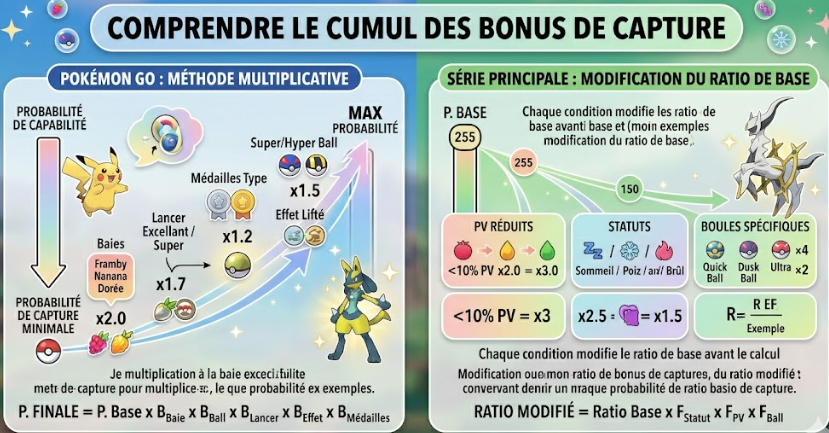
If you’ve ever watched a Pokémon break out of a third Ultra Ball, the problem may not be the ball itself. The most important secret to becoming a better trainer is understanding that Pokémon capture mechanics are not about a single factor but a formula with multiple parts. True mastery comes from stacking bonuses to make the catch easier before you throw.
Relying only on a better ball is a common mistake. To dramatically improve your success, you need to add other multipliers to the equation. Because the mechanics differ, let’s break them down for each game type.
Learn More:How to Increase Shiny Odds in Pokémon GO: The Real Strategy >
For Pokémon GO: Stacking Your Throw Bonuses
In Pokémon GO, every throw is an opportunity to improve your odds. Your goal is to combine as many of these bonuses as possible.
The Formula for Success: (Ball Bonus) x (Berry Bonus) x (Throw Bonus) x (Curveball Bonus)
- Berry Bonus: The right berry effects on the catch rate are your first step. A Razz Berry gives you a 1.5x boost, while a Golden Razz Berry provides a huge 2.5x multiplier.
- Throw Bonus: Hitting the colored circle is key. A “Nice” throw gives a small bonus, “Great” offers a solid multiplier (1.3x-1.7x), and an “Excellent” throw provides the biggest boost (1.7x-1.95x).
- Curveball Bonus: The curveball throw bonus in Pokémon GO is one of the most significant and consistent multipliers you can add. Mastering this technique adds a 1.7x multiplier to every single throw.
Combining a Golden Razz Berry, an Excellent throw, and a Curveball with an Ultra Ball can turn a near-impossible catch into a manageable one.
For the Main Series Games: Weakening the Target
In games like Scarlet & Violet, you have more direct ways to influence the battle before you throw your ball. The strategy here is to lower the Pokémon’s will to fight.
The Formula for Success: (Ball Bonus) x (HP Bonus) x (Status Bonus)
- HP Bonus: This is critical. A Pokémon at full health is much harder to catch than one with only 1 HP remaining. Using moves like False Swipe, which can’t knock a Pokémon out, is the perfect way to get its health as low as possible.
- Status Bonus: This is the single biggest advantage you can give yourself. The status condition catch bonus is a massive multiplier. Putting a Pokémon to sleep (2.5x bonus) or freezing it (2.5x bonus) is far more effective than inflicting paralysis, poison, or burn (1.5x bonus).
Understanding these hidden multipliers, including the rare critical catch mechanics (a special animation that guarantees a catch), reframes the problem. Instead of asking “Which ball is best?” you start asking, “How can I make this catch easier?” This strategic shift will save your best items and make you a far more effective trainer.
Pokéball Types and How to Get Them Faster
In Pokémon GO, different Pokéball types play a crucial role in your catching success. From standard Poké Balls to more advanced options like Great Balls and Ultra Balls, each type offers a different catch rate and is suited for different situations.
For example:
- Poké Ball – basic and widely available
- Great Ball – better for mid-level Pokémon
- Ultra Ball – ideal for rare or high-CP Pokémon
- Special Balls like Premier Balls or event-exclusive items
However, one common challenge many players face is that better Pokéballs are often limited by location. Urban areas with dense PokéStops tend to offer more rewards, while rural players may struggle to collect enough items.
That’s where Fonelora Location Changer becomes incredibly useful.
Instead of relying on your real-world location, Fonelora allows you to virtually move your GPS to high-density PokéStop areas such as major cities or popular farming routes. This dramatically increases your chances of collecting higher-tier Pokéballs in a shorter time.
Why Use Fonelora for Pokéball Farming?
Fonelora isn’t just a simple location spoofer—it’s a full-featured GPS simulation tool designed for realistic and safe gameplay.
Key advantages include:
- Instant teleportation to PokéStop-rich cities worldwide
- Route simulation to automatically spin multiple stops
- Cooldown timer to help avoid soft bans
- Joystick control for manual farming
- Realistic movement speeds to mimic walking or cycling
With these features, you can continuously collect items without physically moving, making it especially useful for grinding resources like Pokéballs.
How to Get More Pokéballs Using Fonelora
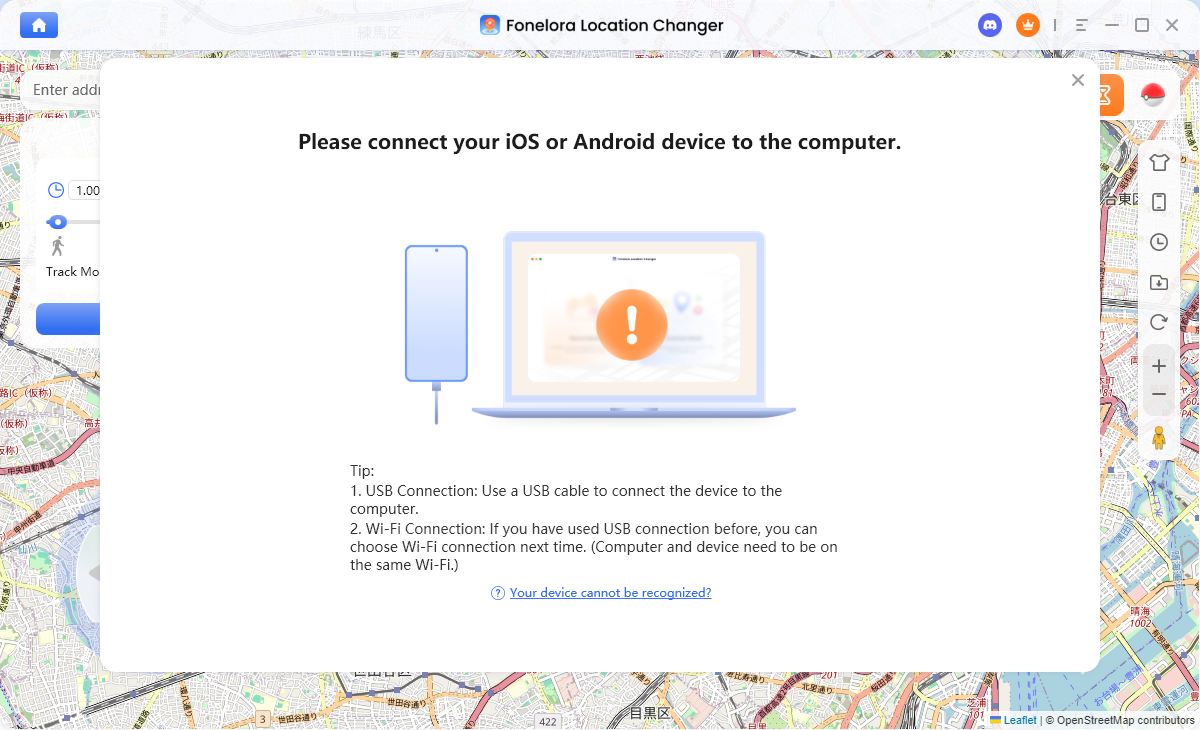
Step 1: Connect Your Device
Download and open Fonelora Location Changer on your PC or Mac, then connect your iPhone or Android device.
Step 2: Choose a Movement Mode
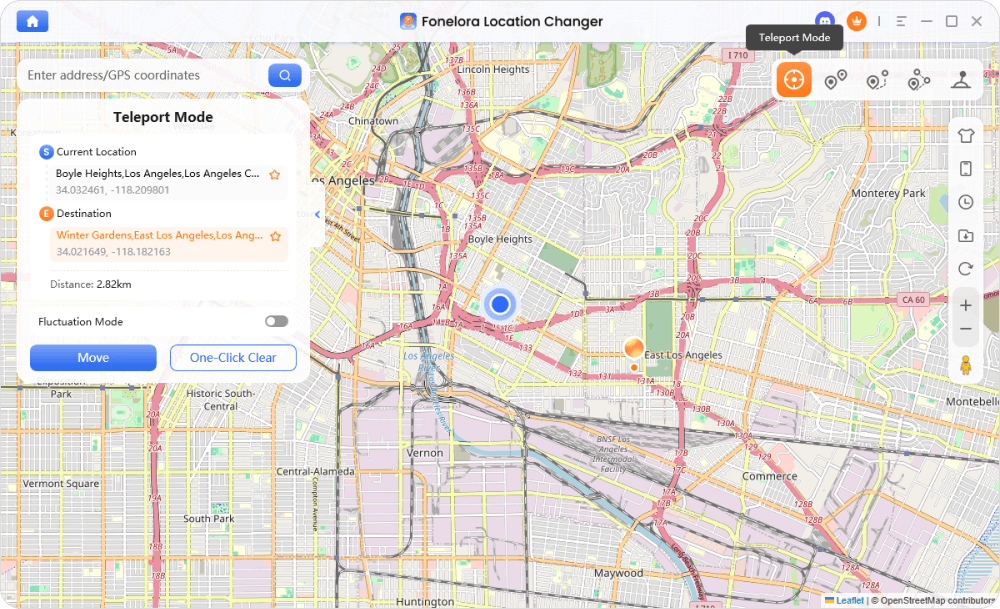
Select Multi-Spot Mode if you want to farm multiple PokéStops automatically, or use Joystick Mode for manual control.
Step 3: Start Collecting Items
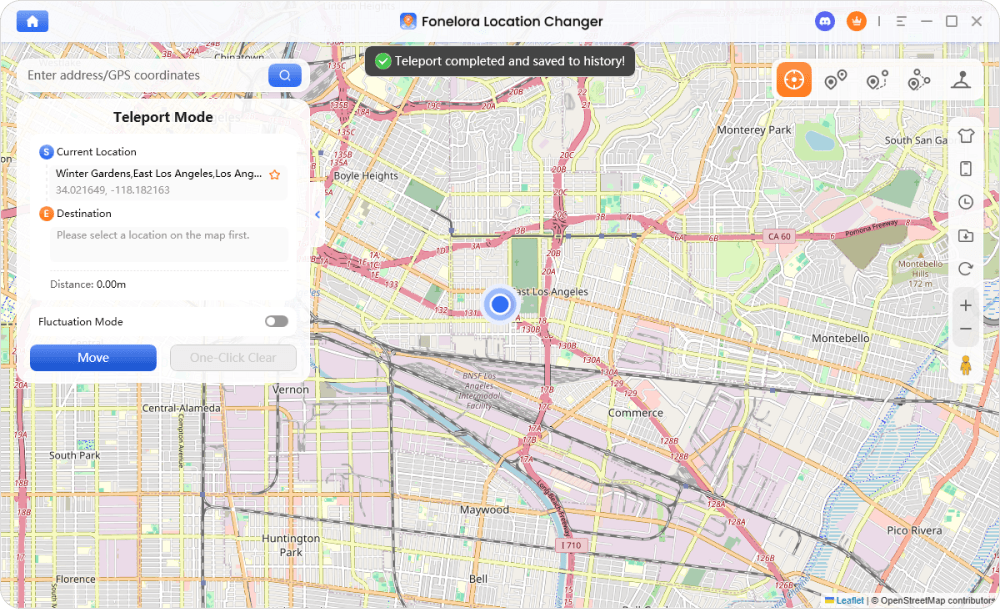
Click “Move” and begin spinning PokéStops. You’ll quickly accumulate Pokéballs and other valuable items.
Pro-Tips I Wish I’d Known Sooner
Beyond the formulas, some of the best catching advice comes from hard-won experience. Here are a few tips that will save you resources and frustration.
- The Shiny Raid Boss Rule: A Shiny Pokémon from a Legendary Raid Battle in Pokémon GO has a 100% catch rate. Don’t waste a Golden Razz Berry on it! This is the perfect time to use a Silver Pinap Berry for extra candy, as the catch is already guaranteed on the first hit.
- Quick Ball is King: In the main series games, always start a battle with a Quick Ball. With its 5x multiplier on the first turn, it’s the most powerful ball in the game under those conditions—even better than a Dusk Ball at night. It often ends the encounter before it even begins.
- “Circle Lock” Technique for Pokémon GO: For tough raid bosses, use this trick: press and hold the Poké Ball until the target circle shrinks to your desired “Excellent” throw size, then let go without throwing. The circle will stay that size. Wait for the Pokémon to perform its attack animation. As the animation is ending, spin and throw your ball. It will land just as the circle reappears, preventing the Pokémon from swatting it away.
- Save Your Master Ball for the Unpredictable: It’s tempting to use a Master Ball on the game’s cover Legendary, but they are often required story catches you can retry endlessly. The real value of a Master Ball is for a random, full-odds Shiny Pokémon that might use a self-destructing move or flee, like an Abra, Graveler, or a roaming legendary in older games.
Learn More:The Truth About Pokémon GO Rare Candy Cheats >
How to Find More Pokémon to Practice On (The Right Way)
Mastering your throwing technique and ball strategy is useless without good Pokémon to practice on. The key is to find reliable and consistent spawns, which you can do by engaging with the game’s community and features.
- Leverage In-Game Events: Pokémon GO is constantly running events like Community Days, Spotlight Hours, and seasonal celebrations. These events dramatically increase the spawn rate of specific Pokémon, giving you hundreds of opportunities to practice your Excellent curveball throws in a short period.
- Use Niantic Campfire: Campfire is the official companion app for Pokémon GO. Its main purpose is to help you find and coordinate with other players for Raid Battles. You can light a “flare” at a raid to attract nearby trainers, ensuring you have enough people to take down a legendary boss and get a chance to catch it.
- Join a Local Community: The heart of Pokémon GO is its community. Look for local Discord servers, Facebook groups, or other social media channels for your area. Players in these groups often report rare spawns, call out high-IV Pokémon, and organize for raid hours. This is the single best way to find out where the action is happening in your town.
- Understand Nests and Biomes: In both Pokémon GO and the main series, certain areas have a higher chance of spawning specific types of Pokémon. In Pokémon GO, these “nests” rotate every two weeks. Learning the nest locations in your local parks can provide a steady stream of a single species to practice on.
The Final Catch: Take Control of Your Pokémon Training
The frustration of a rare Pokémon escaping is a shared experience, but it doesn’t have to be your story. By understanding the complete ball tier system in Pokémon games and mastering how to stack bonuses, you move from a player relying on luck to a trainer making strategic, informed decisions. The final piece of the puzzle is creating opportunities to practice, which comes from engaging with the game and its vibrant community.
Stop wasting your Ultra Balls and start building your confidence. Use these strategies to turn frustrating escapes into successful captures and truly become a more effective trainer.
Your Questions Answered: Poké Ball FAQs
What are all the different Poké Ball types?
There are dozens of Poké Ball types across the main series games, though Pokémon GO uses a smaller, more focused selection. The most common are the Poké Ball, Great Ball, and Ultra Ball. Other specialized types in the main series include the Quick Ball (for the first turn), Dusk Ball (for night/caves), Net Ball (for Bug/Water types), and event balls like the Cherish Ball.
What is the difference between Poké Ball, Great Ball, and Ultra Ball?
These three form the core of the ball tier system in Pokémon games. Each is a direct upgrade in effectiveness. A Great Ball has a 1.5x catch rate multiplier compared to a standard Poké Ball (1x), and an Ultra Ball has a 2x multiplier. This modifier is a key part of the overall catch formula.
When should I use a Master Ball?
The Master Ball guarantees a catch, so it should be reserved for the most critical encounters. This typically means a Legendary Pokémon with a very low catch rate or, more importantly, a full-odds Shiny Pokémon that you cannot risk letting flee or struggle to death.
What is a Premier Ball used for in Pokémon GO?
Premier Balls are special-event items exclusive to Raid Battles and encounters with Team GO Rocket. You receive a limited number after winning a battle, and they are the only balls you can use to catch the Raid Boss or Shadow Pokémon. Any unused Premier Balls disappear when the encounter ends.
Do different Poké Balls affect catch rate?
Yes, absolutely. This is their main purpose. Every Poké Ball has a specific catch rate multiplier Pokémon games use to calculate the probability of a successful capture. A higher multiplier, like that of an Ultra Ball, directly increases your chances.
Which Poké Ball is best for rare Pokémon?
For a 100% guaranteed catch, the Master Ball is unbeatable. Otherwise, the Ultra Ball is the best universally available option. However, the “best” ball is situational in the main series. A Quick Ball on the first turn (5x multiplier) or a Dusk Ball at night (3x multiplier) are both significantly more effective than an Ultra Ball (2x).
Can Poké Balls fail even on weak Pokémon?
Yes. Except for the Master Ball, all Pokémon capture mechanics are based on probability, often called RNG (Random Number Generation). This means there is always a small chance of failure, even when catching a very low-level Pokémon with a high-tier ball.
Are Poké Ball types the same in Pokémon GO and main Pokémon games?
No, they are not. While they share the core trio (Poké, Great, Ultra), the main series games have a much larger and more diverse roster of specialized balls like the Timer Ball, Quick Ball, and Heal Ball. Their acquisition methods and specific catch mechanics often differ as well.



Joy Taylor is a seasoned technical writer with over a decade of experience in mobile technology. At iMobie, she specializes in producing in-depth content on iOS data recovery, iPhone unlocking solutions, and iOS troubleshooting.
Product-related questions? Contact Our Support Team to Get Quick Solution >
