How to Print Text Messages from iPhone for Court
Need to print iPhone text messages or iMessages for court? Learn how to preserve dates, timestamps, sender details, attachments, and conversation context, then export messages to PDF or print screenshots without losing important evidence details.
If you need iPhone text messages or iMessages for a court case, simply printing a few message bubbles may not be enough. A useful evidence copy should make it as clear as possible who was communicating, what was said, when it was sent, and where the conversation fits in context.
You can print messages in two practical ways: export the conversation to a computer with a message-management tool such as AnyTrans, or capture the relevant conversation with iPhone screenshots and print those images. Whichever method you use, preserve the original iPhone and an unedited electronic copy whenever possible.
Important: Court rules vary by jurisdiction and case. No PDF, screenshot, printout, or software export is automatically admissible just because it looks complete. If the messages will be used in active litigation, follow your attorney’s instructions and the applicable court rules for authentication, disclosure, and evidence preservation.
What Should a Court-Ready Text Message Printout Include?
For ordinary personal use, you may only care about the words in the conversation. For legal use, the surrounding information can matter just as much.
| Information to Preserve | Why It Can Matter |
| Sender and recipient | Helps identify who participated in the conversation |
| Phone number or other identifying information | A saved contact name alone may not clearly establish the underlying number or account |
| Date and time | Helps establish when the communication occurred and its sequence |
| Full message text | Shows the actual communication rather than a paraphrase |
| Surrounding messages | Provides context and reduces the risk of a single message being misunderstood |
| Photos and other relevant attachments | Attachments can be part of the communication being relied upon |
| Original device or electronic copy | Can help if the authenticity or completeness of the printout is later questioned |
Under U.S. evidence rules, authentication generally requires enough supporting information for a court to find that an item is what the submitting party claims it is. The exact foundation needed for text messages depends on the circumstances.
That is why a printout containing only isolated message bubbles can be weaker than a copy that also preserves identifying information, dates, times, and enough surrounding conversation to understand what happened.
Should You Show the Contact Name or Phone Number?
Keep both when possible. A contact name such as “John” is something you entered into your own address book and can be changed at any time. The underlying phone number or account details provide additional identifying context.
If the iPhone currently shows only a contact name, consider preserving a separate view of the contact details or another record that links that name to the relevant number.
Should Every Message in the Conversation Be Printed?
Not necessarily, but avoid removing so much context that the meaning of the selected messages changes. Ask your attorney which date range and conversations should be preserved or produced.
Keep a complete original copy even if the final exhibit uses only selected pages. Do not delete messages from the iPhone after creating the printout simply because they are not part of the pages you plan to use.
Method 1. Export and Print iPhone Messages with AnyTrans
If you have a long conversation or need a cleaner computer-based record, AnyTrans currently supports previewing, exporting, and printing iPhone text messages and iMessages from a PC or Mac.
Its current Messages feature supports export in PDF, TXT, and HTML formats. It can also include message attachments such as images, video, audio, and stickers in supported workflows.
AnyTrans – Export and Print iPhone Messages
- Preview SMS and iMessages on a computer before selecting conversations.
- Export supported messages as PDF, TXT, or HTML.
- Print selected iPhone or iPad message conversations.
- Preserve relevant attachments when supported by the selected export.
- Useful for long conversations that would require many individual screenshots.
How to Print iPhone Messages with AnyTrans
Step 1. Launch AnyTrans on your PC or Mac and connect the iPhone that contains the original messages.
Step 2. Open Device Manager and choose Messages.
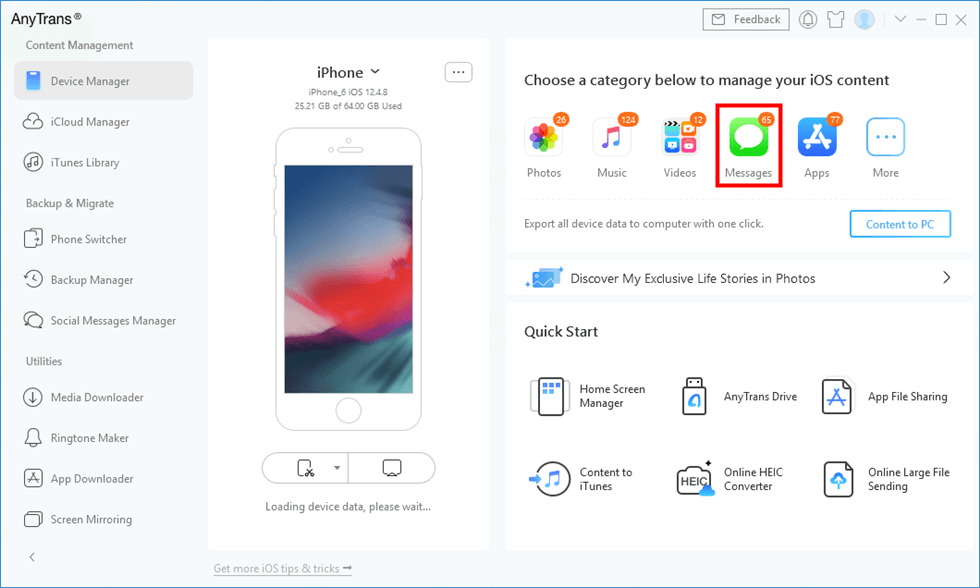
Open the Messages category for the connected iPhone.
Step 3. Review the available conversations and locate the messages relevant to the case.
Step 4. Before printing, check that the selected record includes enough identifying and chronological information for your purpose.
Step 5. Choose the conversation and use the Print option, or export the messages to a supported format such as PDF for review before printing.
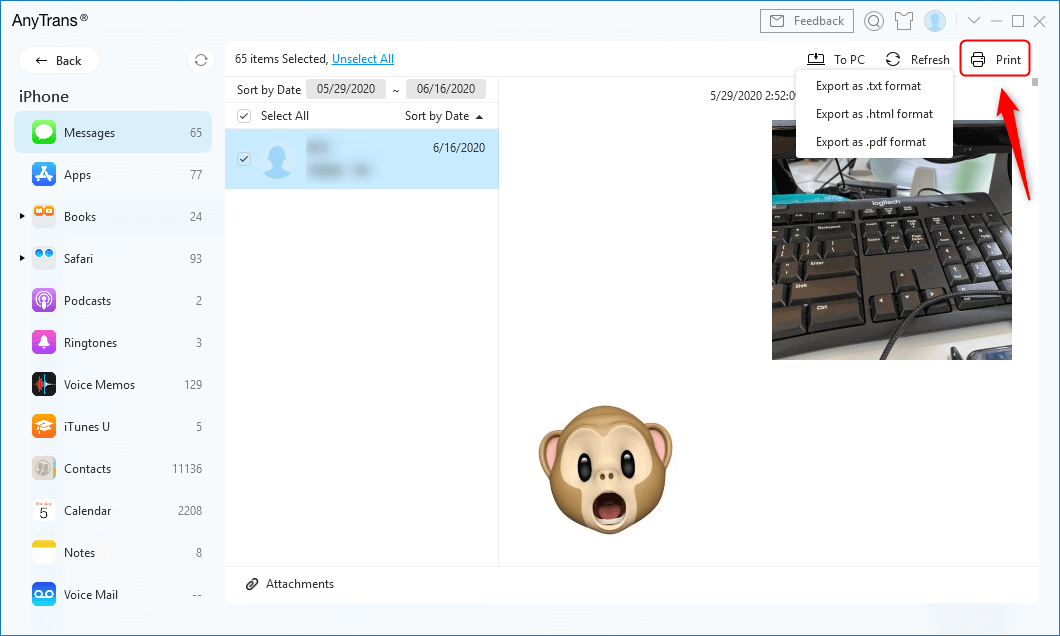
Preview the conversation before exporting or printing it.
Step 6. Save an unchanged electronic copy of the export before making annotations or creating a shortened exhibit version.
Step 7. Print the required pages from the saved export.
A software export can make a conversation easier to read and print, but using AnyTrans does not by itself establish legal authenticity or admissibility. Preserve the original iPhone and follow the evidentiary requirements that apply to your case.
PDF, TXT, or HTML: Which Format Is Better?
| Format | Useful For | Important Consideration |
| Reviewing and printing a stable page layout | Keep the original export as well as any printed copy | |
| HTML | Viewing longer conversations on a computer | Appearance can depend on the browser and linked assets |
| TXT | Plain-text review and searching | May provide less visual context than a formatted conversation |
There is no universal rule that makes one of these formats automatically “court approved.” The appropriate format depends on what must be shown, how the evidence will be authenticated, and the rules of the court handling the case.
Method 2. Print iPhone Text Messages with Screenshots
If you only need a short section of a conversation, screenshots are a free option and can preserve the way the messages appeared on the iPhone.
The main limitation is that screenshots can easily leave out important metadata or context. Capture enough screens to show the participants, dates, times, and sequence of the conversation whenever that information is relevant.
Step 1. Open the Relevant Conversation
Open Messages and locate the SMS or iMessage thread you need.
Step 2. Reveal Message Timestamps
Where supported by your current iOS interface, reveal or preserve the timestamps associated with the relevant messages rather than relying only on the date heading above the conversation.
Step 3. Capture the Conversation in Order
Take screenshots from the beginning of the relevant section to the end. Include a small amount of overlap between consecutive screenshots so the sequence is easy to follow.
Avoid capturing only one sentence if earlier or later messages affect its meaning.
Step 4. Preserve Participant Information
Capture enough identifying information to show whose conversation is displayed. If Messages only shows a saved contact name, separately preserve the contact details that connect that name to the relevant phone number when appropriate.
Step 5. Keep the Original Screenshots
Do not overwrite the only copies with cropped, highlighted, compressed, or annotated versions.
If you need highlights for a presentation copy, keep both:
- the untouched original screenshots;
- the annotated or cropped working copies.
Step 6. Print the Screenshots
You can transfer the screenshots to a computer and print them there, or use the iPhone’s normal print/share options with a compatible printer.
Numbering the printed pages can make a long sequence easier to follow, but do not alter the underlying screenshot content.
Screenshots can be useful evidence, but they are not automatically sufficient to prove who sent a message or that the image has not been altered. Keep the source device and original files available if authenticity becomes an issue.
How to Preserve iPhone Messages Before Printing
If litigation is pending or reasonably anticipated, preservation matters as much as printing. Avoid changing or deleting the source information while you prepare copies.
1. Keep the Original iPhone
Do not erase, trade in, factory-reset, or discard the phone merely because you exported the messages.
2. Do Not Delete Unwanted Messages from the Thread
Removing messages can change context and can create disputes about completeness. Preserve the original conversation even if only part of it eventually becomes relevant.
3. Save More Than One Copy
Keep the original export or screenshots in a secure location and make a separate working copy for printing, highlighting, or organizing.
4. Preserve Relevant Attachments
If an image, video, voice message, link, or other attachment is part of the conversation at issue, preserve it along with the text rather than treating the words as the entire communication.
5. Record How the Copy Was Created
Note basic information such as:
- which iPhone the messages came from;
- the date the export or screenshots were created;
- which software or process was used;
- whether the exported file was later converted, cropped, or annotated;
- where the original copy is stored.
This does not automatically authenticate the messages, but keeping a clear record of the collection process can make later questions about the copy easier to answer.
6. Ask Before Changing the Evidence
If a lawyer, investigator, or forensic examiner is already involved, ask them how they want the phone and messages preserved before installing software, deleting content, or reorganizing conversations.
Common Mistakes When Printing Text Messages for Court
Printing Only the Message Text
A page containing words without identifying information, dates, or context may be difficult to connect to a particular sender, recipient, or event.
Cropping Out the Participant Information
A tightly cropped screenshot may look cleaner, but it can remove information that helps explain where the message came from.
Using Only a Contact Name
A contact label can be edited by the phone owner. Keep additional information linking the contact to the relevant number or account where possible.
Leaving Out Timestamps
Dates and times can be important when the order of events matters. Preserve them whenever they are available.
Editing the Only Copy
Highlights and annotations can be useful for presentation, but do not make them directly on the only preserved copy of the evidence.
Assuming a Printout Is Automatically Admissible
Printing a conversation does not resolve every evidentiary question. Authentication, relevance, hearsay, completeness, disclosure requirements, and other rules can still apply.
Deleting the Messages After Printing
A paper copy is not a substitute for preserving the original source when the authenticity or completeness of the conversation may later be challenged.
FAQs About Printing iPhone Messages for Court
1. How do I print text messages from my iPhone for court?
You can export and print the conversation from a computer with a message-management tool such as AnyTrans, or take chronological screenshots and print those images. Preserve sender information, phone numbers where relevant, dates, timestamps, surrounding context, and the original electronic source.
2. Can screenshots of text messages be used in court?
Screenshots can be used as evidence in some cases, but admissibility is not automatic. The party offering them may need to establish authenticity and satisfy other applicable evidence rules. Preserve the original phone and unedited screenshots.
3. What should be visible in screenshots of text messages for court?
Where relevant and available, preserve the participants, phone number or account identity, date, time, complete message content, surrounding conversation, and attachments. Avoid cropping out identifying or chronological information from the only copy.
4. Do text messages need timestamps for court?
Timestamps can be important for establishing sequence and context. The exact evidentiary requirement depends on the case and jurisdiction, but preserving available date and time information is safer than intentionally removing it.
5. Is a PDF of iPhone messages automatically admissible in court?
No. PDF is a convenient format for storing and printing a conversation, but the file format alone does not establish authenticity, relevance, or admissibility.
6. Can AnyTrans export iPhone messages to PDF?
Yes. AnyTrans currently supports exporting iPhone messages in PDF, TXT, and HTML formats and also provides a message-printing function.
7. Can AnyTrans prove that a text message is authentic?
No. AnyTrans can create an export or printout of supported messages, but legal authentication is a separate evidentiary issue. Preserve the original iPhone and follow the rules and instructions applicable to your case.
8. Should I print the entire text conversation?
Not necessarily, but keep the complete original conversation. The printed exhibit may use a relevant date range or subset, provided the selection does not misleadingly remove necessary context and complies with the applicable legal process.
9. Should I keep my iPhone after printing the messages?
Yes if the messages may be evidence. Keeping the original device and unedited electronic copies can be important if the completeness or authenticity of the printed version is later questioned.
10. Can I edit or highlight text-message screenshots before court?
Keep an untouched original first. If highlights, labels, or cropping are needed for a presentation copy, create a separate version and preserve the unedited source files.
The Bottom Line
Printing iPhone messages for court is not just a matter of putting message bubbles on paper. Preserve the information that helps connect the conversation to its participants and timeline: names, numbers where relevant, dates, timestamps, context, and attachments. Keep the original phone and an unchanged electronic copy even after the pages are printed.
For a short conversation, carefully captured screenshots may be enough for your preparation needs. For a long thread, AnyTrans currently lets you preview, export, and print supported iPhone messages in formats including PDF, TXT, and HTML. Whichever method you use, the final decision about authentication and admissibility belongs to the applicable court rules, not the printing tool.



Joy Taylor is a seasoned technical writer with over a decade of experience in mobile technology. At iMobie, she specializes in producing in-depth content on iOS data recovery, iPhone unlocking solutions, and iOS troubleshooting.
Product-related questions? Contact Our Support Team to Get Quick Solution >
