How to Recover Data from a Broken Android Phone
Broken Android screen, no touch, black screen, or phone that will not boot? Learn which data recovery method fits your phone’s condition, including Google backup, USB transfer, SD card, Samsung recovery, and DroidKit for supported crashed Samsung devices.
A broken Android phone does not always mean the data is gone. What you can recover depends on what is actually broken: the glass, display, touchscreen, Android system, battery, USB access, or the phone’s internal hardware.
The fastest way to choose a recovery method is to check whether the phone still powers on, whether you can unlock it, whether a computer can access its files, and whether your photos, contacts, messages, or other data were already backed up. A phone with a cracked screen but a working system has very different recovery options from a phone that will not power on at all.
Quick answer: If the phone still works and you can unlock it, copy files by USB or make a backup first. If the screen or touch is unusable, try a mouse, external display, or manufacturer backup option when the device supports them. If you already had Google or Samsung backups, restore those before trying deeper recovery. DroidKit’s System Crashed Device extraction is currently intended for supported Samsung devices running Android 5–13.
Can You Recover Data from a Broken or Dead Android Phone?
Sometimes. The answer depends on whether the phone’s storage is still readable and whether you have a way to authenticate or access the device.
| Phone Condition | Recovery Outlook | Best Starting Point |
| Cracked screen, phone works normally | Good | Unlock the phone and copy or back up the data |
| Display is black, touch still works | Possible | External display on supported devices, then unlock and back up |
| Touchscreen is broken, display still works | Possible | USB OTG mouse/keyboard if the phone supports it |
| Screen and touch do not work, phone still boots | Depends on device support and previous USB/backup setup | External display, manufacturer tools, or existing cloud backup |
| Android system crashes or will not boot | Device-specific | Check cloud backups, then consider supported crashed-device extraction |
| Phone does not power on at all | Limited | Hardware diagnosis or professional repair before software recovery |
| Data was stored on removable microSD | Often good if the card itself is healthy | Remove the card and read it separately |
Broken Screen Is Not the Same as a Dead Phone
A phone with a physically broken screen may still be fully running underneath. If Android boots, the storage works, and you can authenticate the device, your files may still be accessible.
A truly dead phone is different. If it does not power on, charge, enter recovery/boot mode, or communicate with a computer, ordinary Android recovery software usually cannot simply scan its encrypted internal storage over USB. The phone may need to be repaired enough to boot and decrypt the data first.
What Data May Already Be Available Without the Broken Phone?
Before doing anything invasive, check accounts and backups that were configured before the damage.
- Google Photos for previously backed-up photos and videos.
- Google Contacts for contacts synced to your Google Account.
- Android/Google backup for supported device settings, messages, call history, apps, and app data that participated in backup.
- Google Drive for files you manually uploaded.
- WhatsApp or another app’s own cloud backup if it was enabled before the phone broke.
- Samsung Cloud or Samsung backup services on supported Galaxy devices.
Google confirms that Android backups can be restored to another Android phone, but the available content depends on what had actually been backed up and on Android-version compatibility. A cloud restore therefore recovers existing backups; it does not extract new files from an inaccessible phone.
Which Broken Android Recovery Method Should You Use?
| If Your Phone… | Try This First | Main Requirement |
| Has working screen and touch | USB file transfer | You can unlock the phone and select File Transfer |
| Shows an image but touch is broken | OTG mouse/keyboard | Device supports USB OTG and you know the screen lock |
| Has broken display but still runs | External monitor on supported models | Device supports video output |
| Already backed up to Google | Restore to another Android device | Access to the same Google Account |
| Is a supported Galaxy with Samsung backup options enabled | Find My Mobile / Smart Switch | Required Samsung services were configured before damage |
| Is a system-crashed Samsung | DroidKit From System Crashed Device | Currently documented for Samsung Android 5–13 |
| Has files on removable SD card | Read SD card separately | Card is readable and files are not device-encrypted |
| Will not power on at all | Hardware repair/data-recovery service | Device must be made sufficiently functional to access encrypted storage |
How to Recover Data from a Broken Android Phone
Method 1. Check Google Backup Before Repairing the Phone
If the Android phone was automatically backing up data before it broke, you may be able to restore supported information on a replacement phone without interacting with the damaged device.
Step 1. Sign in to the same Google Account on the replacement Android device.
Step 2. During setup, choose the option to copy or restore apps and data from a previous device or cloud backup.
Step 3. Select the relevant old-device backup when more than one backup is shown.
Step 4. Choose the available data categories and start the restore.
Step 5. Sign in separately to services such as Google Photos or WhatsApp when their content uses its own synchronization or backup process.
Do not assume that every file on the broken phone exists in Google’s backup. Downloads, some app data, locally stored files, hidden folders, and data from apps that do not participate in Android backup may not be included.
Method 2. Copy Files by USB If You Can Unlock the Phone
If Android is still running and you can operate the screen, connect the phone to a computer and copy accessible files before attempting repairs.
Step 1. Unlock the Android phone.
Step 2. Connect it to the computer with a USB cable that supports data transfer.
Step 3. Tap the USB notification on the Android phone.
Step 4. Under Use USB for, choose File Transfer.
Step 5. Open the device storage on the computer and copy the photos, videos, documents, downloads, and other accessible folders you need.
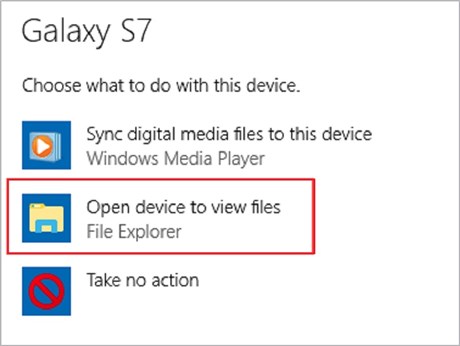
If the phone can be unlocked and File Transfer can be selected, copy important files before attempting a repair.
USB debugging is not required for ordinary Android file transfer. The bigger problem with a broken screen is usually that Android requires the phone to be unlocked and the USB connection to be authorized for file transfer.
Method 3. Use a Mouse or External Display When the Screen Is Damaged
If the phone is still running but you cannot use the touchscreen normally, you may be able to regain enough control to unlock it and make a backup.
Depending on the phone:
- Connect a USB mouse or keyboard through a compatible OTG adapter.
- If the phone supports video output, connect it to a TV or monitor with the appropriate USB-C/HDMI adapter.
- Unlock the device with the PIN, password, or pattern you already know.
- Then enable File Transfer, make a cloud backup, or use the manufacturer’s backup software.
Samsung currently recommends similar mouse/keyboard and external-display options for compatible Galaxy phones with damaged screens. Device support varies, so do not assume every Android phone can output video over USB-C.
Method 4. Use Samsung Find My Mobile or Smart Switch When Available
Samsung provides additional recovery paths for Galaxy phones.
If Find My Mobile and the required Samsung Account settings were already enabled, Samsung currently documents a remote backup option for supported devices. The Galaxy phone must be powered on and connected to Wi-Fi or mobile data.
For a Galaxy that can still be unlocked or controlled, Samsung Smart Switch can also create a backup to a PC or Mac.
Do not use the old workflow that mixes Find My Mobile, a USB cable, and Samsung KIES as though they were one remote-backup process. They are separate recovery approaches.
Method 5. Extract Data from a System-Crashed Samsung with DroidKit
If the screen problem comes from a system crash rather than only broken glass, and the device is compatible, DroidKit Android Data Recovery includes a From System Crashed Device extraction workflow.
The compatibility boundary is important: iMobie’s current DroidKit FAQ documents this particular mode for Samsung devices running Android 5 through Android 13. It should not be presented as an unrestricted broken-phone recovery mode for every Android brand.
DroidKit – Extract Data from a Supported System-Crashed Samsung
- Includes a dedicated From System Crashed Device workflow for supported Samsung phones and tablets.
- Can preview recoverable data before selecting what to extract.
- Current DroidKit documentation lists Samsung Android 5–13 support for this specific crashed-device mode.
- Also provides separate recovery paths for Google Account, SD card, SIM card, and accessible Android devices.
How to Use DroidKit From System Crashed Device
Step 1. Launch DroidKit on the computer and choose From System Crashed Device.
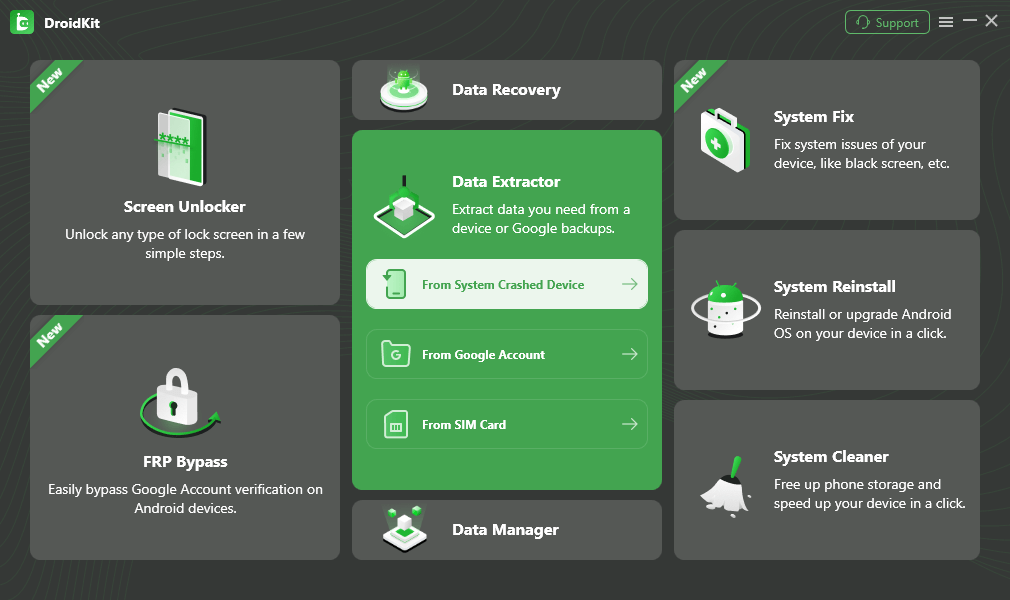
Choose the crashed-device extraction mode for a supported Samsung device.
Step 2. Select the data categories you want DroidKit to look for and continue.
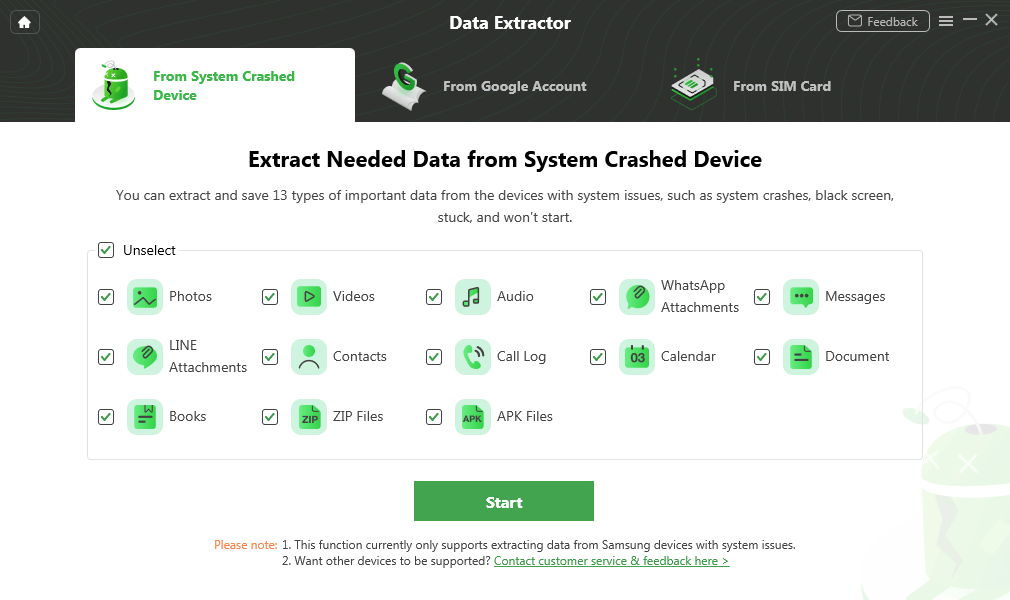
Select the data categories you want to extract.
Step 3. Follow DroidKit’s Samsung-specific instructions, confirm the required PDA/device information, and download the firmware package used by the workflow.
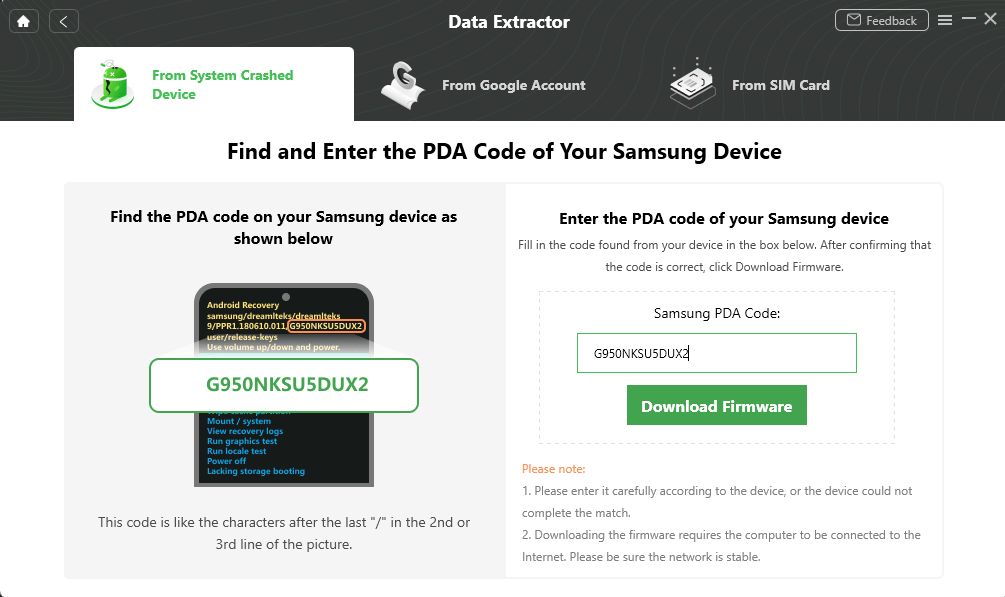
Confirm the Samsung device information before proceeding.
Step 4. Follow the instructions to place the supported Samsung device into the required mode.
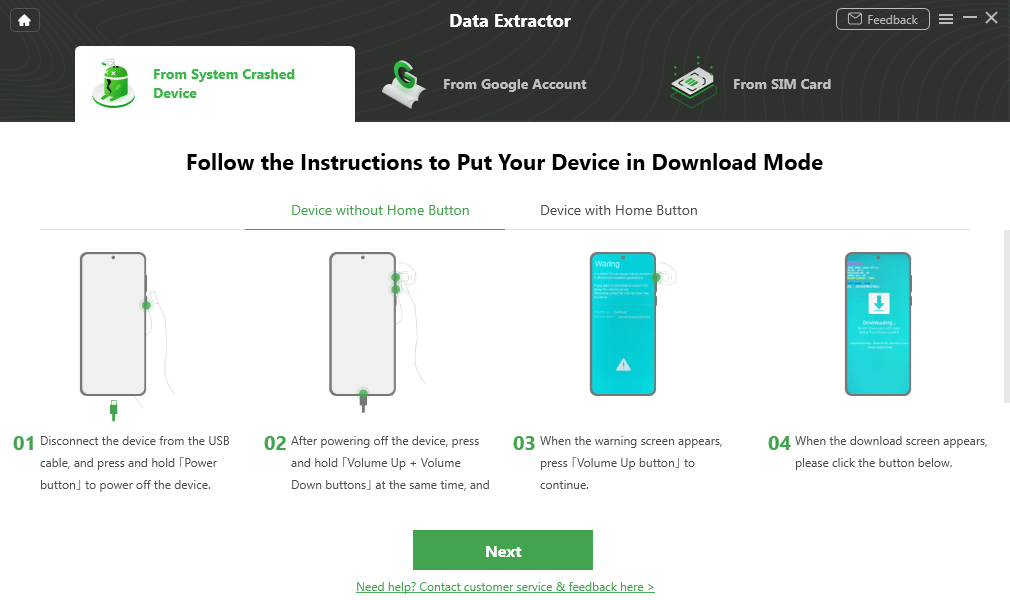
Follow the model-specific Download Mode instructions shown by DroidKit.
Step 5. After the device is ready for extraction, scan the available data, preview the results, and select what you want to save.
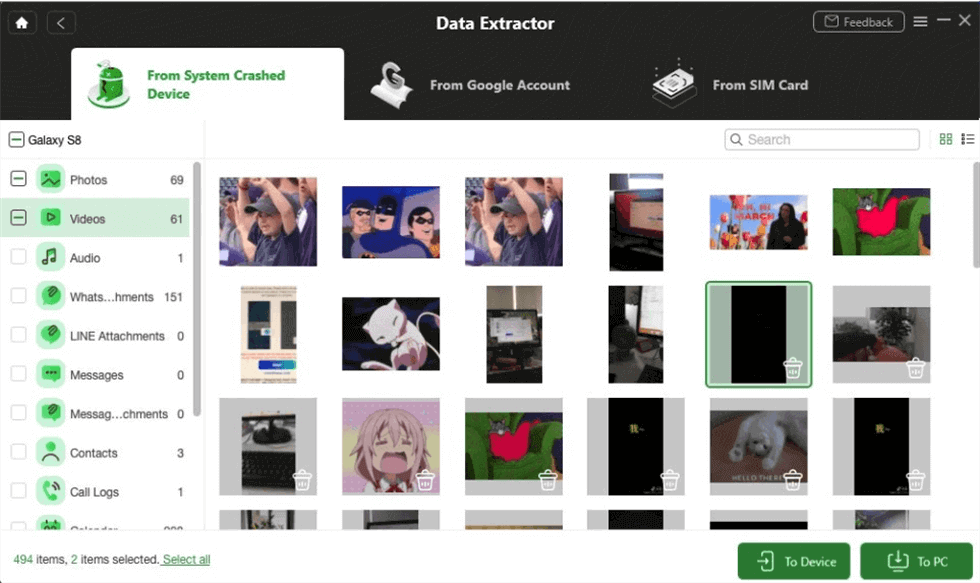
Preview the available data before choosing what to extract.
Recovery is never guaranteed simply because a device is detected. The condition of the storage, Android version, encryption, exact Samsung model, and type of system failure all affect what can be extracted.
Method 6. Recover Files from a Removable SD Card
If important photos, videos, documents, or music were stored on a removable microSD card, you may not need to repair the phone first.
Step 1. Power off the damaged phone if possible.
Step 2. Remove the microSD card.
Step 3. Insert it into a computer with a compatible card reader.
Step 4. Copy accessible files to another storage location.
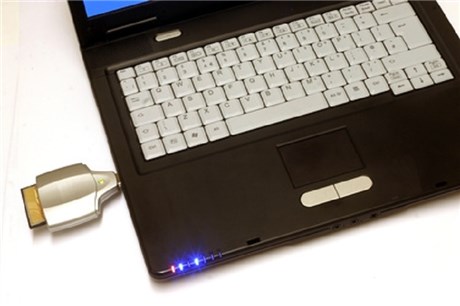
A removable SD card can sometimes be accessed independently of the broken Android phone.
If Android formatted the card as encrypted/adopted internal storage, another computer may not be able to read the files normally. In that case, avoid formatting the card when the computer asks.
Method 7. Get the Phone Repaired Enough to Access the Data
If the Android phone is completely dead, ordinary recovery software has a hard limit: the phone’s internal storage generally needs functioning hardware and successful device authentication/decryption before normal data can be read.
Consider professional diagnosis when:
- the phone shows no charging or power response;
- it cannot enter any boot, recovery, or download mode;
- no computer detects the device at all;
- the motherboard has liquid or impact damage;
- internal storage appears to be failing;
- the data is more valuable than the cost of repairing the phone.
If preserving data is the goal, tell the repair provider that you do not want a factory reset, motherboard replacement, or storage replacement performed without approval. Those actions can destroy or separate the original encrypted data from the hardware needed to decrypt it.
How to Recover Data Without USB Debugging
USB debugging is often mentioned in broken-screen recovery guides, but the first question should be whether you actually need it.
If You Can Unlock the Phone
You can normally transfer ordinary files over USB without enabling USB debugging. Unlock Android, connect the cable, and select File Transfer from the USB options.
If the Screen Is Broken and You Cannot Authorize USB
Your options become more limited. Depending on the phone, try:
- a USB OTG mouse or keyboard;
- an external display if the device supports video output;
- existing Google or manufacturer cloud backups;
- a removable SD card;
- a compatible broken-device extraction mode;
- temporary screen or hardware repair so the device can be unlocked.
For a guide focused specifically on that constraint, see the dedicated article in More Related Articles below rather than treating “USB debugging off” as the same scenario as every broken Android phone.
FAQs About Broken Android Data Recovery
1. Can I recover data from a broken Android phone?
Often yes if the phone still powers on, the storage remains healthy, or the data was previously backed up. Recovery becomes much harder when the phone cannot power on or the internal storage or motherboard is physically damaged.
2. Can I recover data from a phone that will not turn on?
Cloud backups and removable storage may still be accessible without the phone. For data stored only in encrypted internal storage, the device generally needs to be repaired enough to power on and make the storage accessible before ordinary recovery software can retrieve it.
3. Can I recover data from a broken Android without USB debugging?
Yes in some situations. Google backup, SD card recovery, a previously configured cloud service, external display or OTG control, and compatible crashed-device extraction can work without USB debugging. The available method depends on the phone’s condition.
4. Is USB debugging required to copy Android files to a PC?
No. Google’s normal USB file-transfer instructions require the device to be unlocked and the USB mode set to File Transfer. USB debugging is an Android developer feature and is not required for ordinary MTP file copying.
5. How can I recover photos from a broken-screen Android phone?
Check Google Photos or another photo backup first. If the phone still works, unlock it and copy the DCIM/Pictures folders to a computer. If the touchscreen is broken, an OTG mouse or external display may help on supported models.
6. Can I recover Android data if the touchscreen does not work?
Possibly. If the display is visible and the phone supports USB OTG, a mouse or keyboard may let you unlock the device and start a backup. Some phones also support external video output.
7. Can Samsung Find My Mobile back up a broken Galaxy?
Samsung currently documents remote backup through Find My Mobile on supported Galaxy devices when the phone is powered on, online, signed in to the appropriate Samsung Account, and Find My Mobile was enabled beforehand.
8. Does DroidKit recover data from every broken Android phone?
No universal support should be assumed. DroidKit’s current From System Crashed Device FAQ specifically lists Samsung devices running Android 5–13. DroidKit has other recovery modes for accessible devices, Google Accounts, SIM cards, and SD cards, but the correct mode depends on the scenario.
9. Can data recovery software recover everything from a broken phone?
No. Results depend on whether the data still exists, whether the storage is healthy and decryptable, the device model and Android version, backups, and the type of physical or system damage.
10. Should I factory reset a broken Android before recovering data?
No if the data is important and has not been backed up. A factory reset erases local user data, so recovery and backup attempts should come before reset-based repair whenever possible.
The Bottom Line
Broken Android data recovery starts with diagnosis, not software. A cracked display, dead touchscreen, failed Android system, and completely dead motherboard require different recovery paths. Check cloud backups first, then determine whether the phone still powers on, can be unlocked, and can authorize USB access before attempting anything destructive.
If a supported Samsung phone has a system crash that prevents normal access, DroidKit provides a dedicated crashed-device extraction workflow. If the phone has no power or hardware failure, repair or professional data recovery may be necessary before encrypted internal storage can be accessed.
More Related Articles


Roger Smith is a senior technical writer with years of experience in providing Android solutions. He loves to help users solve various problems such as Android unlock, Android data recovery, and Android system repair.
Product-related questions? Contact Our Support Team to Get Quick Solution >
