SamFlash Tool V4.1: Download, FRP Use, Safety & Alternatives
SamFlash V4.1 is one of the builds commonly encountered in Samsung FRP and service-tool tutorials, but package sources, menus, and available functions can vary. Before running it, verify the version, package contents, Samsung model, connection mode, and required drivers. This guide also explains where SamFlash workflows can stop and when a separate guided FRP tool may be a better fit.
SamFlash Tool is commonly researched by Samsung users who need a Windows utility for FRP-related operations, firmware work, or other device-service tasks. The difficult part is not finding a file labeled “SamFlash V4.1.” It is confirming what that package actually contains, whether its interface matches the tutorial you are following, and whether the connected Samsung phone supports the workflow you want to use.
That distinction matters because SamFlash packages are frequently shared outside a clearly verified first-party release channel. Two downloads carrying the same V4.1 label may not necessarily provide the same files, menus, or device workflows. Treat the version name as one compatibility clue, not as proof that a package is current, safe, or appropriate for every Samsung model.
If your main goal is simply to compare Android FRP software rather than use a Samsung service utility, see the FRP bypass tool comparison. SamFlash is better evaluated as a Samsung-focused Windows tool whose usefulness depends on the package, device, driver state, connection mode, and exact operation you need.
Table of ContentsHide
SamFlash Tool V4.1: Who Is It For?
What Is SamFlash Tool and What Can It Do?
SamFlash V4.1 Download: What to Verify First
How to Download and Use SamFlash Tool
SamFlash Tool Not Working? Diagnose the Failure Point
When a Guided FRP Tool Fits Better Than SamFlash
SamFlash vs DroidKit: Different Tools for Different Jobs
SamFlash Tool FAQ
SamFlash Tool V4.1: Who Is It For?
SamFlash makes the most sense when you have a Samsung device, a Windows computer, and enough information to identify the exact function and connection mode required by the tool. It is less suitable when you only need a simple Google-verification recovery route and do not want to deal with drivers, device modes, tool logs, or package-source questions.
| Your Situation | Is SamFlash a Good Fit? | What to Check First |
| You need a Samsung-focused FRP or service function | Worth evaluating | Confirm that the function exists in the package and matches your device workflow. |
| You are comfortable installing Samsung drivers and reading logs | Better fit | Check the exact device mode requested by the tool. |
| You found a V4.1 ZIP but cannot verify where it came from | Do not run it yet | Inspect the source, package contents, signatures/checksums if available, and scan the files first. |
| Your Samsung phone is not detected | Do not switch tools immediately | Fix the cable, USB port, driver, and connection mode first. |
| The phone is detected but the FRP function is unavailable or fails | Compatibility needs review | Compare the exact model, software state, package version, and requested workflow. |
| You need Samsung firmware flashing rather than only FRP recovery | SamFlash may be more relevant | A guided FRP application is not a replacement for every firmware/service function. |
| You only want guided FRP instructions | A separate FRP workflow may fit better | Check whether your device is supported before changing software. |
If the locked device is Samsung but your question is broader than SamFlash itself, the Samsung FRP bypass guide separates model-specific, manual, tool, and troubleshooting routes.
What Is SamFlash Tool and What Can It Do?
SamFlash Tool is a Windows utility associated with Samsung servicing workflows. Packages distributed under the SamFlash name may expose firmware-related functions, FRP-related operations, backup or device-management functions, and different Samsung connection modes.
It should not be treated as an official Samsung consumer application or as one fixed package with identical functionality everywhere it is downloaded. The interface and available operations can depend on the build and distribution you obtain.
Functions Commonly Associated with SamFlash
- Samsung firmware/service workflows: Some packages expose flashing or firmware-oriented functions for compatible Samsung devices.
- FRP-related functions: SamFlash may include Samsung FRP operations for device scenarios supported by that build.
- Device detection and service modes: The required mode can vary by function, so follow the interface and log instructions instead of assuming MTP or Download Mode is always correct.
- Package-dependent utilities: Additional functions can differ between SamFlash distributions and should be verified inside the exact package you plan to run.
Is SamFlash V4.1 the Latest Version?
V4.1 is a version label frequently encountered in SamFlash tutorials and download archives, which is why searches such as SamFlash V4.1 download and SamFlash latest version are common. However, a version label on a third-party page is not enough to establish that the file is the official current release.
Before treating V4.1 as the version you need, check:
- whether the download source identifies who packaged the build;
- whether a changelog or release note is provided;
- whether the archive contents match the tutorial you are using;
- whether the package documents the Samsung model or workflow you need; and
- whether the tool interface matches the screenshots or instructions associated with that build.
Samsung Models Listed in SamFlash V4.1 Materials
The existing SamFlash materials used by this article list examples such as the models below. Treat this as a reference list rather than a guarantee that every package labeled V4.1 supports every software state of those phones.
| Model Code | Galaxy Device | What Still Needs Verification |
| SM-G998U | Galaxy S21 Ultra | Package, software state, required function, and connection mode |
| SM-A505U | Galaxy A50 | Package, software state, required function, and connection mode |
| SM-N986U | Galaxy Note 20 Ultra | Package, software state, required function, and connection mode |
| SM-A037U | Galaxy A03s | Package, software state, required function, and connection mode |
| SM-F926U | Galaxy Z Fold3 | Package, software state, required function, and connection mode |
| SM-A135U | Galaxy A13 | Package, software state, required function, and connection mode |
A model appearing in a list or video should not be interpreted as permanent support across every Android version, binary revision, security update, carrier variant, or package distributed under the SamFlash name.
SamFlash V4.1 Download: What to Verify First
The biggest SamFlash download question is not whether the ZIP is free. It is whether you can establish enough confidence in the package before giving it access to a Windows computer and a connected phone.
| Package Situation | What You Can Verify | Recommended Action |
| The source provides a clear version label and changelog | You have some information about what the package claims to contain. | Still scan and inspect the archive before running it. |
| A checksum or hash is provided | You can check whether your file matches the publisher’s listed file. | Verify the hash, while remembering that a matching hash does not by itself prove the publisher is trustworthy. |
| The download is a third-party mirror with no changelog or checksum | File provenance is difficult to establish. | Be cautious and look for a better-documented source. |
| The archive contains unrelated installers or unexpected executables | The package does not match what you expected from the tutorial. | Do not run the unexpected files. |
| Windows or security software reports unexpected behavior | Package safety has not been established. | Stop and investigate rather than disabling protection automatically. |
SamFlash Download Checklist
- Compare the file name and stated version with the guide you are following.
- Look for a changelog or package notes rather than relying only on “latest version” in the page title.
- Verify a supplied checksum when one is available.
- Scan the archive and extracted files before executing anything.
- Inspect the package for unrelated software or installers.
- Do not disable Windows security or antivirus simply because a tutorial tells you to.
- Keep in mind that testing a USB service utility inside a virtualized environment can change driver and device-detection behavior.
Download note: This article does not treat every file labeled SamFlash V4.1 as identical. Verify the exact package you obtain before following the screenshots below.
How to Download and Use SamFlash Tool
The screenshots below come from the SamFlash workflow already documented on this page. A different package carrying the SamFlash or V4.1 name may have different menus, button labels, or available functions.
Before Connecting Your Samsung Phone
- Use a Windows computer.
- Install the Samsung USB drivers required by the workflow.
- Use a stable data-capable USB cable.
- Check the exact Samsung model rather than relying only on the Galaxy series name.
- Do not assume the phone should be in MTP, Download Mode, or another state until the selected function or log tells you what it needs.
- Back up accessible data before firmware or device-service work when possible.
Guide 1. Inspect the SamFlash Package Before Running It
Step 1. Obtain the SamFlash package from a source whose version and package information you can evaluate.
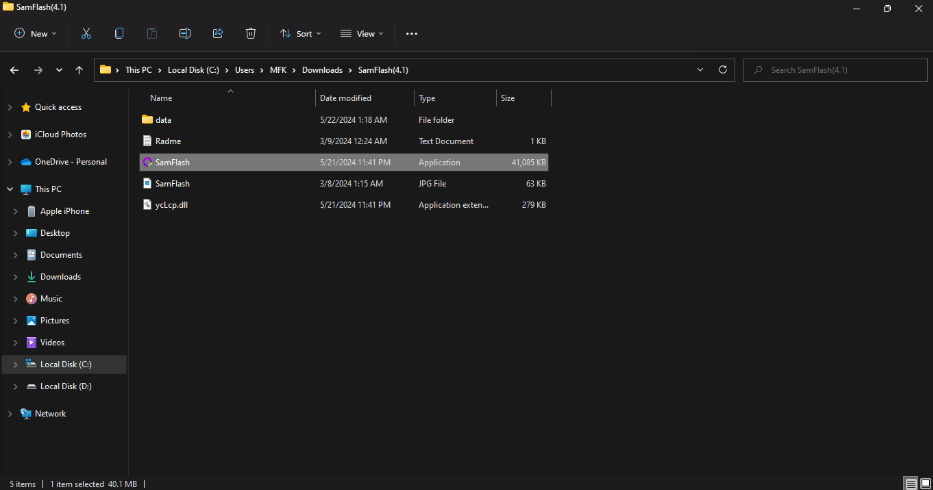
Check the SamFlash package and version information before running the tool.
Step 2. Scan the downloaded archive before extraction.
Step 3. If a checksum is provided by the source, compare it with the file you downloaded.
Step 4. Extract the archive and inspect the contents for files you did not expect.
Step 5. Continue only when the package and interface match the workflow you intend to follow.
Guide 2. Start a Samsung FRP Workflow in SamFlash
Step 1. Locate the SamFlash application included in the package and open it with the Windows permissions required by that build.
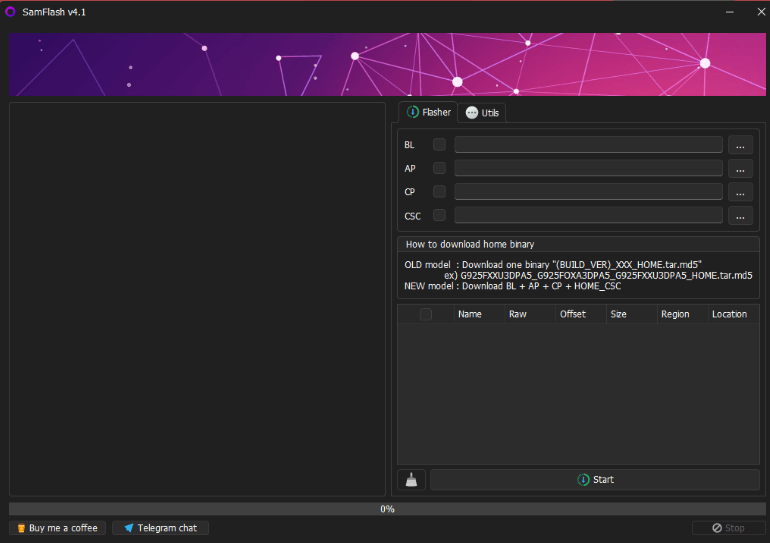
The existing SamFlash workflow shows the application being run as administrator.
Step 2. Connect the Samsung phone with a reliable data-capable USB cable.
Step 3. Wait for Windows and SamFlash to recognize the device before selecting an operation.
Step 4. Choose the FRP-related function only if that option is available in the package and applies to the connected Samsung workflow.
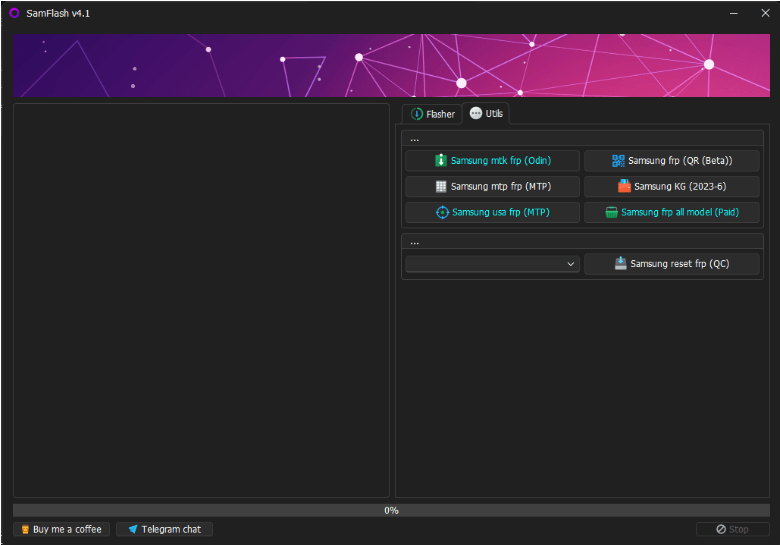
Choose the function that matches the Samsung service task you are performing.
Step 5. Read the SamFlash log or on-screen instructions and place the phone into the connection mode requested by that workflow.
Step 6. Do not substitute another tutorial’s device mode merely because that method also uses SamFlash.
Step 7. Let the selected operation finish before disconnecting the phone.
Step 8. After the tool reports completion, follow the device setup or restart instructions appropriate to the selected operation.
Important: A SamFlash screen that differs from this guide can indicate a different build or package. Verify what you downloaded before trying to reproduce buttons or functions that are not present.
SamFlash Tool Not Working? Diagnose the Failure Point
When SamFlash fails, the point where it stops is more useful than assuming the latest Android security update is automatically responsible. Start with package launch and device detection, then move to the selected function and tool log.
| Where It Stops | What to Check | Do Not Assume |
| SamFlash will not launch | Package integrity, archive contents, Windows warning, required runtime, and whether the file matches the expected build | Do not automatically disable security software just to force it open. |
| Samsung phone is not detected | Samsung USB driver, data cable, USB port, Windows Device Manager, and requested phone mode | Do not assume the FRP function itself is broken yet. |
| The phone appears but the expected FRP function is missing | SamFlash package/build and interface differences | Do not assume every V4.1 archive exposes the same functions. |
| The log asks for another connection mode | The exact device state requested by that workflow | Do not stay in MTP or Download Mode simply because another SamFlash tutorial uses it. |
| The operation starts but fails | Exact Samsung model, current software state, selected function, package version, and log message | Do not automatically label the failure as a security-patch block without evidence. |
| The interface does not match the screenshots | Whether you downloaded another SamFlash build or repackaged archive | Do not force instructions intended for a different interface. |
| The archive contains an extra installer or unrelated executable | Package provenance and file contents | Do not run it merely because the ZIP name says SamFlash. |
SamFlash Does Not Detect the Samsung Phone
Start with Windows detection. Try a known-good data cable, another direct USB port, reinstall the appropriate Samsung driver if necessary, and confirm the device state expected by the SamFlash function you selected.
If Windows cannot maintain a stable connection to the phone, switching from SamFlash to another USB-based FRP program may not solve the underlying connection problem.
The FRP Option Is Missing or Fails
Compare the interface with the package shown in your tutorial. If the option does not exist, you may have a different build or package. If the function exists but fails, use the tool log and exact device information before deciding that the phone is unsupported.
SamFlash Opens but the Tutorial Looks Different
This is an important package-identity warning. A version label alone does not guarantee the menus are identical. Stop and confirm the build rather than clicking the closest-looking service function.
For broader troubleshooting after an FRP method fails, see the FRP bypass not working guide.
When a Guided FRP Tool Fits Better Than SamFlash
SamFlash and a guided FRP application are not interchangeable Samsung service tools. A different FRP workflow becomes relevant when your goal is specifically Google verification recovery rather than firmware servicing, and you do not want to manage SamFlash package sources, manual connection modes, or service-tool logs.
First identify why you are leaving SamFlash:
- Uncertain download source: Do not solve a file-trust problem by running the package anyway. Use a software source you can verify.
- Phone not detected: Fix the USB/driver problem first because another desktop tool also needs a stable device connection.
- SamFlash function does not match the phone: Check a device-specific Samsung FRP route or another workflow that explicitly supports the device situation.
- You only need guided FRP instructions: A consumer-focused FRP workflow may be a better fit than a broader Samsung servicing utility.
- You need firmware flashing: Do not switch to DroidKit expecting it to replace SamFlash’s firmware-oriented service functions.
For compatible Android scenarios, DroidKit FRP Bypass provides a separate Windows/Mac workflow with on-screen instructions.
Start a Guided FRP Workflow in DroidKit
Step 1. Open DroidKit and select FRP Bypass.
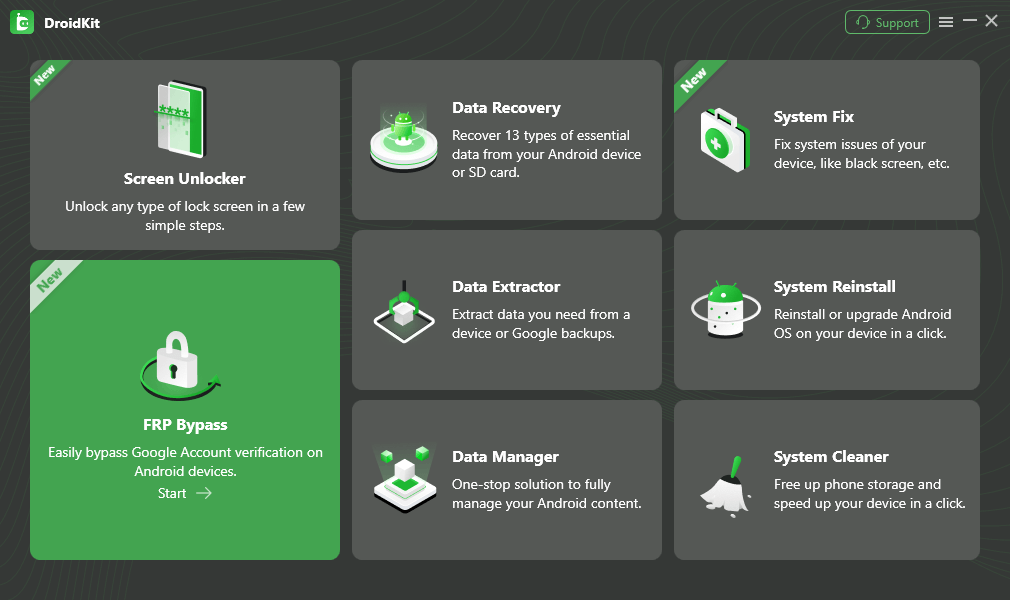
Open the FRP Bypass workflow in DroidKit.
Step 2. Connect the Android device with a stable USB cable and choose the device route requested by the software.
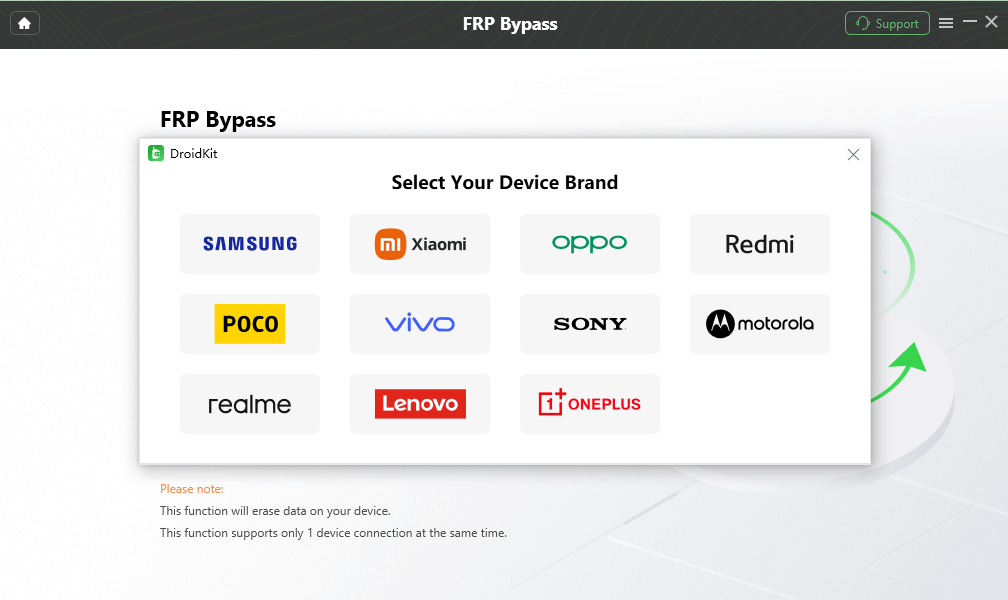
Choose the device route that matches the connected phone.
Step 3. Continue only when the connected device is covered by the FRP workflow shown by DroidKit.
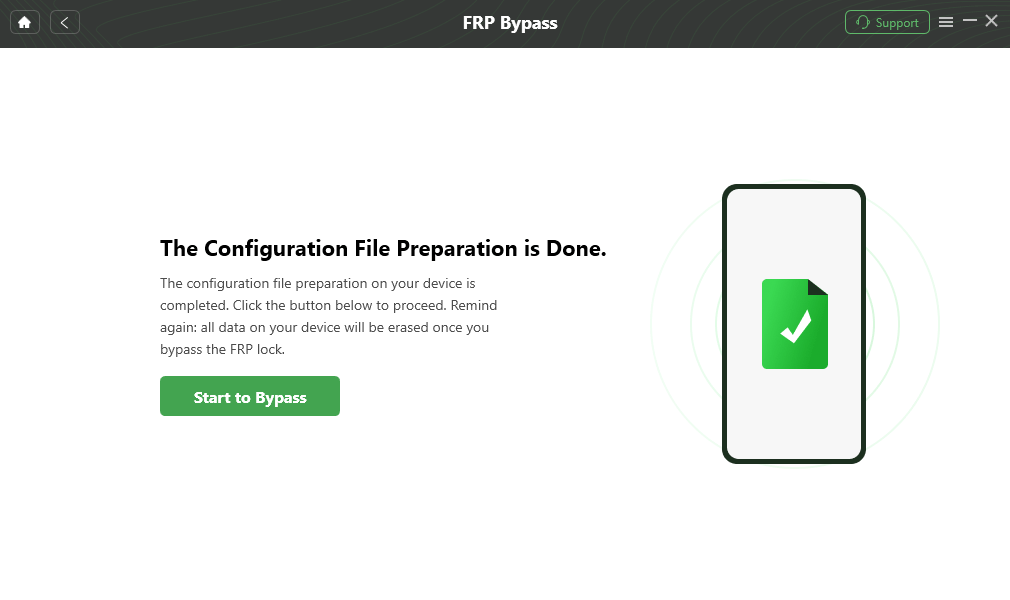
Start the applicable FRP workflow.
Step 4. Select the device/system option requested by the software and follow the corresponding instructions.
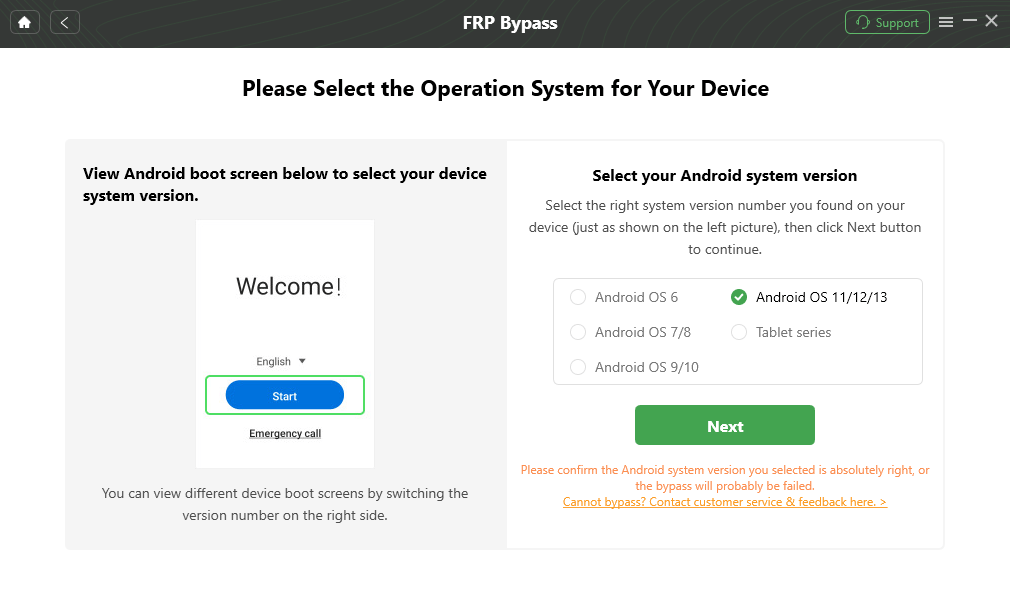
Use the system option required by the applicable FRP workflow.
Step 5. Complete the device-specific preparation shown on screen.
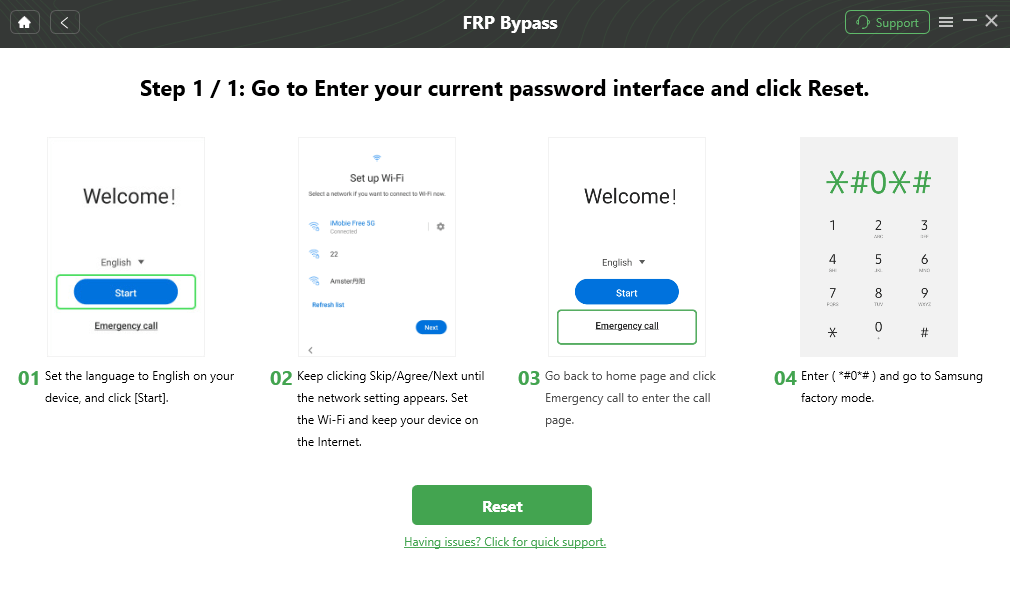
Follow the Samsung preparation steps displayed for the applicable device workflow.
Step 6. Keep the phone connected until the selected process reaches its completion screen.
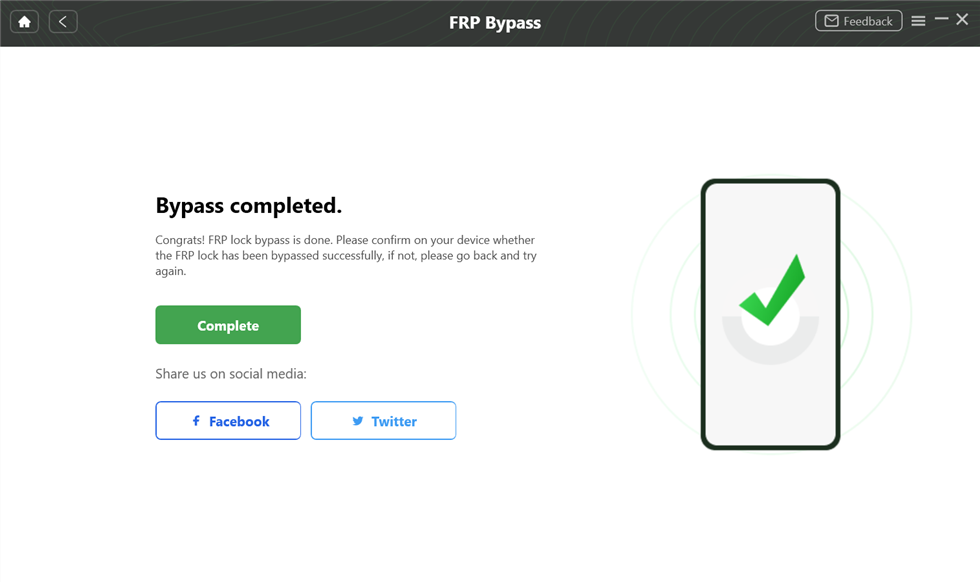
DroidKit FRP workflow completion screen.
Compatibility note: DroidKit is an alternative FRP workflow for supported device scenarios. It should not be presented as a replacement for every Samsung firmware, backup, flashing, or service function associated with SamFlash.
SamFlash vs DroidKit: Different Tools for Different Jobs
SamFlash and DroidKit overlap around FRP intent, but they are not equivalent Samsung servicing utilities. Choose between them based on the task you actually need to perform.
| Item | SamFlash | DroidKit |
| Primary context on this page | Samsung-focused Windows servicing, firmware and FRP-related workflows | Guided Android FRP and other Android utility workflows |
| Best fit | Users comfortable with Samsung drivers, connection modes, package differences, and logs | Users whose main goal is a guided FRP workflow for a supported device |
| Computer | Windows | Windows or Mac |
| Package source | Often encountered through third-party/community distribution | Available directly from iMobie |
| Connection work | May require manual Samsung drivers, device modes, and log interpretation | Provides on-screen device preparation for the supported workflow |
| Firmware/service role | May include Samsung firmware or servicing functions depending on the package | Should not be treated as a replacement for all SamFlash firmware/service functions |
| When to choose it | You need a SamFlash function and can verify the package/device workflow | Your main need is supported FRP recovery and you prefer guided instructions |
SamFlash Tool FAQ
Is SamFlash Tool V4.1 the latest version?
V4.1 is a version label commonly encountered in SamFlash tutorials and archives, but this page does not treat it as a verified official latest release. Check the package source, changelog, interface, and included files before deciding that a V4.1 download is the version you need.
Is SamFlash Tool V4.1 free?
SamFlash packages are commonly distributed without an upfront software purchase, but the word “free” does not establish package safety, current device support, or whether every operation in every distribution works the same way.
Is SamFlash Tool safe to download?
Safety depends heavily on the exact file you obtain. Verify the source information, scan the archive, inspect unexpected executables, and use a supplied checksum when available. Do not treat a ZIP as safe simply because its filename contains “SamFlash V4.1.”
Why does my SamFlash interface look different from the guide?
You may have a different build or repackaged distribution. Compare the version label, archive contents, menus, and tutorial source before trying to substitute similar-looking functions.
Why is SamFlash not detecting my Samsung phone?
Start with the Samsung USB driver, data cable, USB port, Windows device detection, and the connection mode requested by the selected SamFlash workflow. A phone that is not recognized correctly cannot complete the FRP or service operation.
Why is the SamFlash FRP option missing?
The package you downloaded may expose different functions from the one shown in another tutorial. Do not assume every file labeled V4.1 has an identical interface or function set.
Why does the SamFlash FRP operation fail after the phone is detected?
Check the exact Samsung model, current software state, SamFlash package, selected function, and log message. Without specific evidence, do not assume a security patch is automatically the reason for failure.
Does SamFlash work on every Samsung phone?
No. A Samsung model appearing in a tool list or tutorial does not establish support across every Android version, carrier variant, software build, or SamFlash package. Match the exact device and workflow before proceeding.
Is DroidKit a complete SamFlash replacement?
No. DroidKit is relevant here as a separate guided FRP option for supported devices. SamFlash may also be used for Samsung firmware or servicing tasks that are outside the purpose of the DroidKit FRP workflow.
What should I do if SamFlash keeps failing?
Identify where it stops. A launch problem points to the package or Windows environment; no device detection points to the USB/driver layer; a missing function can indicate a package difference; and an operation failure requires reviewing the exact model, workflow, and log before choosing another tool.
SamFlash is most useful when you can verify three things before starting: the package you downloaded, the Samsung device and connection mode, and the exact function you intend to run. The V4.1 label alone cannot answer those questions.
If your need is Samsung firmware or broader servicing, keep the SamFlash workflow separate from a consumer FRP tool decision. If your goal is specifically Google FRP and you have established that SamFlash is not the right workflow, then compare a compatible guided FRP route rather than treating every alternative as a full SamFlash replacement.
More Related Articles


Roger Smith is a senior technical writer with years of experience in providing Android solutions. He loves to help users solve various problems such as Android unlock, Android data recovery, and Android system repair.
Product-related questions? Contact Our Support Team to Get Quick Solution >
