How to Bypass FRP on Samsung A14/A14 5G (Android 14/13/12)
Locked on Google verification after resetting a Samsung Galaxy A14 or A14 5G? Compare account recovery, no-PC options, Odin, and a guided PC-based FRP route for Android 14, 13, and 12, plus what to check when an older method no longer matches your phone.
Stuck on the Google verification screen after resetting your Samsung Galaxy A14 or A14 5G? The right next step depends on more than the model name. Your Android version, One UI build, security update, access to the previously synced Google account, and whether the setup screen still exposes the checkpoint required by a manual method all matter.
This guide focuses specifically on Samsung A14 FRP bypass situations across Android 12, Android 13, and Android 14. Start with account recovery when you still control the Google account. If that is not possible, compare the no-PC, Odin, and computer-based routes below rather than assuming an older Samsung tutorial will match your current setup.
For Samsung models beyond the A14/A14 5G, use the Samsung FRP bypass guide to choose a model- or situation-specific route.
Quick Answer: Which Samsung A14 FRP Method Should You Try?
If you can still recover the Google account previously synced with the Galaxy A14, start there. If account recovery is unavailable, identify the phone’s Android/One UI environment and the exact point where your current method stops before switching routes.
| Your Samsung A14 Situation | Better Starting Point | Check Before Continuing |
| You still control the previously synced Google account | Google Account Recovery | Recover the account and complete Google verification instead of using a bypass method. |
| A14/A14 5G on Android 14 or One UI 6 | Check the exact setup screens before using an older manual method | Older browser, TalkBack, APK, QR-code, or emergency-call paths may not match the current software state. |
| No PC available | Account recovery or a compatible device-specific no-PC route | Confirm that every menu required by the instructions actually appears on your phone. |
| You want to use Odin | Samsung firmware-based workflow | Verify the exact model, firmware, binary, Download Mode, drivers, and files before flashing. |
| An old FRP tutorial stops at a missing menu | Switch method category | Repeating the same shortcut will not restore a setup path that is unavailable on the phone. |
| You prefer an on-screen computer workflow | Evaluate a guided FRP tool | Confirm that the available workflow applies to your Samsung device situation before starting. |
Table of ContentsHide
What Is FRP on Samsung A14?
Which Samsung A14 FRP Bypass Method Should You Use?
Samsung A14 FRP Bypass with a Guided PC Tool
Samsung A14 FRP Bypass on Android 14 / One UI 6
Samsung A14 FRP Bypass with Odin
Can You Bypass Samsung A14 FRP Without a PC?
Samsung A14 FRP Bypass Not Working
FAQs About Samsung A14 FRP Bypass
Conclusion
What Is FRP on Samsung A14?
Factory Reset Protection (FRP) is an Android security feature associated with Google account verification after a protected device is reset. On a Galaxy A14 or A14 5G, you may reach a Verify your account screen asking for a Google account that was previously synced with the phone.
This can happen when:
- you reset the Galaxy A14 before removing the Google account;
- you forgot the Google account or password used on the phone;
- you recently changed the Google account credentials;
- you bought a used A14 that is still associated with a previous owner’s account; or
- the phone returns to Google verification after a factory reset.
If your main problem is the verification screen rather than the Samsung model itself, see the Google verification after factory reset guide for account-recovery and reset-specific scenarios.
If the Galaxy A14 was purchased second-hand and is still linked to another person’s Google account, contact the previous owner or seller first. Use FRP-related methods only on a device you own or are authorized to manage.
Which Samsung A14 FRP Bypass Method Should You Use?
The model name alone does not determine the correct route. Two Galaxy A14 devices can show different setup behavior because of Android version, One UI build, region, firmware, or security updates.
| Method | PC Needed? | Best Fit | Main Limitation |
| Google Account Recovery | No | You still control the previously synced account or its recovery options | Requires access to Google’s account-recovery process. |
| Manual no-PC method | No | The exact browser, accessibility, QR, keyboard, or setup path required by the guide still exists | Older setup shortcuts may be unavailable on the current phone. |
| Odin-related route | Yes, Windows | Advanced Samsung users who can verify firmware and Download Mode requirements | Firmware mismatch or incorrect preparation can create additional software problems. |
| DroidKit FRP Bypass | Yes, Windows or Mac | Users who prefer an on-screen computer workflow when the available FRP route fits the connected device | The applicable device workflow still needs to be confirmed before starting. |
If you are comparing several software options rather than looking only for an A14-specific method, see the Samsung FRP tool comparison.
Samsung A14/A14 5G FRP Bypass with a Guided PC Tool
A guided computer workflow becomes relevant when the Galaxy A14 no longer exposes the setup path required by an older manual tutorial, or when you prefer on-screen instructions to firmware flashing. DroidKit FRP Bypass provides a computer-based FRP workflow for supported device situations.
This option is worth evaluating when:
- the browser or Settings shortcut in a no-PC guide is missing;
- an APK route cannot reach the required installation or account screen;
- you do not want to select and flash Samsung firmware manually;
- you have a Windows or Mac computer available; and
- the FRP workflow presented by DroidKit applies to the connected Samsung device.
How to Start Samsung A14 FRP Bypass with DroidKit
Step 1. Download and install DroidKit on your Windows PC or Mac. Open the software and choose FRP Bypass.
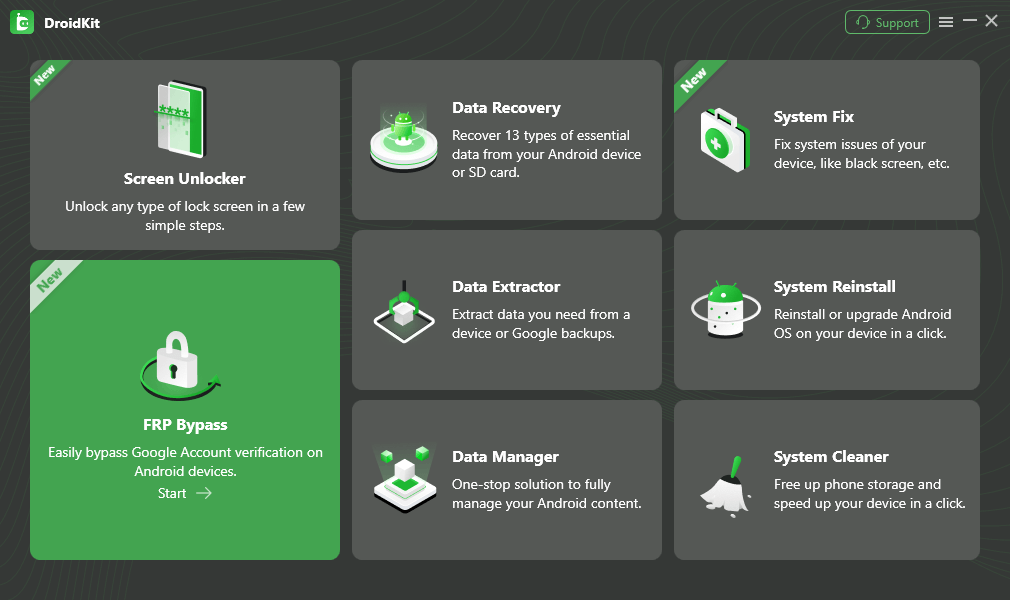
Choose FRP Bypass Mode in DroidKit.
Step 2. Connect the Galaxy A14 to the computer with a data-capable USB cable. Click Start and choose Samsung when the software asks for the device brand.
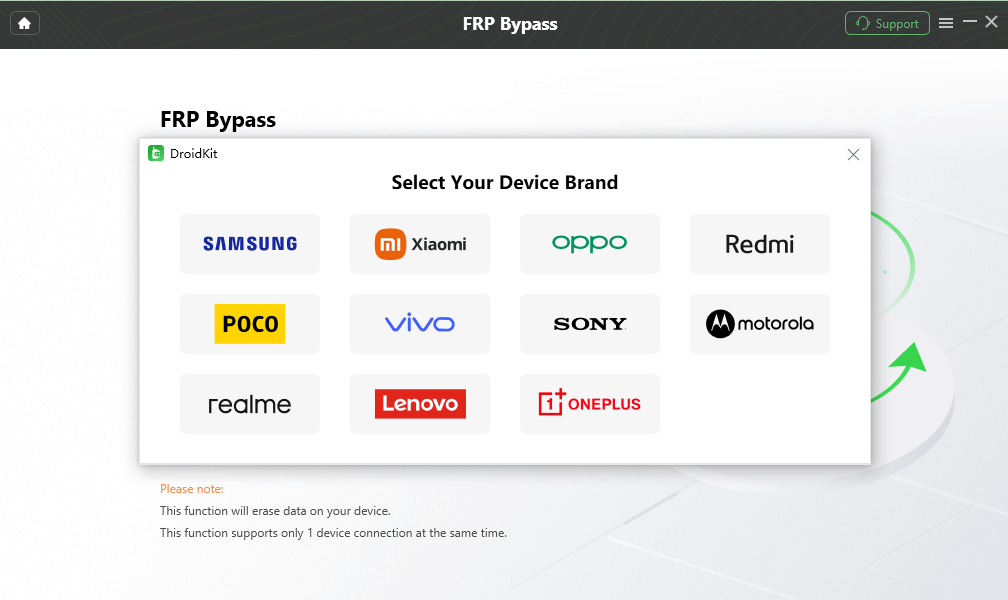
Select the correct device brand.
Step 3. Wait while DroidKit prepares the configuration required for the available workflow. Keep the phone connected and continue when prompted.
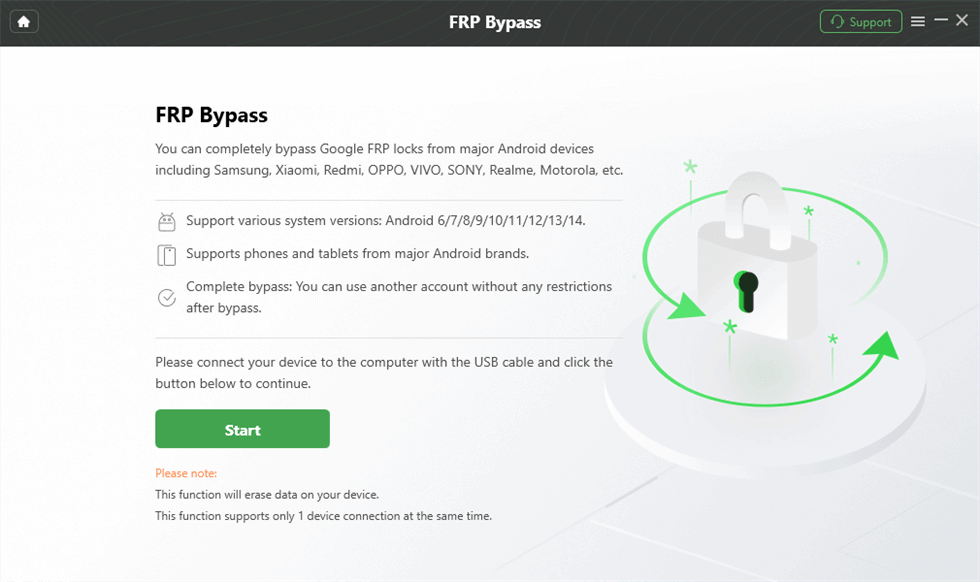
Start the available FRP workflow.
Step 4. Select or confirm the device information requested by DroidKit. Do not substitute instructions from another Galaxy model if the software presents a different route.
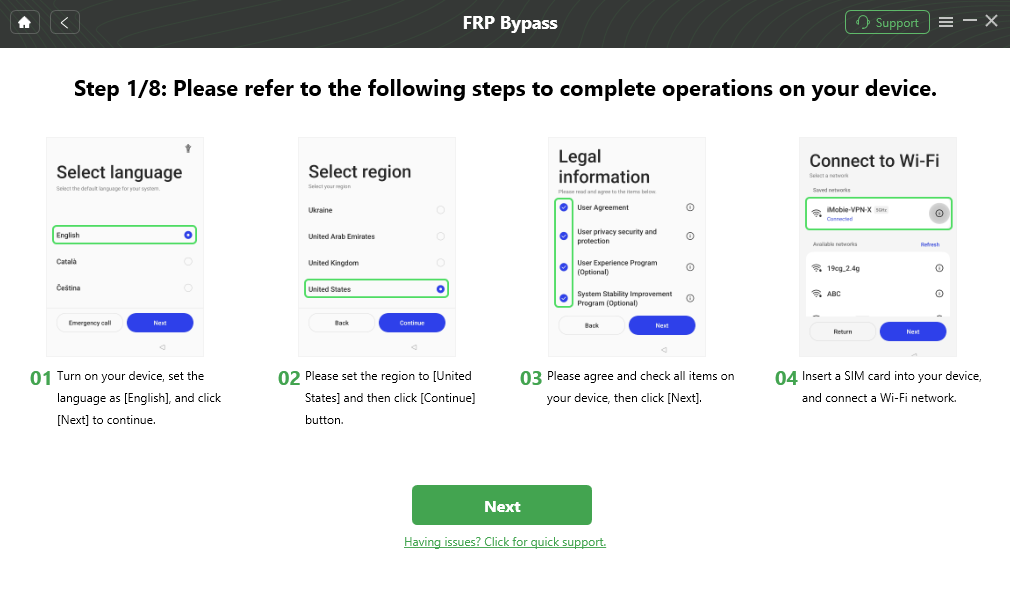
Follow the setup instructions shown for the available workflow.
Step 5. Continue with the on-screen instructions and keep the device connected until the workflow reports completion.
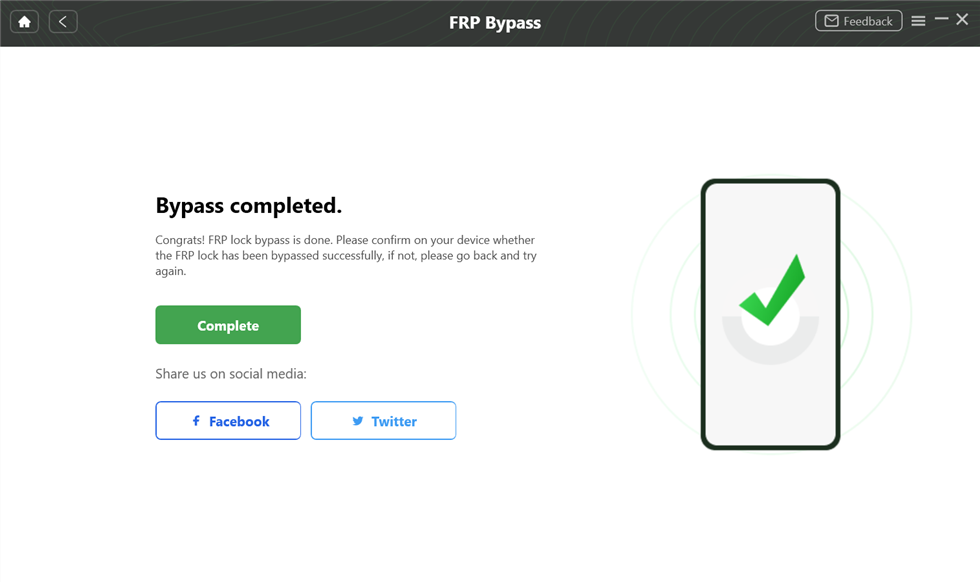
Complete the available FRP workflow.
Samsung A14 FRP Bypass on Android 14 / One UI 6
Android 14 and One UI 6 are important search signals for Galaxy A14 users because an older tutorial may show a setup screen that no longer appears on the phone. Instead of assuming that every Android 14 A14 requires the same method, compare the actual checkpoint required by the instructions.
Common signs that an older manual route does not match your current setup include:
- the tutorial expects Chrome or another browser but the setup flow never exposes it;
- an APK installation route is blocked;
- the TalkBack or accessibility menus differ from the tutorial;
- an emergency-call or QR-code path does not reach the screen shown in the guide;
- the expected Settings or account menu is missing; or
- the phone repeatedly returns to Google verification.
If your A14 is specifically running Android 14, the Android 14 FRP guide provides broader version-specific context. Keep this A14 guide as the primary reference for the model itself.
What to Do When an Android 14 Tutorial Does Not Match
Stop at the first missing checkpoint. If the instructions require a browser, APK installer, TalkBack menu, QR-code route, or Settings activity that is unavailable, repeating earlier steps is unlikely to change the setup environment. Move to account recovery, an A14-compatible workflow, or a computer-based route instead.
Samsung A14 FRP Bypass with Odin
Odin is associated with Samsung firmware flashing on Windows. It is a more technical route than account recovery or a guided consumer tool, and it should not be treated as a universal FRP button.
Before using an Odin-related workflow, confirm:
- the exact Galaxy A14/A14 5G model code;
- the firmware and bootloader/binary information;
- that the files are intended for that exact device configuration;
- that Samsung USB detection is working on the Windows PC; and
- that you understand how to enter the required Samsung Download Mode for the selected workflow.
For the full preparation and troubleshooting path, use the Odin FRP bypass guide. This keeps the firmware-specific instructions in the dedicated Odin article instead of duplicating a generic flashing sequence here.
When Odin Is Not the Right Starting Point
Do not start with Odin simply because another Samsung user reported success with a different model or firmware. If you cannot verify the exact files and device state required by the workflow, choose a less firmware-dependent route first.
Can You Bypass Samsung A14 FRP Without a PC?
Possibly, but a no-PC route is useful only when the required setup path is actually available on your Galaxy A14. The safest no-PC starting point is Google account recovery when you still control the account or its recovery phone/email.
Option 1. Recover the Previously Synced Google Account
If you still control the Google account that was previously used on the Galaxy A14, recover access through Google’s account-recovery process and then return to the verification screen.
If you recently changed the password or the phone does not accept credentials you believe are correct, avoid repeatedly resetting the device. First confirm that you are using the account previously associated with the phone and follow the verification prompts presented by Google.
Option 2. Check Whether a Manual No-PC Route Matches
Older Samsung FRP tutorials may rely on:
- TalkBack or accessibility menus;
- a browser or Settings shortcut;
- APK installation;
- SIM or notification behavior;
- QR-code setup paths; or
- emergency-call-related checkpoints.
These are not interchangeable. If your Galaxy A14 does not expose the exact checkpoint required by a tutorial, stop that route rather than combining steps from several unrelated guides.
Samsung A14 FRP Bypass Not Working? Check the Failure Point
When a Samsung A14 method fails, the screen where it stops is more useful than the name of the method. Use the table below to decide what to check next.
| Failure Point | What to Check | Better Next Step |
| Old tutorial shows a menu that is missing | Android version, One UI build, security state, and Setup Wizard differences | Stop that manual route and choose a method that matches the current screens. |
| FRP APK cannot install | Whether installation is permitted and whether the APK workflow matches the device environment | Do not cycle through random APK files that depend on the same blocked setup path. |
| PC does not detect the A14 | USB driver, data cable, USB port, and required device mode | Resolve detection before retrying a PC-based workflow. |
| Odin does not proceed as expected | Exact model, firmware, binary, drivers, connection, and Download Mode | Return to the dedicated Odin preparation and troubleshooting guide. |
| Google verification returns after another reset | Whether FRP is still active and whether the previously synced account is available | Do not keep factory-resetting the phone; reassess account recovery or the selected FRP route. |
| A method works on another Galaxy but not your A14 | Model code and software differences | Use A14-specific instructions instead of assuming all Samsung phones share one setup path. |
FAQs About Samsung A14/A14 5G FRP Bypass
Can Samsung A14 FRP be bypassed without a PC?
A no-PC route depends on the setup screens available on the specific Galaxy A14. If you still control the previously synced Google account, account recovery is the preferred starting point. Older manual routes are relevant only when the browser, accessibility, APK, QR-code, or other checkpoint required by the instructions still appears.
Does Samsung A14 FRP bypass work on Android 14?
The correct route depends on the phone’s actual Android 14/One UI setup and the checkpoints required by the method. Do not assume an older tutorial is compatible simply because it mentions Samsung A14. Compare its screens with the device before continuing.
Can I use Odin to bypass FRP on Samsung A14?
Odin is a Samsung firmware-flashing utility used in technical workflows. If you are evaluating an Odin-related FRP route, verify the exact Galaxy model, firmware, binary, drivers, files, and Download Mode requirements first. Use the dedicated Odin guide for the firmware-specific procedure.
Why does an old Samsung A14 FRP tutorial no longer work?
The tutorial may depend on a setup shortcut that is unavailable on your current Android version, One UI build, or security state. Missing browser access, blocked APK installation, different TalkBack menus, or a missing Settings path are signs that you should stop that route and choose another method.
What should I do if I bought a used Samsung A14 with FRP?
If the device is still linked to the previous owner’s Google account, contact the seller or previous owner and ask them to resolve the account association properly. Do not treat a second-hand ownership problem as proof that a particular bypass method will work.
Is Samsung A14 screen lock the same as FRP?
No. A PIN, pattern, or password protects access to the device screen, while FRP is associated with Google account verification after a protected reset. Choose instructions for the lock you actually see instead of mixing screen-lock and FRP procedures.
Conclusion
For a Samsung Galaxy A14 or A14 5G stuck on Google verification, start by identifying the account situation and the phone’s current Android/One UI environment. Recover the previously synced Google account when possible. If that route is unavailable, compare the exact prerequisites of a no-PC method, Odin workflow, or guided computer option before proceeding.
The most important compatibility signal is whether your A14 actually exposes the checkpoint required by the method. If an older tutorial stops at a missing browser, APK installer, TalkBack menu, Settings path, or firmware requirement, switch routes instead of repeatedly attempting instructions that no longer match the device.
For users who have ruled out account recovery and whose manual route no longer matches the Galaxy A14 setup, DroidKit can be evaluated as a guided computer-based option when its available FRP workflow applies to the device.
More Related Articles


Roger Smith is a senior technical writer with years of experience in providing Android solutions. He loves to help users solve various problems such as Android unlock, Android data recovery, and Android system repair.
Product-related questions? Contact Our Support Team to Get Quick Solution >
