You share your location with family using Find My for peace of mind, but there are moments when you need personal space without causing alarm by disappearing from the map. This leads to the critical question: can you fake your location on Find My? Many users, feeling a lack of control, search for a way to create a fake location on Find My for iPhone, believing it’s their only option.
This guide provides a clear, honest answer based on hands-on testing. We’ll move past the myths and risky workarounds to show you the safe, Apple-approved methods to manage your privacy. You’ll learn how to control who sees your location—and when—without compromising your device’s security or your ability to find your phone if it gets lost.
The Direct Answer: Can You Spoof Your Find My Location?
Let’s address the main question immediately. On a standard, non-jailbroken iPhone, directly faking or spoofing the GPS coordinates that the Find My app reports is not a practical option. Apple has engineered iOS with integrated security layers that make manipulating core location services extremely difficult. The system constantly cross-references multiple data sources to verify your device’s position.
Any app or third-party service claiming to be an easy iPhone location changer for Find My should be treated with extreme caution. These tools often fail on modern iOS versions or require dangerous procedures that can compromise your personal data and device security.
However, this doesn’t mean you’re without options. The real goal for most users isn’t deception; it’s control. The most effective and secure solution is to master your location-sharing iPhone settings.
A Critical Distinction: “People” vs. “Devices” in Find My
Before we explore the methods, it’s essential to understand a crucial point that causes a lot of confusion. The Find My app has two separate functions that use location:
1. Sharing with People (The “People” Tab): This is your social location. It’s the location you voluntarily share with friends and family. The methods in this guide focus on controlling this shared location.
2. Finding Your Devices (The “Devices” Tab): This is the security location for your hardware. It allows you to track, ping, or erase your own iPhone, iPad, or Mac if it’s lost or stolen.
Here’s the key takeaway: The privacy settings for sharing your location with people do not affect your ability to track your own lost devices. For example, using a secondary device to share your location from home will still allow you to see your iPhone’s true location in the “Devices” tab if you lose it while you’re out. This separation gives you both privacy and peace of mind.
Decision Guide: Which Privacy Method Is Right for You?
Instead of comparing safe methods to risky hacks, it’s more helpful to compare the safe methods against each other. Your choice depends on the social outcome you want to achieve.
| Criteria | Method 1: Stop Sharing with One Person | Method 2: Stop Sharing with Everyone | Method 3: Use a Secondary Device |
| Privacy Level | Targeted. Only affects specific individuals. | Total. You are hidden from everyone. | Strategic. You appear to be in a fixed, trusted location. |
| What Others See | “No location found.” Clearly shows you have stopped sharing with them. | Your location becomes unavailable to everyone you were sharing with. | Your location appears as normal, but from a different device. |
| Social Signal | Intentional. Can seem direct or confrontational. | A Clear Boundary. Like going “off the grid.” May cause questions. | Stealthy. Causes no alarm, as your location is still visible and looks normal. |
| Best For… | Needing privacy from a specific person without affecting others. | Taking a complete break from location sharing for a period of time. | Appearing to be at home (or another location) without raising concern. |
How to Change Your Find My Location Settings (The Safe Way)
Here are the three effective and secure methods to control your iPhone location sharing for better privacy, each suited for a different situation.
Method 1: Stop Sharing Your Location with a Specific Person
This is the most precise technique, ideal for when you need privacy from certain individuals without alerting your entire network.
1. Open the Find My app on your iPhone.
2. Tap the People tab at the bottom of the screen.
3. Select the name of the person you wish to stop sharing with.
4. Scroll down and tap Stop Sharing My Location.
5. Confirm your choice. The other person will now see a message like “No location found.” This looks different from a phone that is off (which might show a last known location), making it clear that you have intentionally stopped sharing with them.
Method 2: Turn Off Location Sharing for Everyone
If you want a complete, temporary break from location sharing, you can disable the feature globally. This is like going “off the grid” within the Find My network.
1. Open the Find My app.
2. Tap the Me tab in the bottom-right corner.
3. Toggle the Share My Location switch to the off position.
This will prevent anyone you’ve previously shared your location with from seeing you on the map. They will not receive a notification, but they will see your status as unavailable if they check.
Method 3: Use a Secondary Apple Device as Your Location Hub
This is the most clever and effective method to change location on Find My iPhone without any risky hacks. By designating another Apple device (like an iPad or an old iPhone that stays at home) as your location source, you can appear to be in one place while you are somewhere else.
1. On your primary iPhone (the one you carry with you), navigate to Settings > [Your Name] > Find My.
2. Make sure Share My Location is turned on.
3. Now, on your secondary device (e.g., an iPad), sign in with the same Apple ID.
4. Go to Settings > [Your Name] > Find My on that secondary device.
5. Tap the option Use This [iPad/iPhone] as My Location. This text is usually blue and located under the “Share My Location” toggle.
From now on, the Find My network will report your location to the “People” you share with based on where this secondary device is, giving you privacy while keeping the service active for your family.
A warning we learned the hard way—make sure your secondary device stays plugged in and connected to Wi-Fi. If it runs out of battery or loses its internet connection, your location will show as “unavailable” or “No location found” until it’s back online. It will not automatically switch back to your iPhone’s location, but the sudden disappearance can still cause questions. Keeping it powered on is key to making this method seamless.
Why Faking Your Find My Location Is So Hard
To understand why a simple find my iphone fake gps app doesn’t work, you need to know how Apple’s system pinpoints your device. It’s not just one signal; the apple find my location services use a sophisticated, multi-layered approach to ensure accuracy and prevent manipulation.
The system cross-references data from several sources simultaneously:
- GPS (Global Positioning System): The primary source for outdoor location, using satellite signals for high precision.
- Wi-Fi Positioning: Your iPhone scans for nearby Wi-Fi networks and compares them against a massive global database to determine your location, which is crucial for accuracy indoors.
- Bluetooth Beacons: In environments like malls or airports, your device can use Bluetooth signals to refine its position further.
- The Find My Network: This is Apple’s key advantage. Even if your device is offline (with no Wi-Fi or cellular), it can send out a secure, anonymous Bluetooth signal. This signal is picked up by the hundreds of millions of other Apple devices around it, which then report your device’s approximate location back to the network.
Because the system blends these inputs, tricking just one (like GPS) is insufficient. The other sources would report conflicting data, and the system would likely flag the inconsistency or default to a more reliable signal, making the find my friends location accuracy incredibly robust.
What About GPS Spoofing Apps for iPhone?
When searching for how to spoof location on Find My, you’ll inevitably encounter tools that claim to offer GPS spoofing for iPhone. However, these solutions come with significant risks and limitations, especially for the Find My app.
The vast majority of tools that can successfully alter an iPhone’s system-level GPS require you to jailbreak your device. Jailbreaking removes Apple’s built-in software restrictions, but it also:
- Instantly voids your Apple warranty.
- Can prevent you from installing critical iOS security updates.
- Exposes your device and personal data to malware and stability issues.
Some computer-based programs claim to create a virtual location for iPhone without a jailbreak. While these might have limited success for certain location-based games, they are generally ineffective against Find My’s multi-source verification system. The risk of compromising your device’s security for a method that is almost certain to fail makes this a poor strategy.
A Safer Alternative for GPS Location Simulation: Fonelora Location Changer
While Apple makes it extremely difficult to manipulate Find My location directly, some users still need a way to simulate GPS locations on their iPhone for privacy testing, location-based apps, social media check-ins, or gaming purposes.
In those situations, a dedicated GPS simulation tool such as Fonelora Location Changer can provide significantly more flexibility than Apple’s built-in location-sharing controls.
Unlike risky jailbreak-based solutions, Fonelora allows users to modify their device’s GPS location without rooting or jailbreaking their phones. This helps avoid many of the security concerns associated with unofficial system modifications.
Why Users Choose Fonelora Location Changer
Many location-changing tools struggle with connection failures, limited compatibility, or outdated iOS support. Fonelora addresses these issues with several practical advantages:
- No Jailbreak or Root Required
- Compatible with Recent iOS and Android Versions
- One-Click GPS Teleportation Anywhere in the World
- Custom Walking Routes and Multi-Spot Navigation
- Real-Time Joystick Movement Control
- Supports Most Location-Based Apps and Games
- Easy Setup for Non-Technical Users
For users who want greater control over how location-dependent applications behave, Fonelora offers a much more accessible solution than modifying the operating system itself.
How to Change Your GPS Location with Fonelora
The setup process is straightforward:
Step 1. Install Fonelora Location Changer on your PC or Mac.
Step 2. Connect your iPhone or Android device via USB.
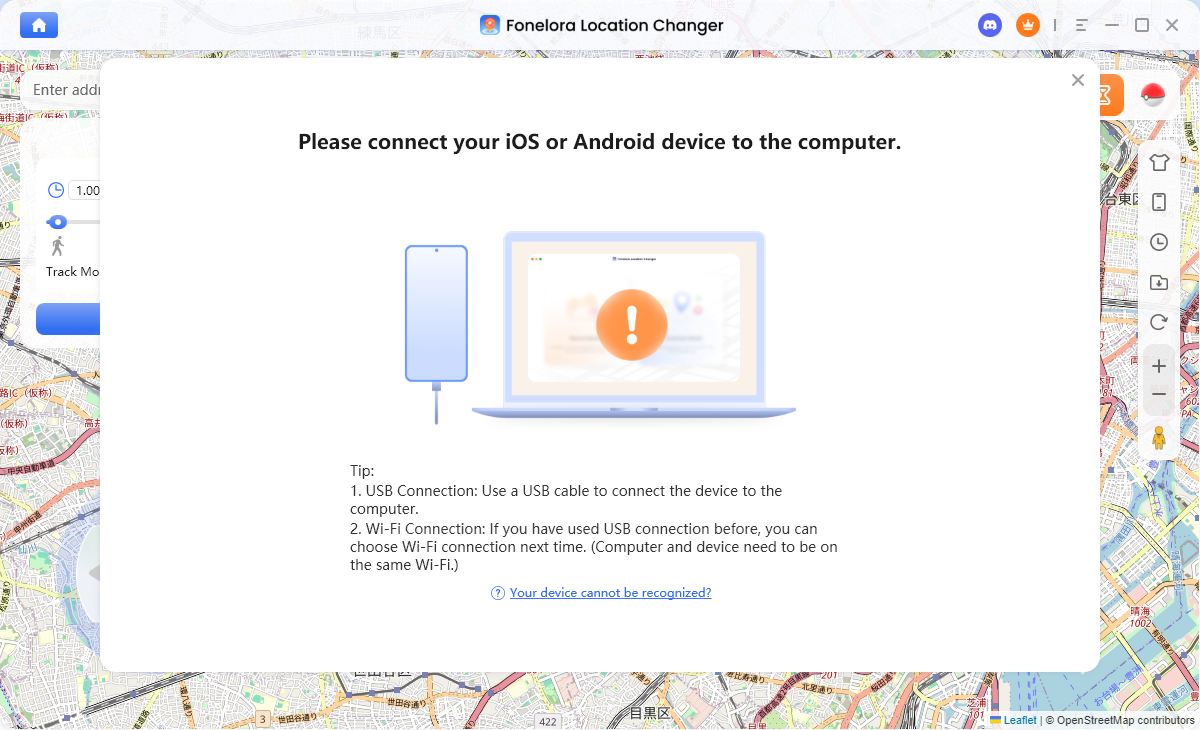
Step 3. Launch the software and select Teleport Mode.
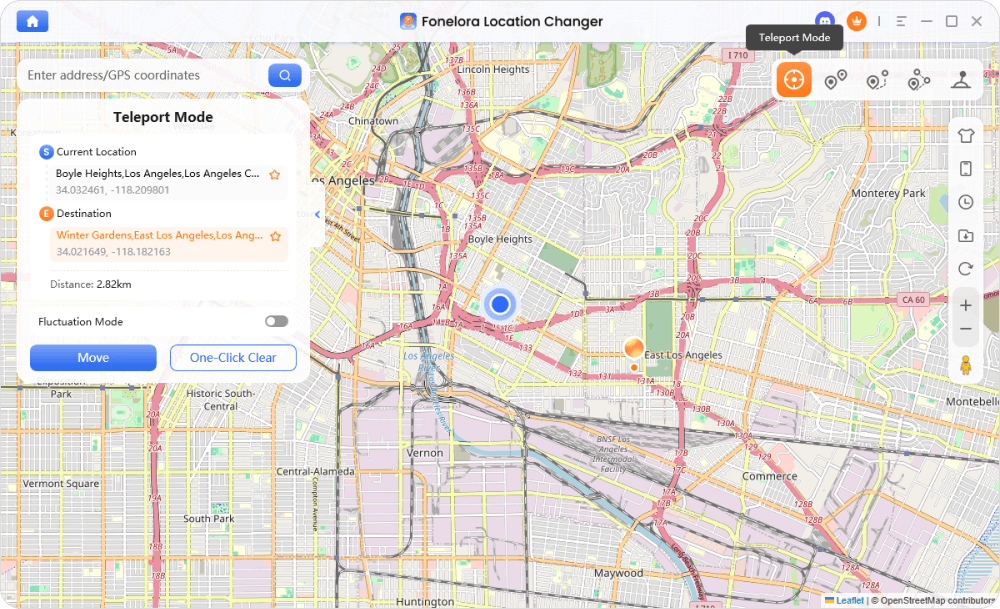
Step 4. Search for any city, address, or GPS coordinate.
Step 5. Click Move to update the device’s GPS location.
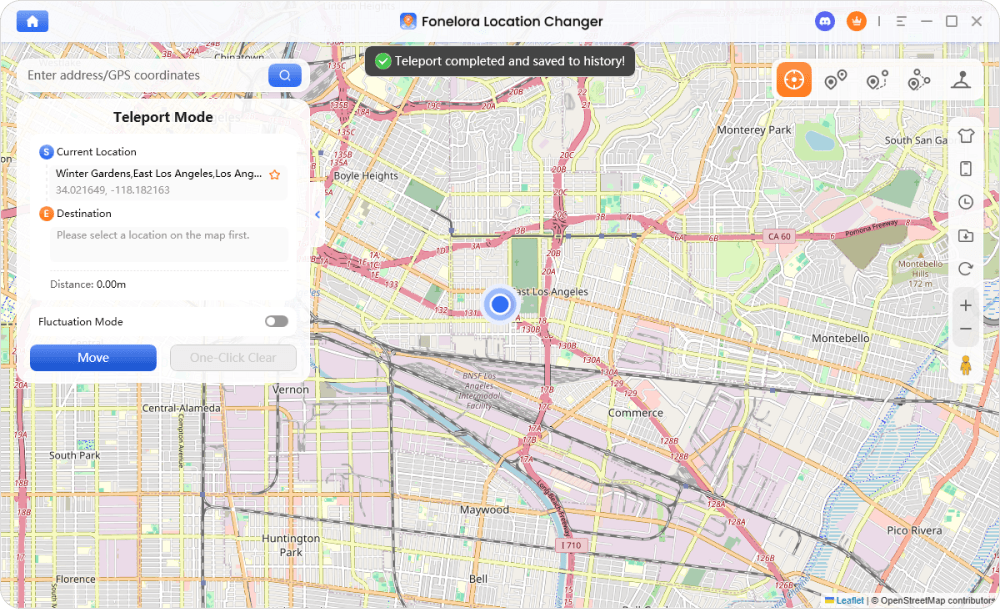
Step 6. Open your preferred location-based app and verify the updated position.
Important Note About Find My
It is important to understand that Apple’s Find My service uses multiple location-verification technologies, including GPS, Wi-Fi positioning, Bluetooth signals, and the Find My network itself.
Because of these additional verification layers, changing your GPS coordinates alone does not guarantee that your Find My location shared with others will behave exactly the same way as location-based apps such as Pokémon GO, Tinder, Snapchat, or Life360.
For most users whose primary goal is managing privacy within Find My, Apple’s built-in location-sharing controls and secondary-device method remain the most reliable solution.
Frequently Asked Questions
Here are direct answers to the most common questions about controlling your location on Apple’s Find My service.
Can you fake your location on Find My?
No, on a standard, non-jailbroken iPhone, it is not practically possible to fake your location. The system’s use of multiple sources (GPS, Wi-Fi, Bluetooth) makes it highly resistant to manipulation. The best approach is to use the built-in privacy settings to control which device reports your location or who can see it.
If I use my iPad as my location, can I still find my lost iPhone?
Yes. The location you share with people is separate from the location of your devices. Even if your friends and family see your location as being at home (from your iPad), you can still log into Find My and see your iPhone’s real-time location in the “Devices” tab if it gets lost.
What happens if the device I’m sharing from loses power?
Your location will become unavailable and will display as “No location found.” It will not automatically revert to showing your iPhone’s location. This is why it’s crucial to keep your designated location-sharing device (e.g., your iPad at home) plugged in and connected to Wi-Fi.
Can you stop sharing location on Find My without them knowing?
No. While they won’t get an active notification, if they check your location, they will see “No location found” instead of your position on a map. This makes it apparent that you have stopped sharing. If your goal is privacy without causing alarm, using a secondary device (Method 3) is the best option. [Internal Link Suggestion: Link the preceding phrase to ‘/iphone-privacy-settings-you-should-change-now’]
Why does Find My show the wrong location?
Occasionally, Find My may be inaccurate. This is usually caused by a weak GPS signal (e.g., you’re deep indoors or in a dense urban area). The device then relies on less precise signals like Wi-Fi positioning. A large blue circle around your location pin indicates this lower degree of confidence. It does not mean someone is trying to fake find my location iPhone.
Conclusion: Take Control of Your Location Privacy
Most people searching for a way to fake their location on Find My are not trying to deceive others—they simply want more control over when and how their location is shared.
Although Apple’s security architecture makes direct Find My spoofing extremely difficult, there are still several effective ways to protect your privacy. Using Find My’s built-in sharing controls, assigning a secondary Apple device as your location source, or temporarily pausing location sharing can all help you manage your visibility without compromising device security.
For users who need broader GPS simulation capabilities across location-based applications, Fonelora Location Changer offers a practical way to modify device GPS locations without jailbreaking or rooting. Combined with Apple’s privacy settings, it provides additional flexibility while maintaining a safer user experience.
Ultimately, the best approach is not to fight Apple’s security system, but to use the available tools—both built-in and third-party—to decide when, where, and with whom your location is shared.


Hot Topics
