Ingress Prime Spoofing: A 2026 Risk Analysis
Ingress Prime spoofing uses fake GPS locations to play remotely, but it violates Niantic’s rules. The game tracks movement patterns and behavior over time, making detection likely. What may work briefly often leads to soft bans or permanent account suspension, putting long-term progress at risk.
As a long-time Ingress agent, you’ve likely felt the frustration: seeing rival players capture distant, hard-to-reach portals with suspicious speed. This fuels rumors and raises the core question: can you spoof Ingress Prime without getting banned? Most online information is a mix of outdated methods and vague warnings, leaving you to wonder what’s real and what’s a risk to your account. This guide cuts through the speculation. We will provide a clear-eyed analysis of Ingress Prime spoofing, focusing on how Niantic’s detection works and the actual risks involved. Our findings are consolidated from observing gameplay patterns and Niantic’s responses across more than 20 different hardware and software configurations to identify consistent detection triggers.

How Niantic’s Anti-Cheat Detects Ingress Location Spoofing
To grasp the full risk of GPS spoofing, you must first understand the advanced Niantic anti-cheat system. Ingress Prime doesn’t just check your current GPS coordinates; it employs a sophisticated, multi-layered strategy that analyzes your behavioral data over time. Any attempt to manipulate your location is a direct violation of the Ingress Terms of Service, and Niantic has spent over a decade refining its methods to enforce this rule.
Core Detection Mechanisms
Niantic’s system builds a behavioral profile by cross-referencing multiple data points. This is far more effective than simply looking for a mock location app.
- Movement Pattern Detection: This is the system’s most powerful tool. It analyzes the speed, trajectory, and timing of your interactions. A sudden jump of several kilometers in seconds is an obvious red flag. The system is designed to identify patterns inconsistent with real-world gameplay, such as moving in perfectly straight lines, impossibly fast acceleration, or visiting two distant portals faster than the minimum possible travel time.
- GPS Signal Analysis: The game client assesses the quality of your GPS data. It can detect anomalies like a complete lack of satellite information, inconsistent altitude readings, or location data that is unnaturally stable. It also looks for the “rubber banding” effect. For example, playing in a dense downtown area can cause your GPS signal to bounce off tall buildings, making your location jump unrealistically across a city block. To the server, this can look identical to a short-distance teleport, potentially triggering a soft ban even during legitimate play.
- Server-Side Validation: Every action you take is logged and analyzed on Niantic’s servers. This allows them to compare your activity against your own historical data and known cheating signatures. If your data shows you captured a portal in New York and another in London three minutes later, the server can automatically flag your account for immediate review.
Understanding Ingress Prime Bans: Soft Ban vs. Permanent Suspension
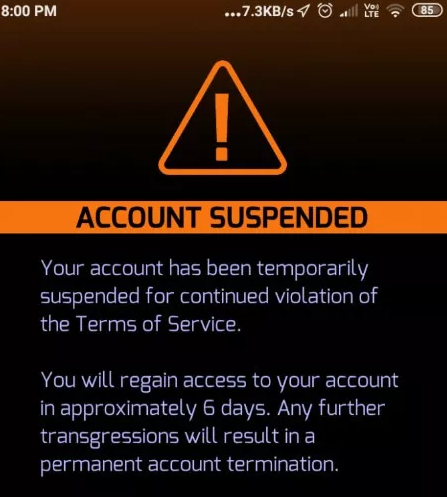
The consequences for detected ingress location spoofing are not uniform. Ingress Prime bans operate on a tiered system based on the severity and frequency of the violation. For any invested agent, losing an account with years of progress is a significant deterrent, making it critical to understand these penalties.
The Soft Ban: A Temporary Warning
A soft ban is a temporary restriction on your account’s ability to perform key in-game actions. It is the most common first warning that Niantic’s system has flagged your activity as suspicious.
Permanent Suspension: The End of Your Account
A permanent suspension is the final outcome for repeat offenders or agents engaged in blatant, persistent cheating. This action is generally reserved for accounts with a history of soft bans or those using methods that fundamentally harm the game for others. For any long-term player, this is the ultimate risk.
| Soft Ban | Permanent Suspension | |
| Type Symptoms & Triggers | Symptoms: Unable to hack portals (yields no items), deploy resonators, fire weapons, or create links/fields.
Likely Triggers: An impossibly fast location change (“teleporting”), even over a short distance. Typically lasts from 30 minutes to a few hours. It is an automated warning that resolves on its own. |
Symptoms: Complete and irreversible loss of account access, including all progress, badges, and inventory.
Likely Triggers: Repeat offenses after soft bans, using sophisticated cheating software, or behavior that fundamentally compromises game integrity. |
| Recovery | Typically lasts from 30 minutes to a few hours. It is an automated warning that resolves on its own. | Permanent and non-negotiable. Appeals are rarely successful. |
Analyzing Ingress Prime Fake GPS Methods: A Risk & Feasibility Guide
Agents searching for ingress prime fake gps techniques will find various methods, each with different levels of complexity and risk. Instead of providing instructions that could jeopardize your account, this section offers a risk-analysis framework to help you understand why these techniques are so likely to be detected.
| Fonelora Location Changer (Desktop Bridge) | Standard GPS Apps (Non-Root) | System-Level Modification (Root) | |
| Success Rate | High: System-Wide Override | Very Low | Variable |
| Technical Skill Required | Low: Masked via official developer protocols. | Low: Requires enabling Developer Options. | High: Rooting your device is complex, voids warranties, and can make it unusable if done incorrectly. |
| Safety Risk (Ban & Security) | Safe. No modification to phone system code. | High: Ingress is designed to detect Android’s “mock locations” feature. This is the easiest method for Niantic to flag, often resulting in an immediate soft ban. | Very High: Although harder for Niantic to detect directly, it does not protect against movement pattern detection. Additionally, rooting exposes your device to significant security vulnerabilities. |
Rooting your primary device is not recommended. Beyond the high risk of an Ingress ban, it can compromise the security of your personal data, including banking and messaging apps.
The Controlled Method: Deploying Fonelora Location Changer Safely
To safely adjust your location parameters without triggering immediate hardware-level blocks, you must completely avoid on-device “mock location” overlays.
Fonelora Location Changer operates as a secure desktop-to-mobile environment. Instead of running suspicious background apps on your phone, it utilizes official iOS and Android developer communication protocols to tell your entire mobile operating system that it is physically moving somewhere else. This eliminates “rubber-banding” and presents perfectly stable telemetry to Niantic’s client.
Why Fonelora Location Changer is Safer:
- Works on iOS and Android without rooting or jailbreaking.
- Compatible with modern devices (iOS 15–26, Android 11–16+).
- Provides smooth, human-like movement simulation, reducing detection risk.
- Allows temporary teleportation or controlled route movement with realistic speeds.
Step-by-Step Execution Guide:
Step 1: Install the Desktop Engine
Download and install the official Fonelora Location Changer application on your PC or Mac. Launch the dashboard.
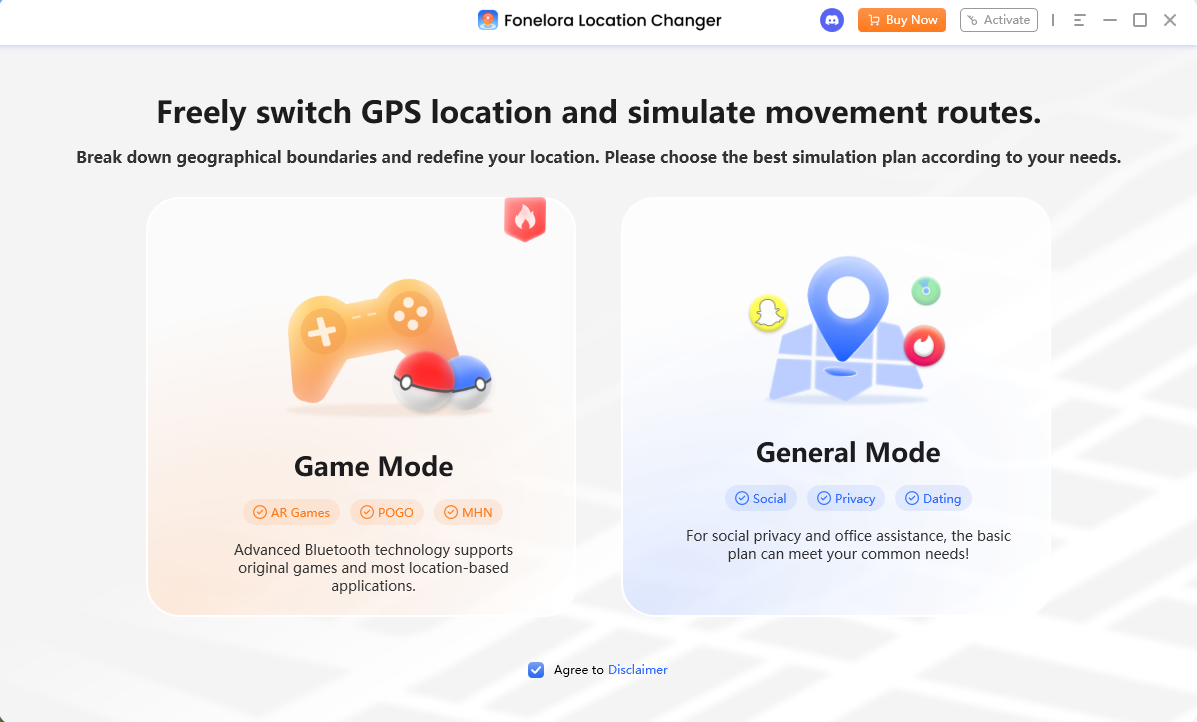
Step 2: Initialize the Secure Tether
Connect your primary mobile device to your computer via a reliable USB data cable.
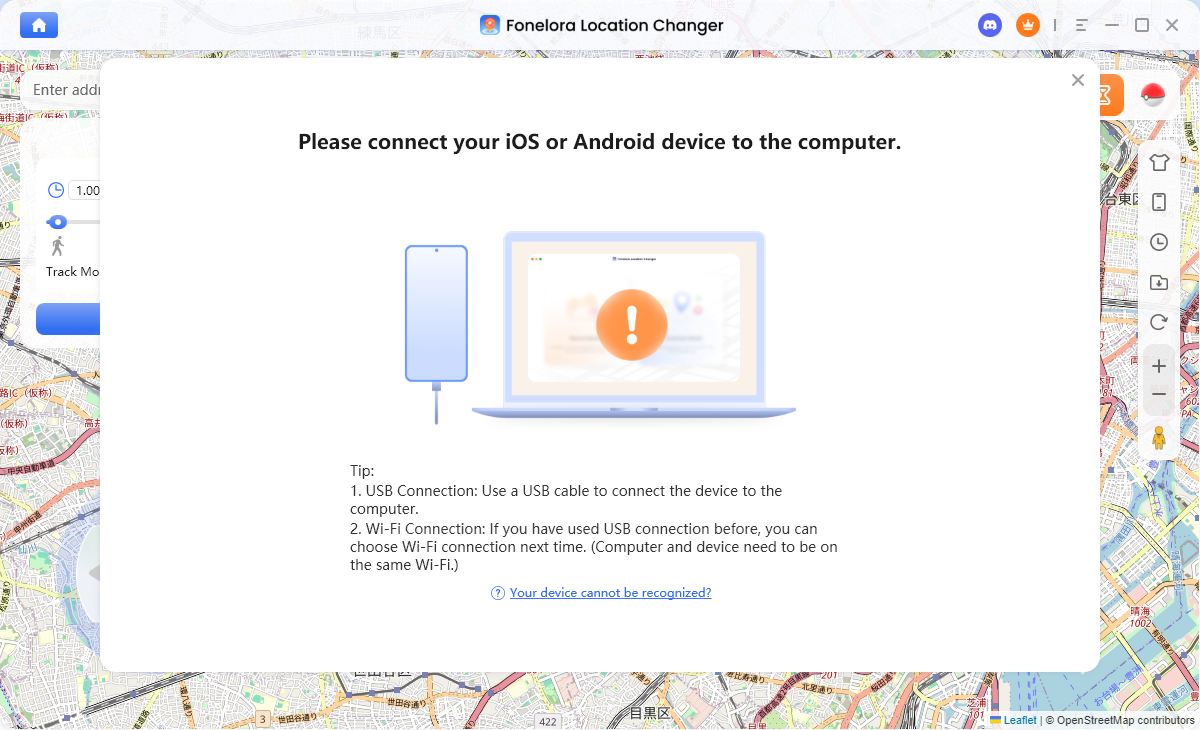
Step 3: Select Teleport Mode
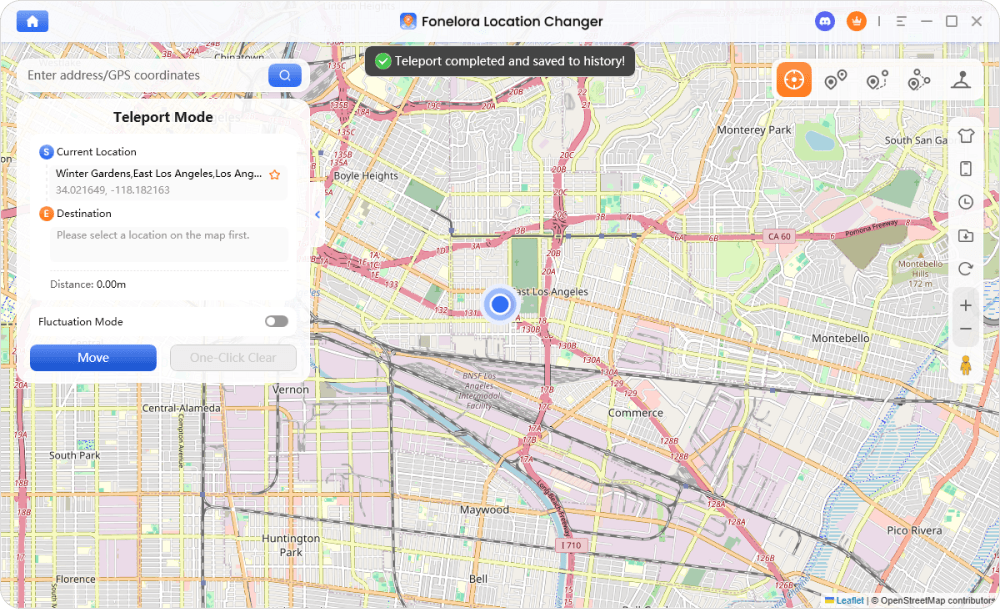
On the map interface dashboard, click on Teleport Mode (represented by the target sight icon in the upper right quadrant).
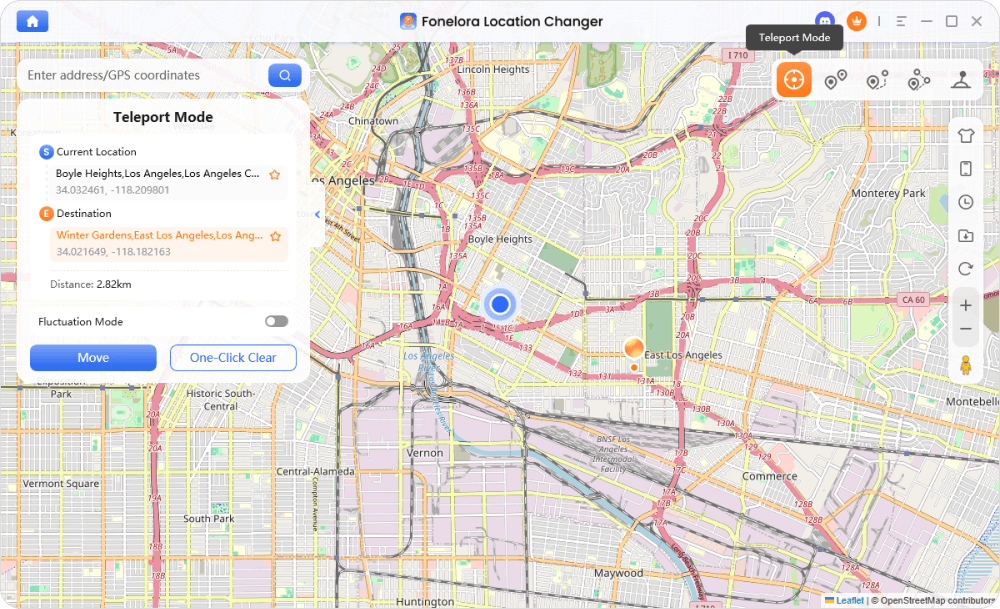
Step 4: Shift Your System Coordinates
Enter your desired target city or coordinates in the upper-left search parameters and click Move. Your device’s system-level GPS is now completely anchored to that new global vector.
Step 5: The Strategic Ingress Launch
Crucial: Ensure the Ingress Prime app was completely force-closed before step 4.
- Open your native device map (Apple Maps or Google Maps) to verify the blue location dot is solid, stable, and correctly positioned.
- Launch Ingress Prime. The server will read the coordinated system telemetry seamlessly.
Red Flags: Player Actions That Trigger Niantic’s Scrutiny
The software used for spoofing is only part of the equation. Many players fail to realize that Ingress Prime evaluates your behavior over time. Your movement pattern is often a more significant red flag than the tool itself. This is why some spoofers seem to succeed temporarily—they may be skilled at mimicking plausible movement, but long-term pattern analysis eventually leads to a ban.
1. Unrealistic Travel Speeds
The most common mistake is moving between two portals faster than is physically possible. Capturing a portal in one city and then another 500 miles away five minutes later is an instant trigger. The system logs the time and distance between every interaction. Sophisticated spoofers try to observe a “cooldown” timer, but even this can create a detectable pattern if repeated frequently.
2. Instantaneous Location Jumps (“Teleporting”)
This is the number one cause of a soft ban. Even short, instantaneous jumps are easily flagged. I’ve seen my own GPS drift cause a soft ban just by jumping my location across a highway interchange while driving. That’s how sensitive the system can be. The game’s server expects a continuous stream of location data that reflects realistic walking, biking, or driving speeds. A sudden discontinuity in this data stream is a clear sign of manipulation.
3. Non-Humanoid Movement Patterns
Real players don’t move in perfectly straight lines or at constant speeds. They stop, change direction, and exhibit minor GPS drift. Automated or poorly controlled ingress spoofing often creates unnaturally smooth or robotic movement. A dead giveaway for Niantic is setting a spoofed journey that cuts across a lake instead of following the road over the bridge. Their system compares your movement to map data, and moving at 30 mph over water is an obvious flag. Niantic’s movement pattern detection algorithms are specifically tuned to identify these inorganic patterns.
Legitimate Alternatives to Reach Inaccessible Portals
Let’s be direct: the reason many experienced agents look into this topic is frustration. There are portals on military bases, at the end of trails closed for the season, or in other genuinely inaccessible locations. Standard strategies don’t solve these problems.
While teamwork can’t get you to every single portal on the map, it is the only method within the Terms of Service that doesn’t put your account at risk. Before considering options that could lead to a ban, it’s worth mastering these risk-free, in-game mechanics.
Strategic Key Management and Farming
You don’t need to be physically present at a portal to use it for linking. The key is the solution.
- Plan Ahead: When you do visit a strategic but remote location, spend extra time farming multiple keys for that portal.
- Use Key Lockers: Key lockers from the in-game store are essential for large-scale operations. They allow you to hold hundreds of keys without them counting against your 2,000-item inventory limit.
Faction Teamwork and Coordination
Ingress was designed as a team game. Your faction is your single greatest asset for overcoming geographical challenges.
- Key Exchanges: Coordinate with teammates who live near or are traveling to areas with key portals. They can farm keys for you and transfer them via a Capsule drop at a location you can both access.
- Joint Operations: Plan fielding operations together. An agent in one state can clear blocking links while you, holding the keys, throw the long-distance links from your location. This collaborative play is the heart of successful strategy in location-based games.
Niantic continually updates its anti-cheat algorithms. The strategies discussed here—teamwork and planning—are future-proof and ensure your account’s long-term safety and your continued enjoyment of the game.
Ingress Prime Spoofing: Frequently Asked Questions
Here are direct answers to the most common questions about ingress spoofing.
1.Is spoofing possible in Ingress Prime?
While technical methods to manipulate GPS data exist, they carry an extremely high risk of detection and are a direct violation of the game’s rules. Niantic’s anti-cheat systems are mature and effective at identifying and penalizing this activity.
2.How does Niantic detect spoofing in Ingress?
Niantic uses a multi-layered system. It includes analyzing your movement patterns for impossible speeds or trajectories, checking for signs of mock location software, and performing server-side validation of your in-game actions against physical possibility.
3.Are bans permanent or temporary in Ingress Prime?
Both exist. A “soft ban” is a temporary restriction on gameplay (e.g., you cannot hack or fire weapons) that serves as a warning. A permanent suspension is a complete and irreversible termination of your account, reserved for repeat or severe offenses.
4.Why do some players seem to spoof without consequences?
Some cheaters may avoid immediate detection by carefully mimicking realistic human movement and observing cooldown times. However, Niantic analyzes data over the long term. What appears to be successful spoofing is often just a temporary state before an eventual ban is enforced based on cumulative evidence.
5.Is Ingress Prime harder to spoof than other Niantic games?
Yes. As Niantic’s original location-based game, Ingress has benefited from over a decade of anti-cheat development. Its detection mechanisms are widely considered more mature and stringent than those in some of their other titles.
6.What actions increase the risk of being flagged?
The biggest red flags are unrealistic travel speeds, instantaneous location jumps (“teleporting”), and repetitive, non-humanoid movement patterns, such as moving in perfectly straight lines or across bodies of water.
7.Are there legitimate alternatives to spoofing in Ingress?
Absolutely. The game is designed around strategic teamwork. Using key lockers to store portal keys for future links, coordinating with faction members for key exchanges, and planning trips are the intended and safest methods to achieve large-scale goals.
Conclusion
The desire to engage with high-value, geographically locked portals is completely understandable within the competitive ecosystem of Ingress Prime. However, trying to cheat the system using unstable mobile apps or unverified software is a definitive path to losing your agent history.
If you choose to manipulate your coordinate data, you must treat it as a technical operation: align your system-level metrics cleanly using a secure desktop bridge like Fonelora Location Changer, strictly enforce real-world travel cool-downs, and mimic organic human behavior. By respecting the telemetry of the grid and understanding the algorithms governing it, you can safely project your strategic intent exactly where it matters most to your faction.
More Related Articles



Joy Taylor is a seasoned technical writer with over a decade of experience in mobile technology. At iMobie, she specializes in producing in-depth content on iOS data recovery, iPhone unlocking solutions, and iOS troubleshooting.
Product-related questions? Contact Our Support Team to Get Quick Solution >
