Monster Hunter Affinity Meaning: Your Guide to Critical Hits
Struggling with the Monster Hunter affinity meaning? This guide explains what affinity is, how it works, and how to choose attack vs. affinity for max damage.
You’re standing at the smithy, trying to make sense of the endgame. In front of you are two powerful weapons. One has massive raw attack power but a glaring negative affinity. The other has lower attack but a high, positive affinity. The frustration is real. You search for the monster hunter affinity meaning but find only confusing wikis or overly technical videos. You need a clear, practical answer to make the right choice and not waste your hard-earned resources.
This guide provides that answer. We will break down Monster Hunter affinity explained into simple terms with clear, numerical examples. This guide is based on hundreds of hours of in-game testing in Monster Hunter World: Iceborne on PC and PlayStation 5, updated for builds. The principles and calculations discussed here have been verified against dozens of endgame weapon and armor combinations to ensure their accuracy for practical build optimization.
What Does Affinity Do in Monster Hunter World? A Simple Explanation
Let’s get straight to the solution: Affinity is your critical hit chance, expressed as a percentage. If a weapon has 20% Affinity, it has a 20% chance to land a critical hit every time you strike a monster.
By default, a critical hit in Monster Hunter applies a damage multiplier of 1.25x, which is a 25% damage increase for that specific attack. You can easily spot a critical hit in-game by the distinct, bright red slash effect that appears on impact.
Here is a simple numerical example to make it concrete:
- Normal Hit: Your attack normally deals 100 damage to a monster.
- Critical Hit: That same attack now has a chance to deal 125 damage (100 x 1.25).
While a 25% boost on a single hit might seem minor, it adds up tremendously over a hunt, especially with fast-attacking weapons. Understanding this simple mechanic is the first step toward effective build optimization.
Learn More:Monster Hunter Now Builds: The Guide to Weapon and Armor Synergy >
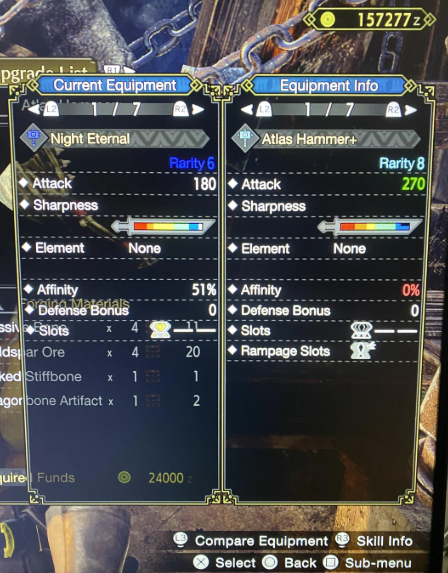
Negative Affinity Monster Hunter Explained: The Damage Penalty
Just as positive affinity provides a bonus, negative affinity introduces a risk. Negative Affinity is the percentage chance to land a “Feeble Hit.” A Feeble Hit is the opposite of a critical hit, identified by a dull, purple-blue impact effect.
This negative affinity penalty applies a damage multiplier of 0.75x, meaning the attack deals 25% less damage than it normally would. This is a critical factor when considering powerful weapons that are often balanced with negative affinity. The high raw attack can be tempting, but the inconsistent damage must be managed.
Let’s use our 100-damage attack example again to illustrate the difference:
- Normal Hit: Deals 100 damage.
- Critical Hit (Positive Affinity): Deals 125 damage.
- Feeble Hit (Negative Affinity): Deals only 75 damage (100 x 0.75).
A weapon with -30% Affinity will, on average, weaken nearly one-third of your attacks. However, as we’ll cover next, negative affinity is not a deal-breaker; it’s a problem that can be solved with the right skills and augments.
Learn More:The Best Weapon in Monster Hunter World: A Complete Guide >
Affinity vs. Attack Power: A Practical Guide to Choosing Your Weapon
This is the core dilemma for many hunters: is high raw attack better than high Monster Hunter critical hit chance affinity? The answer lies in calculating the Expected Average Damage per hit. This simple weapon stats explanation reveals how attack vs affinity scaling truly works.
The critical damage formula for average damage is:
Attack * (1 + (Affinity Percentage * Critical Damage Modifier))
The modifier is +0.25 for a standard critical hit and -0.25 for a feeble hit. Let’s compare two hypothetical Great Swords:
- Weapon A (Diablos Tyrannis II): 230 Attack, -30% Affinity
- Weapon B (Jagras Hacker III): 200 Attack, +20% Affinity
To show our work, let’s break down the calculation for the Diablos weapon. We convert the -30% affinity to -0.30 and multiply it by the negative modifier of 0.25.
230 * (1 + (-0.30 * 0.25)) = 230 * (1 – 0.075) = 230 * 0.925 = 212.75
Now, let’s see how they stack up in a simple table:
| Weapon | Raw Attack | Affinity | Average Damage Calculation | Result (Avg. Damage) |
| Diablos Tyrannis II | 230 | -30% | 230 * (1 + (-0.30 * 0.25)) | 212.75 |
| Jagras Hacker III | 200 | +20% | 200 * (1 + (0.20 * 0.25)) | 210.00 |
Initially, the high-attack Diablos weapon wins out slightly. However, this is before factoring in skills. This is where many hunters make a mistake—judging a weapon by its base stats alone.
The Real Difference: How Skills Change Everything
The previous calculation was just the first step. Now, let’s prove why building around affinity is so powerful. We’ll give both weapons a standard, achievable endgame skill package: Weakness Exploit 3 (+50% affinity on weak spots) and Critical Boost 3 (critical hits now deal +40% damage instead of +25%).
Here’s how their stats transform when hitting a tenderized weak spot:
- Weapon A (Diablos): -30% + 50% = 20% Final Affinity. Criticals now deal 1.40x damage.
- Weapon B (Jagras): +20% + 50% = 70% Final Affinity. Criticals now deal 1.40x damage.
Let’s re-run the numbers with our new critical damage modifier of +0.40.
| Weapon | Base Attack | Final Affinity (with WEX 3) | Average Damage Calculation (with Crit Boost 3) | Result (Avg. Damage) |
| Diablos Tyrannis II | 230 | 20% | 230 * (1 + (0.20 * 0.40)) | 248.40 |
| Jagras Hacker III | 200 | 70% | 200 * (1 + (0.70 * 0.40)) | 256.00 |
Suddenly, the tables have turned. The “weaker” Jagras weapon now consistently outperforms the Diablos weapon because its high base affinity synergizes far more effectively with essential damage skills. This framework doesn’t just give you an answer; it empowers you to make your own data-driven decisions for any weapon in your arsenal.
Learn More:Monster Hunter Now Joystick: The Ultimate Guide to Playing Without Walking >
How to Maximize Damage: Combining Affinity with Key Skills
Understanding affinity is the first step; unlocking its true power is the next. A core insight for high-level play is that affinity’s value grows exponentially when combined with skills that enhance critical hits.
The Critical Boost Skill
The single most important skill for any affinity-focused build is Critical Boost. It directly increases the damage multiplier of your critical hits.
- Default: Critical hits deal +25% damage (1.25x multiplier).
- Critical Boost Level 1: Critical hits deal +30% damage (1.30x multiplier).
- Critical Boost Level 2: Critical hits deal +35% damage (1.35x multiplier).
- Critical Boost Level 3: Critical hits deal +40% damage (1.40x multiplier).
At max level, Critical Boost dramatically increases the value of every point of affinity, making it a cornerstone of any damage-focused build.
The Weakness Exploit Skill
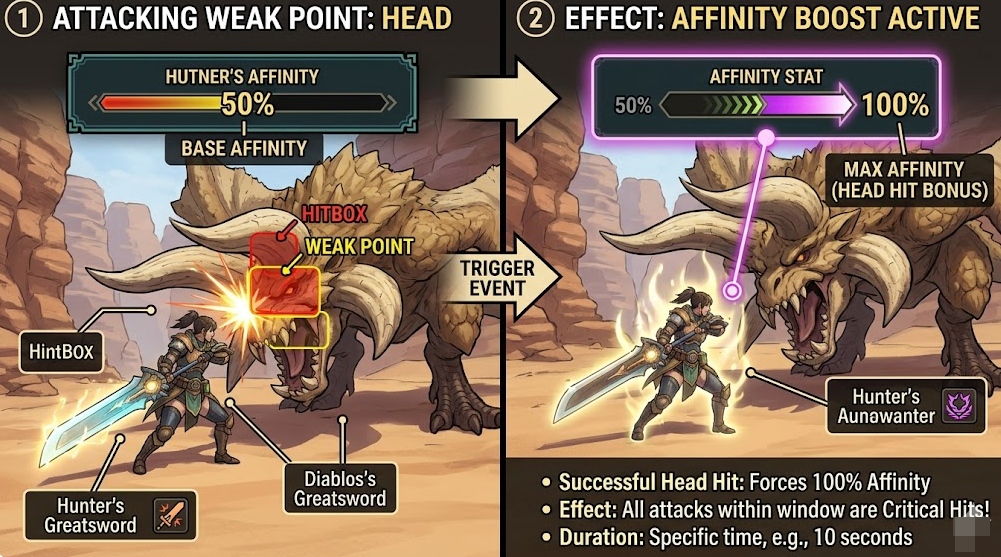
While some skills provide a flat affinity bonus, Weakness Exploit rewards skillful play. This skill grants a massive, conditional affinity bonus when you attack a monster’s weak point (where you see orange damage numbers).
At Level 3, Weakness Exploit provides +50% Affinity on tenderized weak spots. This technique allows you to reach the affinity cap mechanics of 100% on the most important hits without dedicating all your armor slots to permanent affinity skills.
Learn More:The Ultimate Diablo Monster Hunter Guide >
How Do I Increase Affinity in MHW?
Now that you understand its importance, here are the primary methods for increasing your weapon’s affinity and turning a good build into a great one.
Key Armor Skills
Your main source of affinity will come from skills on armor pieces and decorations.
- Critical Eye: The most direct method. It provides a flat, unconditional boost to your affinity, up to +40% at Level 7.
- Weakness Exploit: A core skill for almost every endgame build, providing up to +50% affinity on tenderized weak points.
- Agitator: Activates when a monster is enraged, granting a bonus to both Attack and Affinity. An incredibly efficient skill.
- Maximum Might: Grants an affinity bonus when your stamina is full. This is a great choice for weapons that don’t constantly drain stamina.
Weapon Augments
In the endgame, you can use the augmentation system at the smithy to directly modify your weapons. You can add Affinity augments, which typically provide +10% for the first level. This is the best technique for canceling out a weapon’s innate negative affinity.
Armor Set Bonuses
Certain armor sets provide powerful bonuses that synergize with high-affinity builds. The most famous is Master’s Touch from the Teostra armor, which prevents your weapon from losing sharpness on a critical hit, massively boosting your damage uptime.
Pro-Tip: Efficiently Finding Rare Materials with Fonelora
Optimizing your affinity is only half the battle; you also need to find the right monsters to farm for those critical materials. For hunters looking for a more flexible way to manage their location and discover rare spawns globally, we recommend Fonelora Location Changer.
Product Overview Fonelora Location Changer is a secure GPS solution for iOS and Android that allows users to instantly change their device’s coordinates without jailbreak or root. It features a Safe Game Mode that simulates realistic movement patterns—essential for reducing risks in location-based apps. With its built-in 360° GPS joystick and support for multiple movement speeds, it provides a smooth, realistic navigation experience for exploring global content and protecting your privacy.
How to Use Fonelora Location Changer (Step-by-Step Guide)
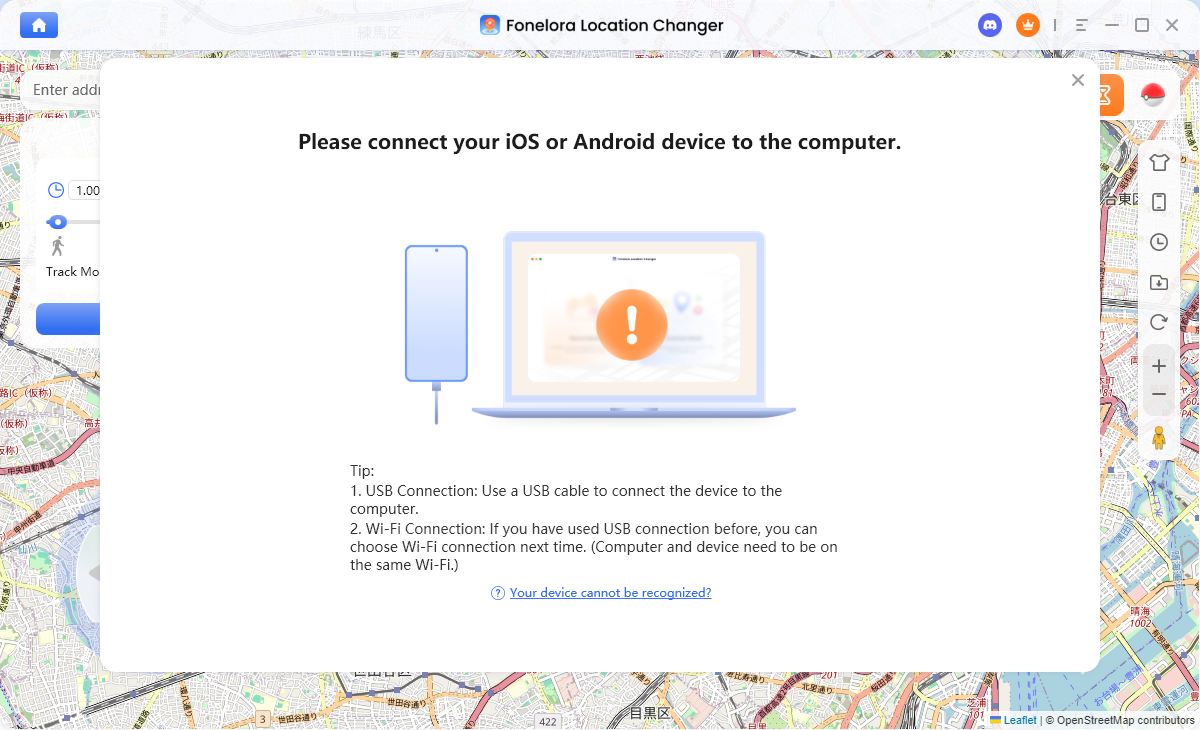
- Step 1: Connect Your Device Launch Fonelora on your computer and connect your phone via USB or Wi-Fi.
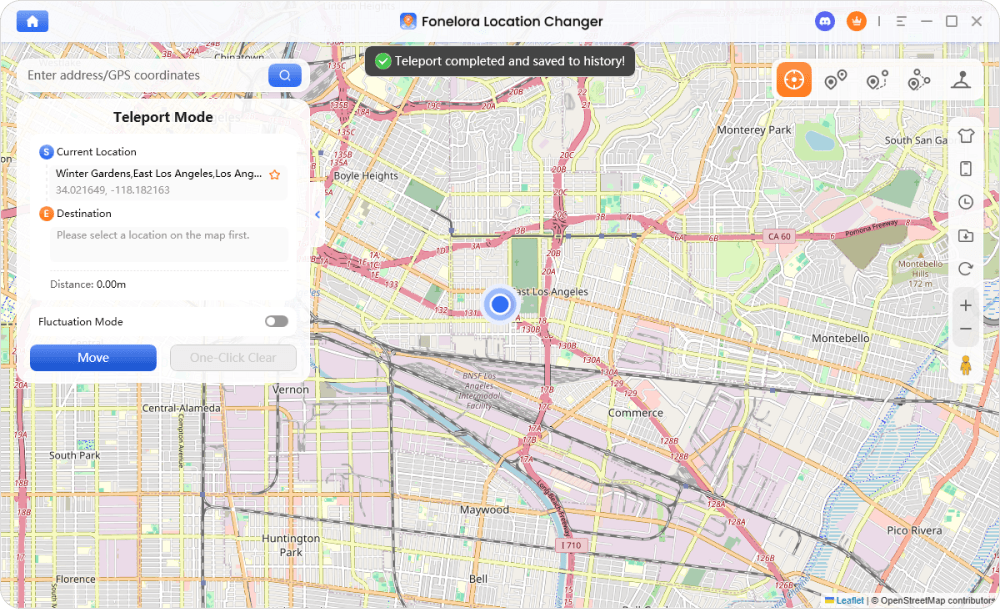
- Step 2: Choose a Location Mode Select Teleport Mode for instant changes or Multi-Spot Mode to simulate a natural hunting route.

- Step 3: Change Your GPS Location Enter your target coordinates and click “Move” to update your location across all apps instantly.
Frequently Asked Questions About MHW Affinity
Here are concise answers to the most common questions about affinity in Monster Hunter.
What does affinity mean in Monster Hunter?
Affinity is your critical hit chance, represented as a percentage. For example, 30% Affinity means you have a 30% chance of landing a critical hit.
How does affinity affect damage?
A standard critical hit deals 25% more damage (a 1.25x multiplier). This bonus can be increased to +30%, +35%, or +40% with the Critical Boost skill.
What does negative affinity do in Monster Hunter?
Negative affinity is the chance to land a “Feeble Hit,” which deals 25% less damage (a 0.75x multiplier). It is a damage penalty used to balance weapons with extremely high raw attack power.
Should I choose attack or affinity?
It depends on the specific numbers and the skills you plan to use. As our guide demonstrates, a weapon with positive affinity is often easier to optimize with skills to achieve higher overall damage, even if its base attack is lower. Always calculate the “Expected Average Damage” with your target skills included.
What is the best affinity percentage to aim for?
For optimal builds, the goal is to reach 100% affinity on monster weak points. This ensures every hit on a prime location gets the full damage bonus from skills like Critical Boost, which is the cornerstone of the best affinity percentage MHW builds.
How do I increase affinity in Monster Hunter World?
You can increase affinity through three primary methods: Armor Skills (like Critical Eye and Weakness Exploit), Weapon Augments at the smithy, and specific Armor Set Bonuses.
This guide is regularly updated to reflect new game patches and meta shifts, ensuring the advice remains accurate for your current hunts.
Master Your Build, Master Your Hunt
Understanding the MHW affinity meaning transforms you from a confused hunter into a confident strategist. You no longer have to guess at the smithy; you now have the tools and the framework to calculate a weapon’s true potential. You’ve seen how a weapon that looks weaker on paper can become a powerhouse with the right skills.
This knowledge removes the fear of making inefficient choices and wasting valuable materials. It puts you in full control of your build and, ultimately, your hunt. Go back to that smithy, apply what you’ve learned, and forge the weapon that will truly carry you to victory. Happy hunting



Joy Taylor is a seasoned technical writer with over a decade of experience in mobile technology. At iMobie, she specializes in producing in-depth content on iOS data recovery, iPhone unlocking solutions, and iOS troubleshooting.
Product-related questions? Contact Our Support Team to Get Quick Solution >
