MSM Download Tool Guide: Package Matching, OnePlus EDL & Common Errors
MSMDownloadTool.exe is only one part of a device-specific recovery package. The exact phone model, region, firmware build, drivers, and recovery purpose matter more than simply finding the newest EXE. This guide explains OnePlus EDL recovery, package matching, download checks, and common MSM Tool errors.
Search results often make MSM Download Tool look like one Windows application with a single “latest version.” In practice, that is the wrong place to start.
An archive may contain the familiar MSMDownloadTool.exe, but the executable is only one part of a recovery package. The firmware images, configuration files, drivers, regional settings, and service requirements around it may have been prepared for one particular phone and software branch. A device can connect successfully and still be paired with the wrong package.
Before asking which MSM Tool version is newest, ask a more useful question: Was this complete package built for my exact model, region, and recovery situation? The sections below explain how to answer that question, how a OnePlus EDL recovery workflow is typically structured, and how to interpret errors such as Waiting for Device, image mismatch, timeout, or login prompts.
Do You Actually Need MSM Download Tool?
MSMDownloadTool is most relevant to a device-specific firmware recovery job. It is usually not the first tool to choose simply because an Android phone is locked, asks for a Google Account, or needs a normal software update.
| Your Situation | Is MSM Tool a Good Starting Point? | Why |
| A compatible OnePlus phone cannot boot after a software failure | Possibly | A matching stock recovery package may be relevant. |
| MSM Tool says “Images do not match with the phone” | Do not flash yet | Recheck the model, region, carrier variant, and package build. |
| MSM Tool stays on Waiting for Device | Not a firmware problem yet | Driver, cable, USB port, or EDL connection must be fixed first. |
| The phone boots normally but you forgot the PIN or pattern | Usually no | This is primarily a screen-lock problem, not an unbrick job. |
| The phone asks for a previously synced Google Account after reset | Usually no | This is an FRP/account-verification problem. |
| An OPPO phone only needs a normal supported update | No | Use the manufacturer-supported update route first. |
What Is MSM Download Tool?
MSM Download Tool is a name commonly used for Windows-based recovery and flashing utilities bundled inside certain device service packages. It is especially familiar in older OnePlus recovery discussions and other device-specific Qualcomm service workflows.
The key phrase is device-specific package. MSMDownloadTool.exe does not work in isolation. A recovery archive may also contain:
- Firmware images intended for a specific phone.
- Package configuration files.
- USB or Qualcomm driver requirements.
- Regional or carrier-specific software content.
- Service settings associated with that recovery build.
- Login or authorization requirements in some packages.
Think of the EXE as the control panel for the package, not as the entire recovery product. Copying a newer MSMDownloadTool.exe into an older firmware folder does not automatically upgrade compatibility because the files surrounding the executable may still belong to another device.
MSMDownloadTool Is Not a Universal Android Utility
A firmware recovery job, a forgotten screen PIN, and Google verification after a factory reset are different problems. They should not all begin with the same software simply because an MSM Tool download appears in search results.
Start by identifying the device state. If the phone cannot boot after a software failure, firmware recovery may be relevant. If Android boots normally and only the local password is forgotten, use a screen-lock recovery route. If setup asks for an old Google Account after reset, treat it as FRP.
What Is MSM Tool Actually Used For?
The clearest MSMDownloadTool use case is restoring a compatible device with a recovery package created for that exact device.
For a matching model and documented recovery build, MSM recovery may be useful when the phone:
- Cannot boot normally after a software failure.
- Is stuck in a software-related boot loop.
- Needs to be returned to the stock software contained in a specific recovery archive.
- Requires the low-level recovery connection documented for that model.
Even then, do not assume every boot loop needs EDL flashing. Battery faults, storage failure, physical damage, a bad update, or a recoverable Android system problem can produce similar symptoms. Before choosing a destructive firmware recovery route, the Android boot loop troubleshooting guide can help separate a general boot problem from a true unbrick scenario.
What About FRP?
MSMDownloadTool should not be treated as a generic FRP bypass utility. If the phone has already been factory reset and now asks for a previously synced Google Account, the immediate problem is Google verification rather than finding another firmware package.
For that situation, compare dedicated Android FRP tool options and identify the actual lock state before reflashing the operating system.
Where to Get MSM Download Tool
Do not begin by downloading an isolated MSMDownloadTool.exe simply because its version number is larger. Start with a recovery resource tied to the exact device and recovery purpose.
For a OnePlus Recovery Package
Look for a recovery discussion or package that explicitly names the OnePlus model and variant. For example, the OnePlus Community has a device-specific MSM recovery thread associated with the OnePlus 6T:
OnePlus 6T MSMDownloadTool recovery thread
The important point is not merely that the page mentions MSM Tool. It is that the recovery information is tied to a specific device generation. A OnePlus 6T package should not automatically be used for a OnePlus 7, Nord, 8-series phone, or another regional variant.
For a Normal OPPO Software Update
If an OPPO phone starts normally and only needs a supported software update, use the normal manufacturer route instead of introducing an unrelated low-level recovery archive:
OPPO System Upgrade Tool / ColorOS Assistant
A normal operating-system update and an EDL recovery job are different tasks. Using a low-level service package when the phone only needs an ordinary update adds risk and complexity without solving a matching recovery problem.
Five Checks Before Running MSMDownloadTool.exe
1. Check the model code. A commercial phone name may cover more than one hardware or regional variant.
2. Check the region or carrier version. Global, Indian, European, Chinese, and carrier-specific packages should not be assumed to be interchangeable.
3. Check the package build. Identify which software branch and firmware images are included in the archive.
4. Check the recovery purpose. Confirm that the package was intended for the device state you are trying to repair.
5. Keep the package intact. Avoid mixing the EXE, firmware images, configuration files, drivers, or license-related files from several unrelated archives.
MSM download rule: choose a recovery package because the device information matches, not because the EXE has the highest version number.
What About MSM Tool 4.0.58, 4.0.59, 5.0.15, or Other Builds?
Those version numbers can matter after you have already identified the correct device package. They are much less useful when comparing archives intended for different phones.
An older MSMDownloadTool build bundled with the correct firmware can be more appropriate than a numerically newer executable extracted from another model’s recovery archive. For MSM packages, latest and correct are not the same thing.
How a OnePlus MSM/EDL Recovery Workflow Works
The workflow below describes the general pattern found in device-specific OnePlus MSM recovery packages. It is not a universal procedure for every OnePlus phone. Always follow the instructions supplied for the exact model and archive.
Step 1. Verify the Package
Step 1. Confirm the full OnePlus model name and model code.
Step 2. Check the region or carrier variant.
Step 3. Confirm that the recovery source explicitly refers to that phone.
Step 4. Read the expected data-loss result before continuing. A full stock recovery flash should generally be approached as a data-erasing operation.
Step 2. Prepare the Windows PC
Step 1. Extract the complete recovery archive into its own folder.
Step 2. Install the driver specified by the recovery instructions.
Step 3. Use a stable, data-capable USB cable and a direct USB port on the computer.
Step 4. Do not mix files from multiple MSM recovery archives during initial setup.
Step 3. Open the MSM Package
Step 1. Open the extracted recovery folder.
Step 2. Launch the MSMDownloadTool executable included with that exact package.
Step 3. Follow any package-specific startup, account, or authorization instructions supplied by the source.
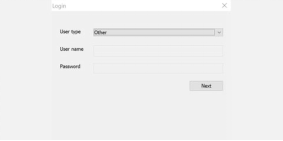
Open the MSMDownloadTool included with the matching recovery package.
Step 4. Connect the Phone in the Required Recovery Mode
Step 1. Power off the phone if the recovery procedure instructs you to do so.
Step 2. Follow the low-level connection sequence documented for the exact model.
Some older OnePlus MSM guides use a powered-off device and a volume-key connection sequence, but do not assume one button combination works across every OnePlus generation.
Step 3. Connect the phone with the timing described in the device-specific instructions.
Step 4. Watch both Windows and MSM Tool for the expected connection state.
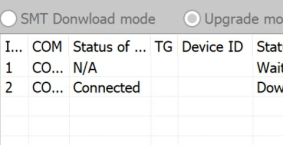
Do not start recovery until the phone is detected in the expected state.
Step 5. Confirm Detection and Package Matching
Step 1. Confirm that the phone appears in MSM Tool.
Step 2. Recheck that the recovery package belongs to the exact device and region.
Step 3. Do not treat successful USB detection as proof that the firmware images are compatible.
Communication and package compatibility are separate checkpoints. A phone can communicate correctly with the computer while still being paired with the wrong recovery content.
Step 6. Run the Recovery
Step 1. Start the operation only after the package match has been verified.
Step 2. Keep the USB connection stable during the active recovery process.
Step 3. Read the final status reported by the tool.
Step 4. If the operation fails, save the exact error text before changing the driver, cable, EXE, firmware package, or version.
Step 5. After a successful operation, follow the model-specific restart and first-boot instructions.
MSM Download Tool Errors: Check the Failure Before Changing Versions
The least useful troubleshooting approach is changing the EXE, driver, firmware, USB cable, and region package all at once. Each common MSM error points to a different layer of the recovery process.
MSM Download Tool Does Not Detect the Phone
Treat this as a connection problem first. Check:
- Whether Windows shows the expected device interface.
- Whether the required USB or Qualcomm driver is installed.
- Whether the cable supports stable data transfer.
- Whether the USB port is reliable.
- Whether the device entered the required low-level connection state.
- Whether the key sequence and connection timing match the exact model instructions.
Changing firmware packages does not fix a device that has never established the expected USB connection.
“Images Do Not Match with the Phone”
This error should send you back to package identity, not to another random download.
Recheck:
- The exact phone model.
- The regional variant.
- The carrier version.
- The recovery software branch.
- Whether the archive belongs to another OnePlus generation.
Do not force a package simply because its phone name is similar to yours.
MSM Tool Stays on “Waiting for Device”
The application is open, but the expected communication state has not been established. Recheck the driver, USB cable, port, key sequence, and connection timing before investigating firmware compatibility.
Connection Timeout or Repeated Disconnects
If the device repeatedly appears and disappears, start with the physical connection and driver layer. A weak cable, unstable port, driver conflict, or inconsistent EDL connection can interrupt recovery before the firmware package becomes the main issue.
If the disconnect always occurs at the same stage while USB communication remains stable, preserve the error text and return to package compatibility rather than repeatedly clicking Start.
MSMDownloadTool.exe Asks for Login or Authorization
Not every MSM package behaves the same way. Some service packages or recovery environments may require authorization.
Do not assume that a patched EXE, “None Lic” file, or license-related file copied from another archive is compatible with the package you are using. Authorization behavior belongs to the package context, and mixing unrelated files introduces another source of mismatch.
The Tool Finishes but the Phone Still Does Not Boot
Keep the final status and any available log. Then check:
- Whether the package actually belonged to the device.
- Whether the process reported a genuine successful completion.
- Whether the phone may have a hardware rather than software fault.
- Whether the device-specific instructions require another step after recovery.
A completed-looking progress screen does not prove that every underlying phone problem was caused by software.
Why the “Latest MSM Download Tool Version” Can Be Misleading
Search demand for the latest MSM Download Tool version is understandable because ordinary software is usually updated by installing the newest release. MSM recovery packages work differently because the executable is only one component of the archive.
Consider two packages:
- Package A: an older MSMDownloadTool build bundled with firmware for the exact phone and region.
- Package B: a newer MSMDownloadTool build extracted from a recovery package intended for another device.
Package B has the larger version number. Package A can still be the correct recovery package.
Can You Replace Only MSMDownloadTool.exe?
Do not assume that swapping the executable is supported. The EXE, configuration, firmware images, and package behavior may be designed to work together. If a device-specific recovery source provides one complete archive, preserve that package unless the same source explicitly documents another configuration.
Can You Use an OPPO MSM Package on OnePlus or Realme?
Do not decide package compatibility from brand relationships or Qualcomm hardware alone. Firmware images remain device-specific. Two phones using Qualcomm chipsets do not automatically have interchangeable recovery packages.
Match the Tool to the Actual Phone Problem
Your Phone Is Stuck in a Software Boot Loop
MSM recovery may be relevant when a verified recovery package exists for the exact device and the failure is genuinely software-related. If the cause is still unclear, diagnose the boot-loop problem before committing to a full low-level flash.
Your OPPO Phone Only Needs a Normal Update
Use the manufacturer-supported update path. Do not turn an ordinary system update into an EDL recovery task unless the actual phone state requires that level of recovery.
Your Phone Shows Google Verification After a Factory Reset
This is an FRP problem. Start with account recovery and FRP-specific options instead of assuming the device requires a complete stock-firmware recovery package.
Your Phone Boots Normally but You Forgot the PIN
If Android reaches the lock screen normally, the phone is not being recovered from a failed firmware state. EDL recovery adds package matching, low-level USB communication, firmware replacement, and data erasure to a problem that began as a local screen credential.
If the Phone Boots but the Password Is Forgotten
For a phone that boots normally and only has a forgotten PIN, pattern, or password, start with the screen-lock category instead of MSMDownloadTool. The Android phone unlocking software guide explains the difference between screen-lock, FRP, SIM-lock, and other unlock-tool scenarios.
For supported Android devices, DroidKit Screen Unlocker provides a separate computer-based workflow. It is not an alternative to a genuine MSM unbrick procedure; it is relevant only when the phone itself boots and the main problem is the local screen lock.
How a Screen Unlock Workflow Differs
Step 1. Open DroidKit on the computer and select Screen Unlocker.
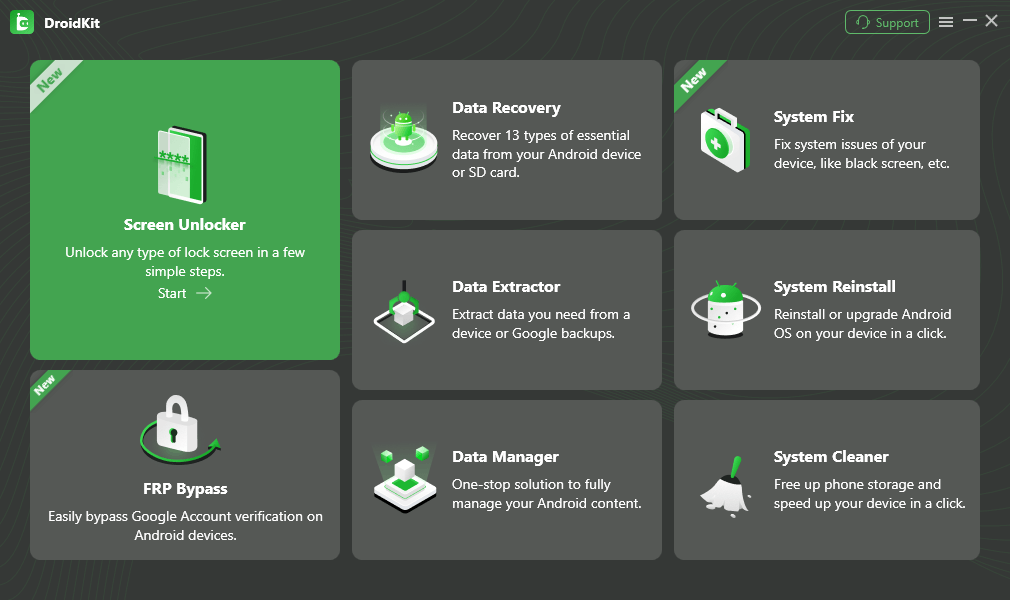
Choose Screen Unlocker for a local screen-lock problem.
Step 2. Connect the locked Android phone with a data-capable USB cable and begin the workflow.
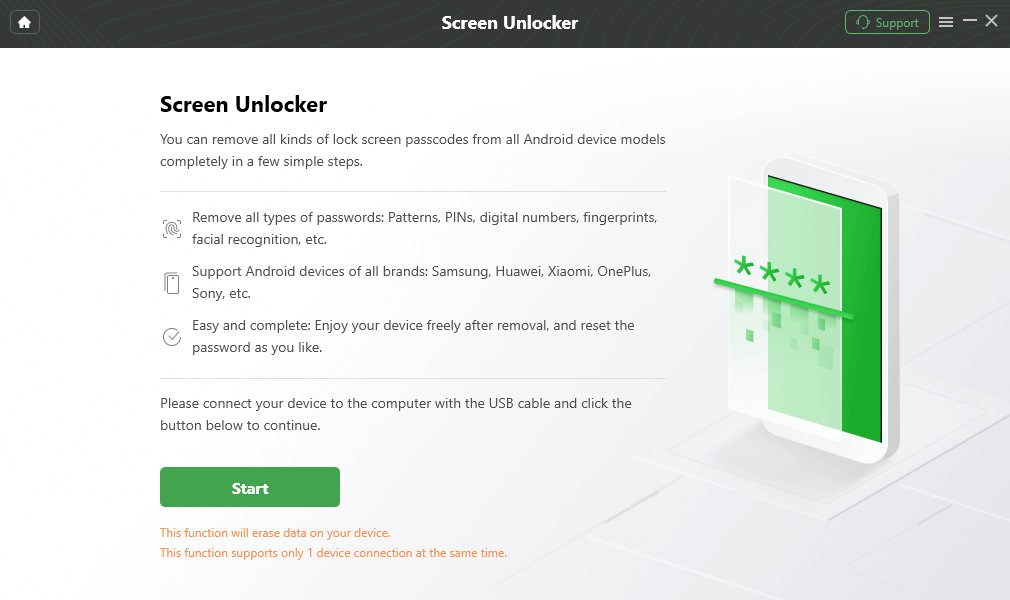
Connect the phone for the screen-lock workflow.
Step 3. Follow the instructions for the detected device route and review the expected data-loss result before continuing.
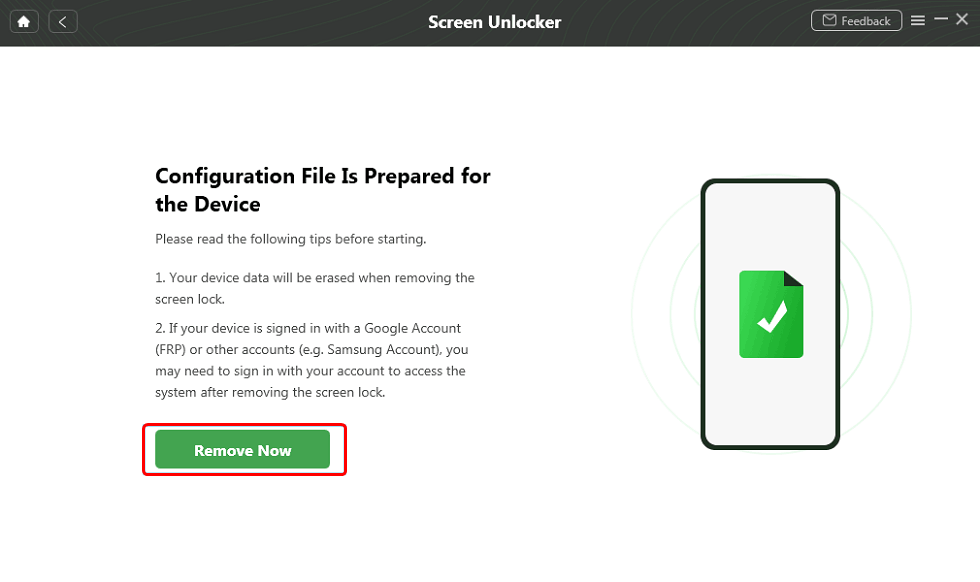
Continue with the device-specific screen-lock instructions.
Screen-lock removal can erase device data depending on the supported route. The important distinction for an MSM visitor is that stock-firmware recovery and local password removal are not the same repair job.
FAQs About MSM Download Tool
Is MSMDownloadTool.exe enough to recover a phone?
No. The executable is only one part of a device recovery package. The firmware images, configuration files, target model, regional variant, drivers, and service requirements also need to match.
Where should I get MSM Download Tool?
Start with a recovery source tied to the exact phone and problem rather than downloading an isolated EXE. For OnePlus recovery, look for a model-specific package or discussion. For a normal supported OPPO update, use the manufacturer’s normal update route.
What is the latest version of MSM Download Tool?
The highest version number is not automatically the right package. An older MSMDownloadTool build bundled with recovery content for the exact model can be more appropriate than a newer executable taken from another device archive.
Can I use one OnePlus MSM Tool package on another OnePlus model?
Do not assume so. Check the exact model, region, carrier variant, and recovery build. The same MSMDownloadTool filename does not make firmware images interchangeable.
Why does MSM Tool show “Images do not match with the phone”?
Recheck package selection. The message can indicate a mismatch involving the phone model, regional variant, carrier version, or recovery build. Do not try to force the package through the error.
Why does MSM Tool stay on Waiting for Device?
The expected communication state has not been established. Check the USB driver, cable, USB port, recovery-mode sequence, connection timing, and whether the instructions belong to the exact phone.
Why does MSMDownloadTool ask for login or authorization?
Package behavior varies, and some service workflows may require authorization. Follow the requirements documented for that package instead of copying patched executables or license-related files from unrelated archives.
Does MSM Download Tool erase data?
A full stock recovery flash should generally be approached as a data-erasing process. The package can restore the phone to the software state contained in the recovery build, so MSM Tool should not be selected as a no-data-loss password recovery method.
The Package Matters More Than the EXE Version
With MSMDownloadTool, an identical executable name can appear inside very different recovery packages. One archive may belong to a specific OnePlus model and region, another may contain a different firmware branch, and a third may require a service condition that does not apply to your phone.
When MSM Tool cannot see the device, troubleshoot the connection layer. When the images do not match, stop and verify the package. When the program requires authorization, investigate the requirements of that specific archive. Do not answer every MSM error by searching for a larger version number.
For MSM recovery, the useful question is not “Which EXE is newest?” It is “Does this complete recovery package belong to this exact phone?”
More Related Articles


Roger Smith is a senior technical writer with years of experience in providing Android solutions. He loves to help users solve various problems such as Android unlock, Android data recovery, and Android system repair.
Product-related questions? Contact Our Support Team to Get Quick Solution >
