Can You Downgrade to Unsigned iOS? A Practical 2026 Guide
Want to downgrade to an unsigned iOS version? In some cases, it may be possible, but only under limited conditions. Apple does not officially support installing unsigned iOS versions, and success usually depends on saved SHSH blobs, compatible firmware, the correct nonce, and a working restore path. In this guide, you will learn what unsigned iOS means, when a downgrade may work, what you need before starting, and which safer alternatives to consider.
Quick Answer: If you are searching for how to install unsigned IPSW, the short answer is: you normally cannot install it through Finder, Apple Devices, or iTunes after Apple stops signing that firmware.
In limited advanced scenarios, an unsigned restore may be possible when you already have valid device-specific SHSH/SHSH2 blobs, can reproduce the required APNonce/generator conditions, and the target firmware is compatible with the necessary SEP/baseband restore path. Tools such as futurerestore can attempt this, but success is device- and firmware-specific and data loss is possible.
What Is an Unsigned iOS Version?
Every iOS version must be verified by Apple before it can be installed on an iPhone or iPad. When Apple is still verifying a firmware version, that version is considered signed. After Apple stops verifying it, that version becomes unsigned. Once a version is unsigned, you generally cannot install it through standard Apple tools. The related firmware file, usually in IPSW format, also becomes unusable through normal verification. That is why people often search for terms such as unsigned IPSW, downgrade to unsigned iOS, or install unsigned firmware on iPhone.
Signed vs. Unsigned IPSW: What Changes?
| Firmware State | Apple Verification | Normal Finder/iTunes Restore | What It Means for You |
| Signed IPSW | Apple is still authorizing installation | Usually available for compatible devices | Use normal restore/update tools or a supported downgrade workflow |
| Unsigned IPSW | Apple is no longer authorizing normal installation | Normally blocked | Requires an advanced, device-specific restore path if one exists |
| Unsigned IPSW + saved SHSH blobs | Still unsigned by Apple | Not enough for a normal restore by itself | May be usable with futurerestore only when nonce, SEP/baseband, device, and firmware conditions also line up |
Key Terms You Should Know
- IPSW: The firmware file used to install or restore iOS or iPadOS.
- Signed iOS: A firmware version Apple is still verifying for installation.
- Unsigned iOS: A firmware version Apple no longer verifies through official channels.
- SHSH / SHSH2 blobs: Device-specific restore data required for some unsigned restore methods.
- Nonce / Generator: A value that must match during the restore process, or the installation will fail.
- futurerestore: A technical tool often used in manual unsigned restore attempts.
Can You Downgrade to Unsigned iOS?
Sometimes, yes—but not through official Apple methods.
Apple stops signing older iOS versions to keep users on newer software, so an unsigned downgrade is not normally supported in Finder, iTunes, or other standard restore workflows.
In certain advanced cases, users may still attempt to restore an unsigned IPSW with saved SHSH blobs and tools such as futurerestore. However, the process is highly technical, device-dependent, and far from guaranteed. Even a small compatibility issue can cause the downgrade to fail.
If your real goal is not specifically to install an unsigned version, but to fix lag, update problems, boot errors, or get back to a stable supported version, a simpler repair or supported downgrade method is usually the better choice.
When Is Unsigned iOS Downgrade Possible?
An unsigned iOS downgrade may only be possible when several technical conditions are met. These usually include:
- You already saved SHSH or SHSH2 blobs for the exact device and target firmware.
- Your device and target firmware have a compatible restore path.
- The nonce and generator can be set correctly.
- The required restore tools support your device and firmware combination.
- SEP and baseband compatibility do not block the restore process.
If any of these conditions are missing, the downgrade may fail even if you follow every step correctly. That is why unsigned iOS downgrade is not a practical option for most casual users.
What You Need Before You Start
Before attempting to install unsigned IPSW, make sure you understand the risks and prepare the required files and tools.
| Requirement | Why It Matters |
|---|---|
| Full iPhone backup | The process can erase all data if the restore fails or completes as a clean install. |
| Saved SHSH / SHSH2 blobs | These are often required to attempt an unsigned restore on a specific device and firmware. |
| Target IPSW file | You need the exact firmware file for the iPhone or iPad model you are restoring. |
| Correct nonce / generator | If the nonce does not match, the restore will typically fail. |
| futurerestore and related tools | Manual unsigned restore methods generally depend on command-line tools. |
| Sufficient storage and stable connection | Low storage, unstable USB connections, or interruptions can break the process. |
| Technical patience | Unsigned restore is complex and may require repeating steps or recovering from errors. |
Backup compatibility warning: A backup created on a newer iOS/iPadOS version may require that newer software when you try to restore it. Apple can prompt you to update the device before a newer backup can be restored. So making a backup before downgrade is essential, but it does not guarantee that the backup can be restored directly onto an older iOS version.
Important: If you do not already have the correct SHSH blobs for your target version, an unsigned downgrade is usually not possible in practice. In that case, consider supported restore or repair options instead.
Which Restore Path Fits Your Situation?
| Your Situation | Best Next Step |
| Target IPSW is still signed | Use Finder/Apple Devices/iTunes or a supported downgrade tool |
| Target IPSW is unsigned and you have no saved SHSH blobs | A normal unsigned restore is generally unavailable; choose a currently signed version instead |
| Target IPSW is unsigned and you have valid SHSH blobs | Check APNonce/generator, SEP/baseband, device, and futurerestore compatibility before proceeding |
| You only want to fix update bugs, boot problems, or instability | Use a supported repair or signed-firmware downgrade path rather than an unsigned restore |
How to Restore Unsigned IPSW with SHSH Blobs
The general manual workflow below explains how advanced users attempt to restore unsigned iOS. It may not apply to every device, firmware version, or restore path. This method is not official, not beginner-friendly, and may not work on all devices or firmware combinations.
Step 1: Download the target IPSW file
Get the correct IPSW for your exact device model from a trusted firmware source such as ipsw.me. Make sure the firmware matches your device exactly.
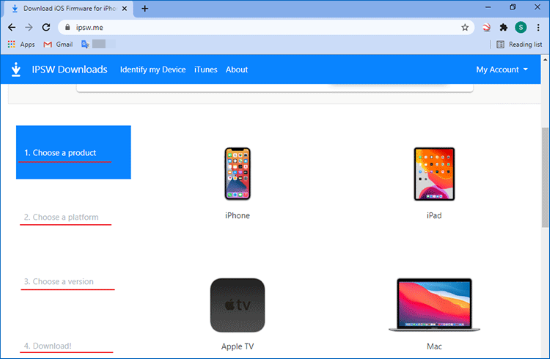
IPSW.me shows whether a firmware version is still signed, which helps you confirm
whether a normal restore is still possible.
Step 2: Prepare your SHSH blobs
You need SHSH or SHSH2 blobs saved for the same device and the same iOS version you want to restore. These blobs are unique to each device and version. If you previously saved them, keep them in an easy-to-find folder on your computer. If you do not have them, the unsigned restore path may not be possible.
Step 3: Prepare the nonce / generator
The nonce in your SHSH blobs must match the device during restore. Users commonly extract the generator value from the SHSH2 blob and set it on the device before starting
the restore process.
Step 4: Download futurerestore and required tools
Download the latest available build of futurerestore and place the IPSW file and SHSH blobs in the same working folder if needed.
Step 5: Run the restore command
Advanced users typically run a futurerestore command in Terminal or Command Prompt to attempt the restore. The exact command varies depending on the device, firmware, and additional compatibility requirements.futurerestore -t blob.shsh2 --latest-sep --latest-baseband -d target.ipsw
This is only a simplified example based on a common futurerestore workflow. The correct options vary by device, target firmware, APNonce/generator state, SEP/baseband compatibility, and restore method. Do not copy a command from another device without checking the current futurerestore documentation for your exact case.
Step 6: Watch for restore and recovery mode issues
During the process, your device may enter recovery mode, restart unexpectedly, or fail to proceed. If the device exits recovery mode or the generator resets, you may need to repeat parts of the workflow. If you need help with restore or recovery state issues, see:How to Put iPhone in Recovery Mode.
Why Unsigned iOS Restore Often Fails
Even when the steps look correct on paper, unsigned iOS restore can still fail for many reasons. Common causes include:
- Missing or incorrect SHSH blobs: The blobs must match the device and target firmware exactly.
- Nonce mismatch: If the nonce on the device does not match the blob, verification fails.
- SEP or baseband incompatibility: Some device and firmware combinations cannot restore cleanly.
- Wrong IPSW file: Using a firmware package for the wrong model will stop the process.
- Tool limitations: Restore tools are not equally reliable across all devices and versions.
- Recovery mode interruptions: Exiting recovery unexpectedly can break the restore chain.
- Data loss risk: Some restore attempts may wipe the device even if your goal is only to downgrade.
Bottom line: Unsigned downgrade is not a guaranteed solution. It is best treated as an advanced, high-risk workflow rather than a routine iPhone maintenance method.
A Simpler Alternative for Supported Downgrade or Repair Tasks
If your real goal is to fix system issues, leave a beta, or return to an older currently signed firmware, a desktop tool can simplify the process. This is different from forcing an unsigned IPSW onto the device. AnyFix provides guided iOS/iPadOS upgrade, downgrade, and system-repair workflows.
Its current documentation states that downgrade availability depends on Apple signing status: the downgrade screen displays supported firmware packages that are available for the connected device. AnyFix does not bypass Apple’s signing restriction to install an arbitrary unsigned IPSW.
Data warning: AnyFix’s current downgrade guide states that downgrading erases device data,so back up first and verify whether your backup can be restored to the target iOS version.
Explore related guides:Downgrade iOS Without iTunes, and Install IPSW with or without iTunes.
How to Downgrade to a Supported iOS Version with AnyFix
Step 1: Download AnyFix, connect your iPhone to the computer, and choose the Upgrade/Downgrade option on the welcome screen.
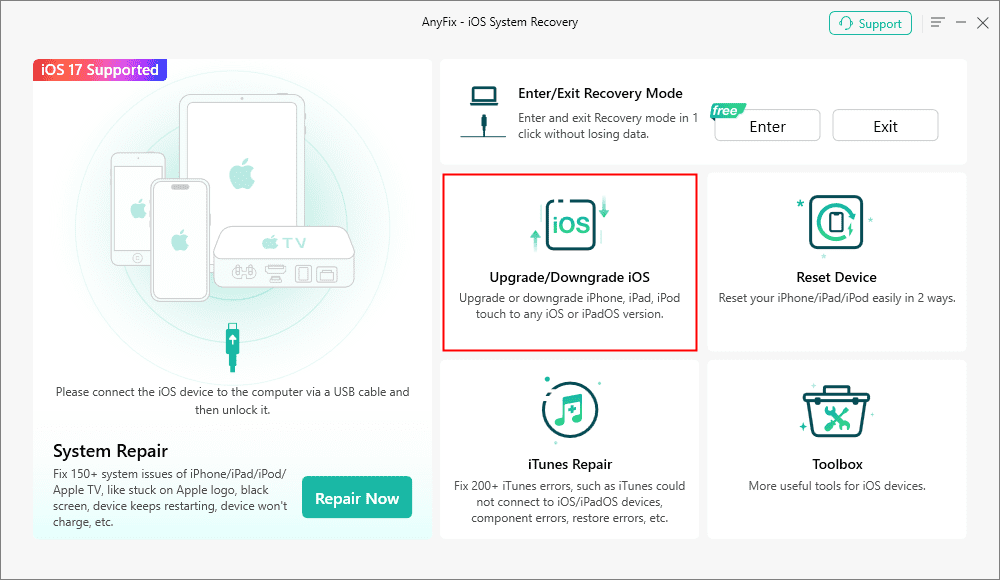
In AnyFix, start by choosing the Upgrade/Downgrade option on the welcome screen.
Then choose the downgrade option and click Start Now to continue.
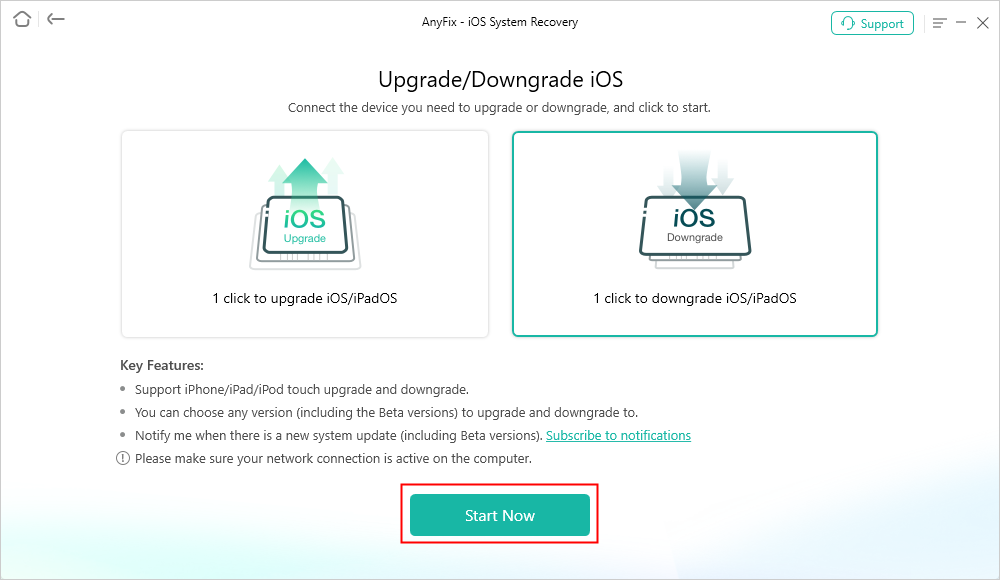
After opening the Upgrade/Downgrade feature, choose the downgrade workflow and click
Start Now.
Step 2: Review the firmware versions AnyFix currently lists as supported for the connected device. Choose an available version, download the package, and then click the Downgrade button. If the unsigned version you want is not available, AnyFix cannot force it into the supported list.
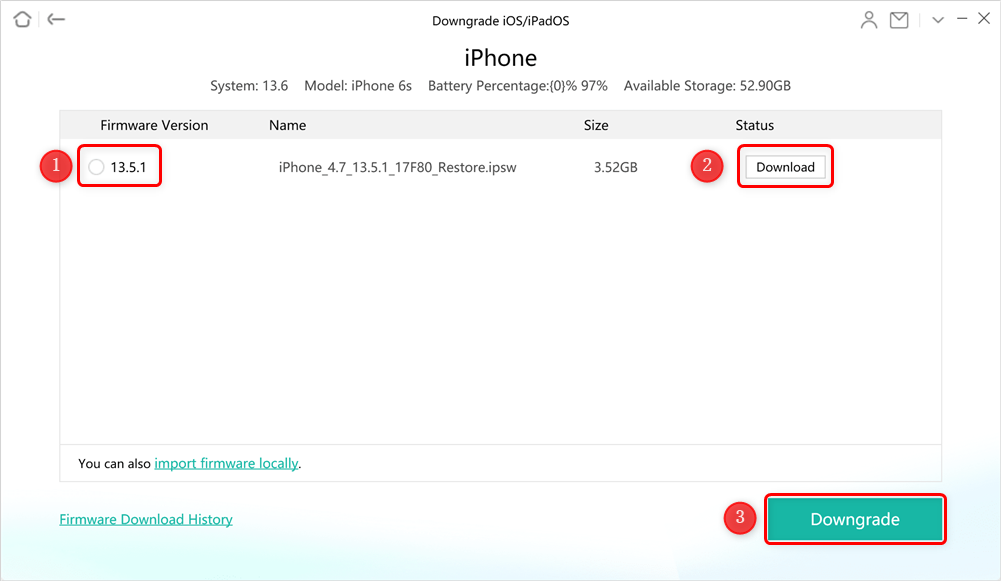
After your device is detected, you can choose the firmware version and proceed with
the downgrade workflow.
Step 3: Keep your iPhone connected while AnyFix installs the selected iOS version, and do not disconnect it until the process is complete.
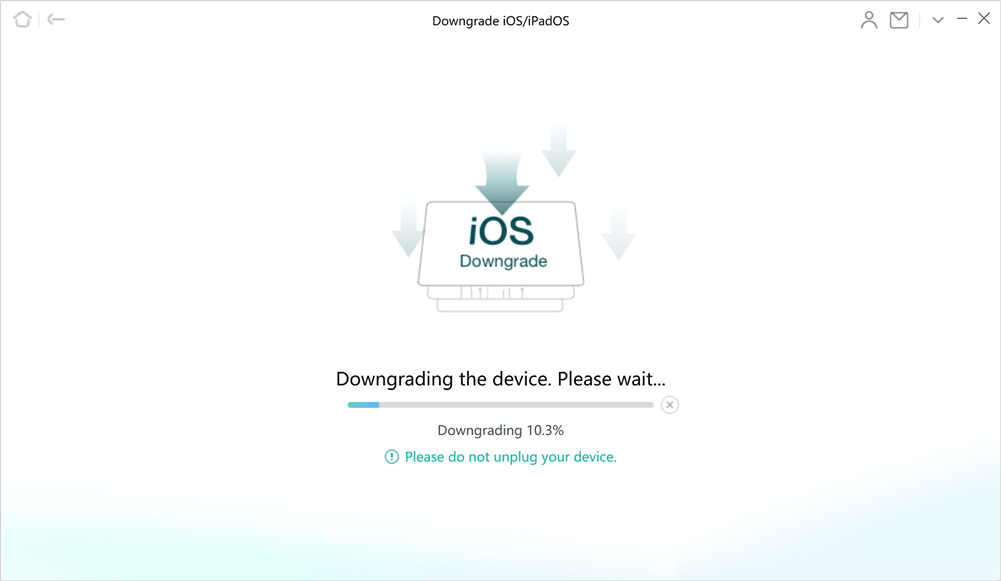
Keep the device connected until AnyFix completes the installation process.
Should You Try an Unsigned iOS Downgrade?
- Try it only if you already saved the correct SHSH blobs and understand the risks.
- Avoid it if you cannot confirm device compatibility, nonce requirements, or restore support.
- Choose a simpler route if your real goal is fixing performance issues, update bugs, or boot errors.
FAQs About Unsigned iOS Downgrade
1. Can you downgrade to unsigned iOS without SHSH blobs?
In most modern downgrade scenarios, no. futurerestore requires a valid signing ticket/APTicket (commonly saved as SHSH/SHSH2) for the target firmware and device, plus compatible nonce and restore conditions. Without the required ticket, the normal unsigned restore path is generally unavailable.
2. Is downgrading to unsigned iOS officially supported by Apple?
No. Apple only supports installation of firmware versions it is currently signing. Once a version is unsigned, it is no longer installable through normal official restore methods.
3. Will downgrading unsigned iOS erase my data?
It can. Because unsigned restore attempts are complex and error-prone, you should always assume there is a risk of full data loss and create a backup before starting.
4. Why does futurerestore fail even when I follow the steps?
Common reasons include nonce mismatch, wrong SHSH blobs, incompatible SEP or baseband, an incorrect IPSW file, tool limitations, or interruptions during recovery mode.
5. Is unsigned IPSW the same as unsigned iOS?
They are closely related. Unsigned iOS refers to a firmware version Apple no longer verifies. The IPSW file for that firmware is the install package, and it also becomes unusable through normal official verification.
6. Can Finder or iTunes install an unsigned IPSW?
Normally, no. Standard Apple restore workflows require firmware that Apple is still authorizing for installation. Once the target firmware is unsigned, selecting its IPSW manually does not make Finder, Apple Devices, or iTunes bypass Apple’s verification.
7. How do I check whether an IPSW is still signed?
Check the signing status for the exact device model before downloading or restoring firmware. A firmware-status site such as IPSW.me can help distinguish signed and unsigned builds, but always match the IPSW to the exact device identifier.
8. Can I restore a backup made on a newer iOS after downgrading?
Not always. Apple notes that an iCloud or computer backup may require a newer version of iOS/iPadOS before it can be restored. If the downgraded device is older than the backup requires, you may be prompted to update before restoring that backup.
9. What should I do if I only want to fix iPhone lag, update problems, or boot issues?
If your goal is device repair rather than installing a specific unsigned version, a supported repair or downgrade workflow is the safer option. A tool like AnyFix can be a more practical choice for those situations.
The Bottom Line
For how to install unsigned IPSW, the key limitation is Apple signing. A normal Finder, Apple Devices, or iTunes restore will not install firmware after Apple stops signing it. Advanced restore attempts can work only in limited device/firmware scenarios and typically require valid SHSH/SHSH2 blobs, matching APNonce/generator conditions, compatible SEP/baseband components, and a tool such as futurerestore.
Back up first, but remember that a newer-iOS backup may not restore directly to an older iOS version. If you do not already meet the technical requirements for unsigned restore, choose a firmware Apple is still signing. For supported downgrade or repair tasks, AnyFix can simplify the workflow, but it does not bypass Apple’s signing restrictions to install an arbitrary unsigned IPSW.



Joy Taylor is a seasoned technical writer with over a decade of experience in mobile technology. At iMobie, she specializes in producing in-depth content on iOS data recovery, iPhone unlocking solutions, and iOS troubleshooting.
Product-related questions? Contact Our Support Team to Get Quick Solution >
