How to Bypass Google Pixel FRP After Factory Reset [4 Ways]
Stuck on Google verification after resetting a Pixel phone? Compare Google Account recovery, previous-owner help, legacy no-PC Pixel FRP routes, and a supported computer-based option, plus what to do when old TalkBack or APK methods no longer match your device.
Is your Google Pixel stuck on “Verify your account” after a factory reset? That usually means Factory Reset Protection, or FRP, is active and Android is asking for a Google Account that was previously synced with the phone.
The best Pixel FRP route depends on what you still have: access to the original Google Account, contact with the previous owner, an older Pixel setup environment that still exposes a manual entry point, or a computer-based FRP workflow that supports the connected device.
Quick Answer: Start with the Google Account previously used on the Pixel. If you forgot the account or password, try Google Account recovery before using a bypass method. For a second-hand Pixel, contact the seller or previous owner first. Older TalkBack, browser, APK, or SIM-based tutorials should be treated as device- and software-specific legacy routes, not universal Pixel fixes. If the manual path no longer matches your setup screen, switch method category instead of repeating the same loophole.
If your problem is the Google verification screen itself rather than Pixel-specific behavior, the Google account verification after factory reset guide covers the wider account-recovery and post-reset decision path.
What Is FRP on Google Pixel?
Factory Reset Protection is part of Android’s post-reset device security. When a Google Account has been associated with a protected Android phone, the setup process may ask for that previously synced account after the device is factory reset.
On a Pixel, you may see messages such as:
- “Verify your account.”
- “This device was reset.”
- “Sign in with a Google Account that was previously synced on this device.”
- a setup screen that will not continue until Google Account verification succeeds.
FRP is different from the normal Pixel PIN, pattern, or password that protects the lock screen before a reset. Once the phone has been erased and setup asks for the old Google Account, troubleshoot the Google verification state rather than a normal screen-lock problem.
For the broader Android explanation, see the Android FRP bypass guide.
Ownership reminder: Use FRP recovery or removal methods only on a Pixel you own or are authorized to manage. If a second-hand phone is still tied to another person’s account, resolve the ownership and account-transfer issue first.
Which Google Pixel FRP Method Should You Use?
Choose the route from the account and setup state instead of starting with the newest-looking FRP APK or an old YouTube shortcut.
| Your Situation | Better Starting Point | PC Needed? | Main Limitation |
| You know the Google Account previously used on the Pixel | Sign in with that account | No | You need the correct account credentials. |
| You know the account but forgot the password | Google Account recovery | No | Google may require recovery verification or additional security checks. |
| You bought the Pixel second-hand | Contact the previous owner or seller | No | The seller must be able to resolve the old account association. |
| An old TalkBack, APK, browser, or SIM guide matches your exact setup screen | Evaluate that legacy route cautiously | Depends on the method | Setup Wizard behavior changes across Android versions and security updates. |
| The old no-PC route stops at a missing menu | Switch method category | Depends on the next route | Repeating the same shortcut will not restore a missing setup entry point. |
| Official recovery options are unavailable and a supported computer workflow exists | Evaluate a guided FRP tool | Yes | Compatibility depends on the connected device and available workflow. |
Method 1. Recover the Previously Synced Google Account
For a Pixel you own, this should be the first method. If you remember the Gmail address but not the password, recover the account itself before looking for a bypass utility.
Step 1. From another trusted phone or computer, start Google’s normal account-recovery process.
Step 2. Use the recovery phone number, recovery email, trusted device, or other verification option available for the account.
Step 3. Once you can access the account again, return to the Pixel setup screen and enter the Google Account requested by the device.
Step 4. Follow any additional verification or waiting instructions shown by Google rather than repeatedly resetting the Pixel.
How Do You Know You Have the Right Google Account?
If you use several Gmail accounts, look for the one that was actually signed in on the Pixel before the factory reset. A different Google Account that you own may still be rejected because the setup process is looking for an account previously associated with that device.
If the main problem is identifying or dealing with the old account after reset, use the Google-verification guide linked above rather than moving immediately to an APK route.
Method 2. Ask the Previous Owner to Remove the Google Account
If you bought the Pixel used and setup is asking for another person’s Google Account, contact the seller or previous owner first.
Ask them to:
- confirm that the Pixel was legitimately transferred to you;
- help complete the Google verification step if required;
- remove their Google Account from the device after access is restored;
- make sure the phone can complete setup without returning to their credentials; and
- provide proof of sale or return assistance if they cannot release the device properly.
Second-hand Pixel: If the seller cannot verify ownership or help remove the old account association, another factory reset usually does not solve the underlying FRP problem. Consider returning the device instead of stacking multiple bypass tutorials.
Method 3. Check Legacy Pixel FRP APK and No-PC Routes
Older Google Pixel FRP tutorials commonly use one of several setup-screen paths:
- TalkBack or accessibility menus;
- Braille keyboard or keyboard settings;
- a browser or Google search entry point;
- an FRP APK copied through USB or OTG;
- SIM notification or lock-screen behavior; or
- Android Settings or app-info screens exposed during setup.
These methods should now be treated as legacy compatibility routes. They depend on the exact Pixel model, Android version, security state, Setup Wizard behavior, and which menus remain accessible.
Legacy Route A: FRP Bypass APK
The original version of this article instructed users to copy a third-party FRP APK to a USB drive, attach it through OTG, install it, open Settings, and reset the phone again.
There are several reasons not to present that sequence as a universal current Pixel method:
- the Pixel may block APK installation during setup;
- the file source may be unverified;
- the Settings path used by an older tutorial may no longer be exposed;
- another factory reset does not automatically guarantee that FRP will disappear; and
- an APK that worked on one Android build may not fit another.

Older Pixel guides may use an FRP APK, but installation and setup access must still match the device.
If you find an FRP APK elsewhere, do not assume that a file described as “latest” is safe or compatible. Avoid unknown mirrors, repacked APKs, and instructions that ask you to disable protections without explaining why.
Legacy Route B: TalkBack and Braille Keyboard
The previous article also used TalkBack, Braille keyboard, Accessibility, Assistant, Google search, Android Setup, and Google Play Services to reach setup areas that were not normally available.
Before trying any version of that route, compare your Pixel with the first few checkpoints:
| Checkpoint | Continue Only If | Stop If |
| Assistive Options / Vision Settings | The same accessibility entry point appears during setup. | The Pixel does not expose the menu shown by the tutorial. |
| TalkBack Settings | The gestures and Settings path match the instructions. | The gesture or menu behavior is different. |
| Braille Keyboard | The keyboard setup route is available. | The required keyboard or Settings link is missing. |
| Google / Assistant entry point | The setup environment lets the route reach the required screen. | Search, Assistant, browser, or Settings access is blocked. |
| Android Setup / Play Services controls | The exact app controls are available and match the guide. | The controls are disabled, renamed, or inaccessible. |

An older Pixel FRP route depended on TalkBack behavior that may differ on current Android builds.

The legacy route also depended on a Braille keyboard setup path.
If a required screen is missing, do not try to combine unrelated steps from another Pixel or Android version. The missing checkpoint is evidence that the method does not match the current setup environment.
What About the Old SIM PIN / PUK Trick?
Some older Pixel FRP instructions intentionally enter incorrect SIM PIN or PUK codes to trigger notifications or expose another screen. This article no longer recommends deliberately exhausting SIM PIN or PUK attempts.
Locking or disabling a SIM does not solve the underlying Google Account ownership problem, and modern Pixel setup behavior may not expose the same notification path anyway. If a tutorial depends on intentionally making the SIM unusable, choose another route.
Method 4. Use a Supported Computer-Based FRP Workflow
If account recovery is unavailable, the previous owner cannot help, and legacy Pixel setup routes no longer match the device, a guided computer workflow may be easier to evaluate.
DroidKit FRP Bypass provides a computer-based FRP workflow for supported Android device situations. Check the connected-device route before starting rather than assuming that every Pixel model or Android security state is covered.
When to Consider a Computer-Based Route
- The Pixel belongs to you or you have clear authorization to service it.
- You cannot recover the Google Account previously used on the phone.
- The previous owner is unavailable or the phone was already legitimately transferred.
- The old TalkBack, browser, APK, or keyboard route stops at a missing screen.
- You prefer guided on-screen instructions to several device-specific manual loopholes.
- The software presents an applicable workflow for the connected device.
How to Start the DroidKit FRP Workflow
Step 1. Open DroidKit on your computer and choose FRP Bypass.
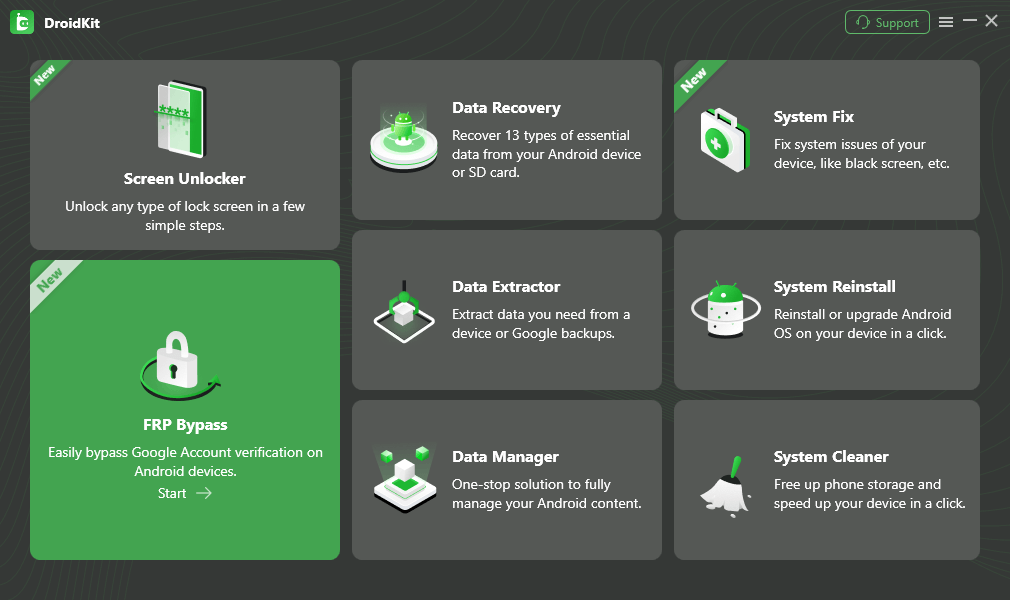
Choose FRP Bypass Mode.
Step 2. Connect the Android phone to the computer with a data-capable USB cable and click Start.
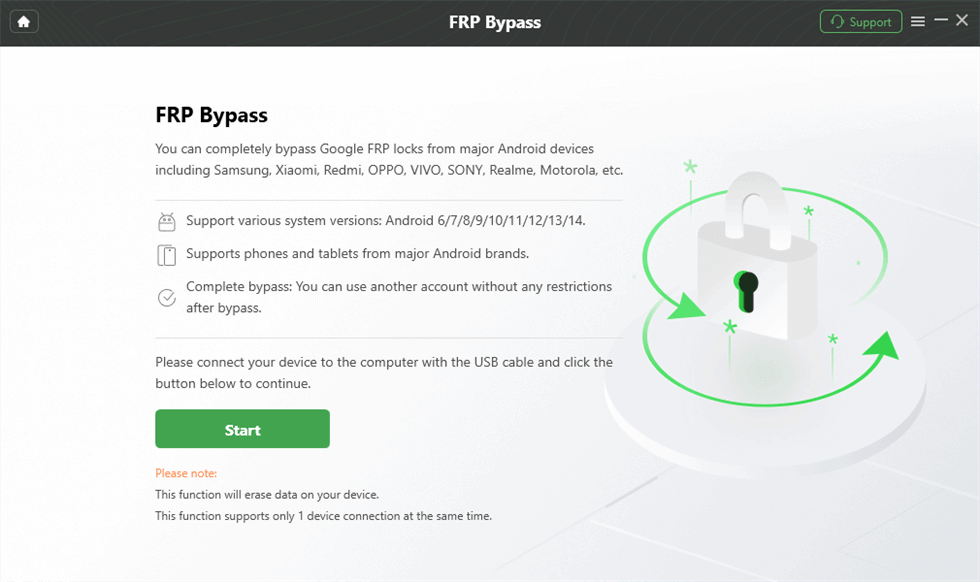
Connect the device and start the workflow.
Step 3. Select the correct device brand when prompted and continue only if the software provides an applicable route for the connected phone.
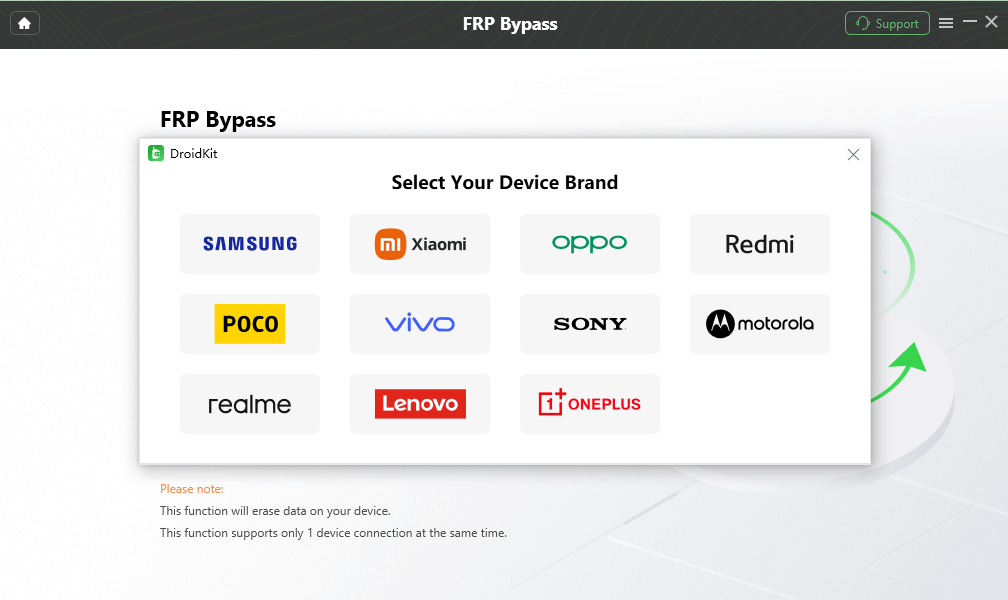
Choose the correct device brand.
Step 4. Let DroidKit prepare the configuration required for the available workflow, then follow the on-screen instructions.
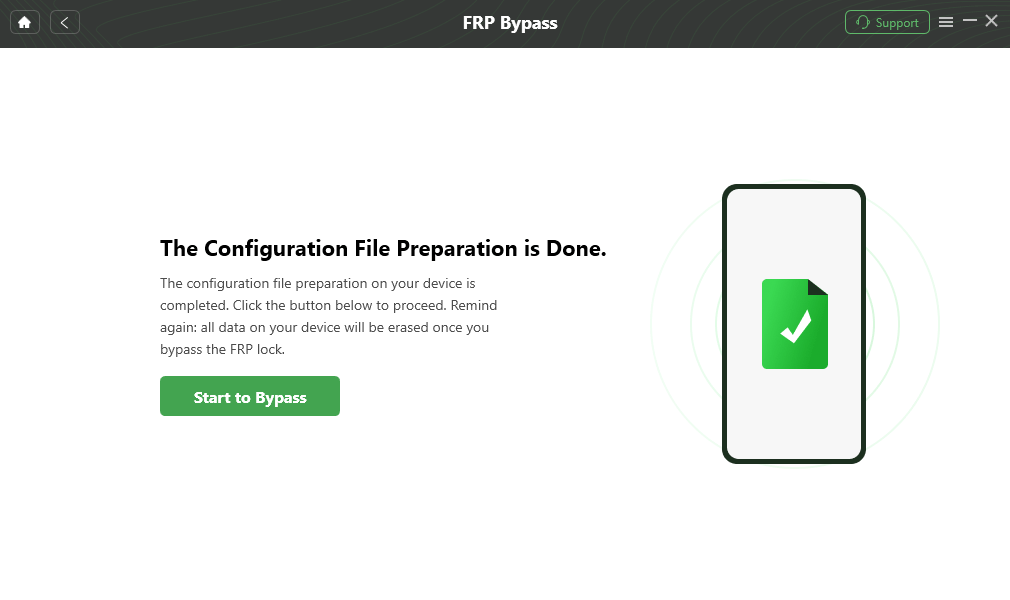
Continue with the available FRP workflow.
Step 5. Keep the device connected until the workflow reports completion, then continue the Android setup process.
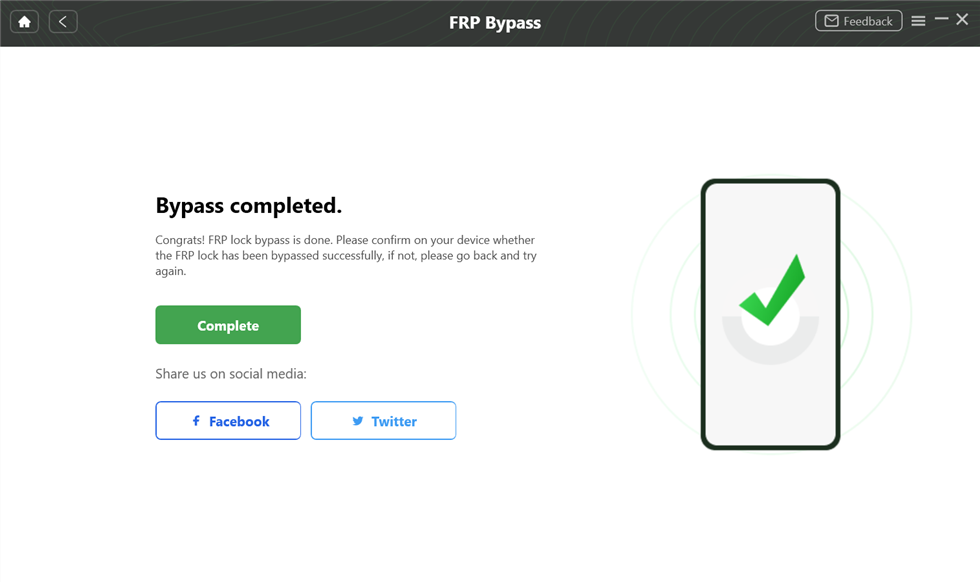
Complete the available FRP workflow.
DroidKit – Check the FRP Workflow for Your Device
If your Pixel manual route has stopped at a missing setup screen, check the current DroidKit FRP workflow and device requirements before switching to another random APK or loophole.
Google Pixel FRP Bypass Not Working? Diagnose the Failure Point
If a Pixel FRP method does not work, the first screen where it differs from the instructions usually tells you what to do next.
| Failure Point | What It Suggests | Better Next Step |
| The Google Account is rejected | You may be using the wrong account or the account recovery process is incomplete. | Confirm which Google Account was previously synced with the Pixel. |
| A second-hand Pixel asks for another person’s account | The previous owner is still relevant to setup. | Contact the seller instead of factory resetting the phone again. |
| FRP APK says “App not installed” | The APK or installation route does not fit the current setup environment. | Do not keep installing renamed or unknown copies of the same APK. |
| TalkBack menu differs from the tutorial | The Android or Setup Wizard environment has changed. | Stop the legacy route at that checkpoint. |
| Braille Keyboard or Assistant is missing | The no-PC path no longer matches the device. | Switch to account recovery or another method category. |
| SIM notification trick does not expose another screen | The old setup loophole is unavailable. | Do not intentionally exhaust SIM PIN or PUK attempts. |
| A computer workflow does not recognize the device | USB connection, device state, or workflow compatibility may be wrong. | Resolve detection and verify support before retrying. |
| Google verification returns after restart | The selected procedure did not resolve the active FRP state. | Reassess the Google Account and method compatibility instead of repeating the same steps. |
Why Old Pixel FRP Tutorials Age Quickly
Manual FRP tutorials often depend on setup behavior that is not the main subject of the guide title: a specific TalkBack gesture, keyboard setting, notification, browser shortcut, app-info page, or Google Play Services control. When Android changes one of those checkpoints, the entire route can stop even though the phone is still a Google Pixel.
For this reason, choose Pixel FRP instructions by the screens actually present on the device rather than by a video title that simply says “all Pixel models” or “latest security patch.”
FAQs About Google Pixel FRP Bypass
What is Google Pixel FRP?
Google Pixel FRP is Android Factory Reset Protection. After a protected Pixel is factory reset, setup can require a Google Account that was previously synced with the device before the phone can be used again.
Can a factory reset remove FRP from a Google Pixel?
Do not assume another factory reset removes FRP. If the Google Account is still associated with the device, Pixel setup may continue to request verification after the reset. Resolve the account or use an applicable authorized FRP route instead.
Can I bypass Google Pixel FRP without a PC?
Older Pixel no-PC tutorials may use TalkBack, accessibility, keyboard, browser, APK, or notification entry points. They are useful only when the exact setup screens still match your device. If a required checkpoint is missing, stop that route rather than assuming every Pixel has the same loophole.
Does the TalkBack FRP method still work on Google Pixel?
There is no universal answer across Pixel models and Android builds. Older routes depended on specific TalkBack gestures, Braille keyboard settings, Assistant access, and Setup Wizard behavior. Compare those checkpoints with your phone before relying on the method.
Can I use an FRP Bypass APK on a Google Pixel?
An APK route is device- and setup-dependent. The Pixel must allow the required file access, APK installation, and downstream Settings path. Avoid unverified APK sources and stop if the setup environment blocks the first required step.
Should I intentionally lock my SIM with the wrong PUK to bypass Pixel FRP?
This article does not recommend deliberately exhausting SIM PIN or PUK attempts. Locking or disabling the SIM does not resolve Google Account ownership and an old notification-based route may not exist on the current Pixel software.
What should I do with a second-hand Pixel that asks for the previous owner’s Google Account?
Contact the seller or previous owner and ask them to resolve the account association properly. If they cannot verify ownership or release the phone, consider returning the device rather than repeatedly resetting or bypassing it.
What should I do if every manual Pixel FRP method fails?
Use the failure point to choose the next route. Missing TalkBack or browser screens indicate that the old setup path does not match your phone; a rejected Google Account points back to account verification; and an undetected device should be diagnosed before another computer-based operation is attempted.
Final Words
Google Pixel FRP bypass is not one fixed sequence that works on every Pixel generation. Start with the previously synced Google Account, use account recovery when you still control it, and involve the seller when a second-hand Pixel remains tied to another person.
Older APK, TalkBack, Braille keyboard, browser, and SIM-based methods should now be treated as compatibility-dependent routes. If the screen shown by your Pixel differs from the tutorial at an early checkpoint, stop there instead of combining instructions from several Android versions.
When account-based routes are unavailable and the phone is authorized for servicing, evaluate a current computer-based FRP workflow by actual device support. That produces a clearer decision path than assuming a legacy “all Pixel models” method will still work.
More Related Articles


Roger Smith is a senior technical writer with years of experience in providing Android solutions. He loves to help users solve various problems such as Android unlock, Android data recovery, and Android system repair.
Product-related questions? Contact Our Support Team to Get Quick Solution >
