D&G Password Unlocker Guide: Download, Setup & FRP Use
D&G Password Unlocker is an older Windows utility commonly found through third-party RAR mirrors and Android FRP tutorials. Before running it, verify the archive, confirm Windows can detect the phone, and make sure the guide matches your device and lock type. This page also explains what to check when D&G does not detect the phone or reports completion while Google verification remains.
D&G Password Unlocker has an unusual search problem: the tool name is easy to find, but the download trail and current device fit are much harder to establish. Users search for D&G Unlocker, DG Password Unlocker, D & G Password Unlocker, and D&G Unlocker Tool while usually looking for the same things—a Windows download, setup instructions, an explanation of the old interface, or help with Google FRP after a factory reset.
The package referenced by the existing article is a compressed RAR archive hosted on MediaFire. That mirror is still available, but it is a third-party file-sharing page rather than evidence of a publisher-controlled D&G release channel. A recognizable archive name tells you which file you found; it does not establish current Android support, phone compatibility, or whether another copy using the same D&G name is identical.
The word Password in the product name creates another problem. A phone asking for a PIN or pattern before normal use has a local screen lock. A phone asking to Verify your account after a factory reset has Google FRP. Those two users should not choose a D&G function—or another unlock product—from the same starting point.
D&G Password Unlocker: What the Tool Actually Is
D&G Password Unlocker is a Windows desktop utility circulated through older Android unlocking and FRP guides. The interface shown in the existing article is organized around phone-brand tabs and service actions rather than one universal Android workflow.
That distinction matters. Seeing Samsung, Motorola, Huawei, or another brand inside an old utility is not equivalent to having current compatibility documentation for every model sold by that brand. The exact phone, Android build, Windows driver state, connection mode, and selected operation can still determine whether the workflow goes anywhere.
If your main goal is comparing current FRP-oriented software rather than specifically researching D&G, use the FRP bypass tool comparison. This article stays focused on the D&G archive, interface, setup, and failure points.
What Is D&G Unlocker Tool?
The D&G name refers here to a desktop tool package rather than an Android app installed directly on the locked phone. The archive referenced by this page contains a Windows-oriented setup package.
The D&G Password Unlocker interface shown in the existing article.
Older public guides associate D&G mainly with FRP-related and other Android service operations. This page does not assume that every function described in an old tutorial remains applicable to current Android devices.
What Functions Appear in the D&G Interface?
The useful way to describe D&G is by what users can see in the older interface, not by building an unsupported modern compatibility list.
| Function Area | What It Means | What Still Needs Verification |
| FRP-related actions | Operations associated with Google verification or post-reset servicing in older guides | Exact model, Android state, brand workflow, and current device behavior |
| Device information | Reading or identifying information from a connected phone | Windows detection, driver, connection mode, and supported device state |
| Reset / erase actions | Service actions that may reset device information or user data | Data impact and whether the selected action actually addresses the user’s lock type |
| Brand-oriented actions | Functions grouped under different Android manufacturers | A visible brand tab does not confirm every model under that brand is supported |
Do not infer an extra feature simply because another utility with a similar name offers it. Work from the D&G screen and workflow you actually have.
D&G Password Unlocker Download: Check the RAR First
The strongest secondary intent around this page is download. The first useful fact is simple: the file referenced by the existing guide is a RAR archive, not an Android APK.
The historical external mirror used by this article is:
D&G Password Unlocker RAR archive on MediaFire
That file-sharing page currently identifies the archive as d-g_unlocker_tools_installer.rar. Treat it as a historical third-party mirror, not an official D&G download center or proof of current device support.
RAR Is Not the Same as APK
An `.rar` file is a compressed archive. You extract it on a computer; you do not install the RAR itself on Android as if it were an `.apk` application.
If another guide tells you to transfer this same RAR directly to the locked phone and install it like an Android APK, the guide is either mixing file types or talking about a different package.
What the Filename Does Not Tell You
The filename can identify the archive, but it does not establish:
- who originally published the software;
- which Android versions or builds were tested;
- which exact phone models match the service operations;
- whether another D&G archive has been modified or repackaged;
- whether the interface inside your archive matches an older tutorial; or
- whether an operation that once worked still matches the current phone state.
Pre-Installation Check for the D&G Archive
Step 1. Confirm that the file name and download page match the D&G package you intended to investigate.
Step 2. Scan the compressed archive before extracting it.
Step 3. Extract the files into a separate folder so the D&G package does not become mixed with drivers or executables from other unlock tools.
Step 4. Inspect and scan the extracted files before launching the installer or executable.
Step 5. Keep the archive name and original download page recorded. If the UI later differs from the guide, package identity becomes part of the troubleshooting process.
Step 6. Do not create broad antivirus exclusions or disable system-wide security merely because an old unlock-tool tutorial recommends it.
D&G download checkpoint: finding the RAR solves only the file-location problem. You still need to establish whether Windows can run the package, whether the phone can be detected, and whether the selected D&G operation matches the device state.
Who Should Still Consider D&G Unlocker?
D&G still makes sense as a research or troubleshooting choice when you specifically need to reproduce an older D&G workflow and understand that the support boundary is not documented like a current consumer product.
| D&G Is a Better Fit When | D&G Is a Poor Fit When |
| You specifically need to inspect or reproduce the D&G interface | You selected it only because “Password Unlocker” sounds like it removes every Android lock |
| You have a Windows PC and can diagnose drivers and USB detection | You need a native Mac application |
| You know the exact phone model and the older workflow matches the device state | The guide is for another phone, Android build, or connection state |
| You can stop and diagnose the exact point where the workflow diverges | You plan to keep running reset/erase actions until one changes the phone |
| You can evaluate a third-party archive before running it | You cannot establish what the downloaded package contains or where it came from |
The key question is not whether D&G is “old.” It is whether the specific archive and device workflow give you enough information to make the next step meaningful.
What D&G Simplifies—and What You Still Need to Verify
The Brand Tabs Make the Interface Easy to Understand
The old D&G UI gives users an obvious starting point by organizing operations around Android brands. That is easier to navigate than a command-line service utility.
The Download Trail Is Harder to Evaluate Than the UI
A clear-looking interface does not answer who released the copy you downloaded, whether the archive was modified, or what current phones still match its older workflows.
The Product Name Mixes FRP and Screen-Lock Intent
Someone searching “DG Password Unlocker” may expect PIN or pattern removal even though the tutorial they find is really about FRP after a reset. Identifying the lock type before choosing a function prevents a large part of that confusion.
USB Detection Is Only One Checkpoint
A computer recognizing the phone proves that part of the connection layer is working. It does not prove that the selected D&G operation supports the phone or that an FRP action will change Google verification.
D&G Unlocker Not Working? Find the Failure Point
“D&G not working” can describe several unrelated failures. Diagnose the first failed layer rather than immediately downloading another RAR with the same name.
| Failure Point | Problem Layer | What to Check Next |
| The RAR will not extract | Archive / download | Recheck whether the download completed and whether the archive itself is intact. |
| D&G will not launch | Windows / package | Check the extracted package, Windows warning, runtime requirements, and whether the UI matches the expected build. |
| Windows does not detect the phone | USB / driver / connection state | Check the data cable, USB port, driver, and the device state expected by the guide. |
| Windows sees the phone but D&G does not | Tool / connection workflow | Check whether the D&G operation expects a different driver or device mode. |
| The phone connects but the brand workflow looks different | Compatibility / tutorial mismatch | Compare the exact model, Android environment, and expected prompts before continuing. |
| The FRP action starts but stops | Operation / device workflow | Record the selected function, device details, final message, and whether the connection remained stable. |
| D&G says complete but Google verification returns | Result mismatch | Confirm that the selected action was actually intended for the device and FRP state before trying another reset or erase function. |
| Security software flags the package | Package provenance | Investigate the exact file and source rather than permanently disabling protection. |
The RAR Archive Does Not Extract
Solve the archive problem before thinking about phone compatibility. Redownloading the same documented archive is more defensible than adding random DLLs from unrelated websites to force a damaged copy to run.
D&G Opens but Does Not Detect the Phone
Check whether Windows detects the device at all. Then check the USB driver, data cable, port stability, and connection state expected by the D&G guide. An unrecognized device is a communication problem before it is an FRP problem.
The Phone Is Detected but the Brand Workflow Does Not Match
Do not use the presence of a Samsung, Motorola, Huawei, or other brand tab as proof of model support. If the phone prompts or device state diverge from the tutorial, record that mismatch instead of selecting the closest-looking operation.
The Operation Starts but Does Not Finish
Capture the exact phone model, Android version if known, D&G brand tab, selected action, connection state, and final program message. Changing several variables at once makes it harder to identify which part actually failed.
D&G Reports Completion but FRP Is Still Active
If the phone returns to Google verification, do not respond by clicking every reset or erase action visible in D&G. The result tells you that the selected workflow did not resolve the verification state as expected.
If you want a broader comparison of FRP-specific software at this point, return to the FRP tool comparison only if you did not already use it above. For CMS deduplication, the final published version should keep this URL in one body location only.
Security Software Flags the Archive
A familiar D&G filename or old screenshot is not enough reason to dismiss a security warning. Confirm which file triggered the alert, where the archive came from, and whether the package contents match what you expected.
FRP or Screen Lock? Do Not Mix the Two
The D&G name makes this distinction especially important.
| What the Phone Shows | Lock Type | Correct Direction |
| PIN, pattern, password, fingerprint, or face lock before normal access | Local screen lock | Use screen-lock recovery or Android screen-unlock software. |
| “Verify your account” after a factory reset | Google FRP | Use account recovery, previous-owner resolution, or an FRP-specific workflow. |
| SIM network unlock code or another carrier restriction | Network / carrier lock | Use the carrier or network-unlock route instead. |
If your phone boots normally and only the PIN, pattern, or password is forgotten, use the Android phone unlocking software guide instead of treating an FRP-oriented D&G tutorial as the correct screen-lock method.
If the phone instead asks for a Google account after reset, keep the troubleshooting focused on FRP rather than local password removal.
When a Current FRP Workflow Makes More Sense
There is a specific point where another copy of the D&G RAR stops answering the real question. You may reach that point when the archive provenance cannot be established, Windows repeatedly fails to detect the device, the D&G brand workflow does not match the phone, or the program reports completion while Google verification remains unchanged.
At that stage, decide whether you want to keep investigating the old D&G package or move specifically to a current FRP product workflow. That does not mean another product replaces every reset, erase, or service action shown inside D&G.
For compatible Android FRP scenarios, DroidKit FRP Bypass provides an iMobie-distributed Windows/Mac workflow. Check the current device route before purchase rather than assuming every Android phone follows the same procedure.
Why Changing Tools Is About Workflow, Not Just Age
D&G leaves several decisions outside the application: you need to identify the archive, judge whether the tutorial matches the phone, establish Windows detection, interpret the brand tab, and decide what a failed result means.
The relevant difference with a current FRP product is that the device-oriented instructions and product distribution are maintained as part of the current software experience. That matters most for the D&G user who is stuck between an old archive and a phone that no longer behaves like the tutorial.
D&G Password Unlocker vs DroidKit
| Point of Comparison | D&G Password Unlocker | DroidKit FRP Bypass |
| Distribution | Commonly encountered through old guides and third-party archives | Distributed through iMobie’s current product channel |
| Main question | Does this D&G package and old workflow still fit my phone? | Does the current FRP workflow cover my device situation? |
| Computer platform | Windows workflow discussed in this article | Windows and Mac downloads are available |
| Setup burden | User needs to evaluate the archive, drivers, detection, brand tab, and old instructions | Software presents instructions for the applicable FRP route |
| Relevant overlap | FRP-related operation in the old D&G workflow | Guided FRP recovery for supported scenarios |
| Not equivalent | May expose other service/reset actions in the installed build | Should not be treated as a replacement for every D&G service function |
How to Start a Guided FRP Workflow with DroidKit
Step 1. Install DroidKit on your computer, open the program, and select FRP Bypass.
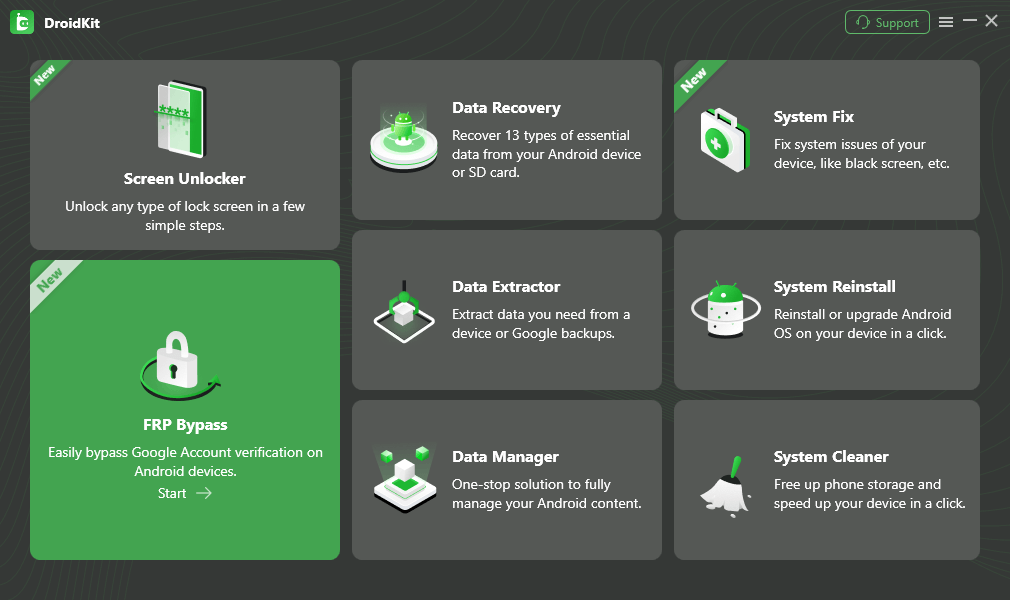
Open the FRP Bypass module.
Step 2. Connect the Android device with a data-capable USB cable and click Start.
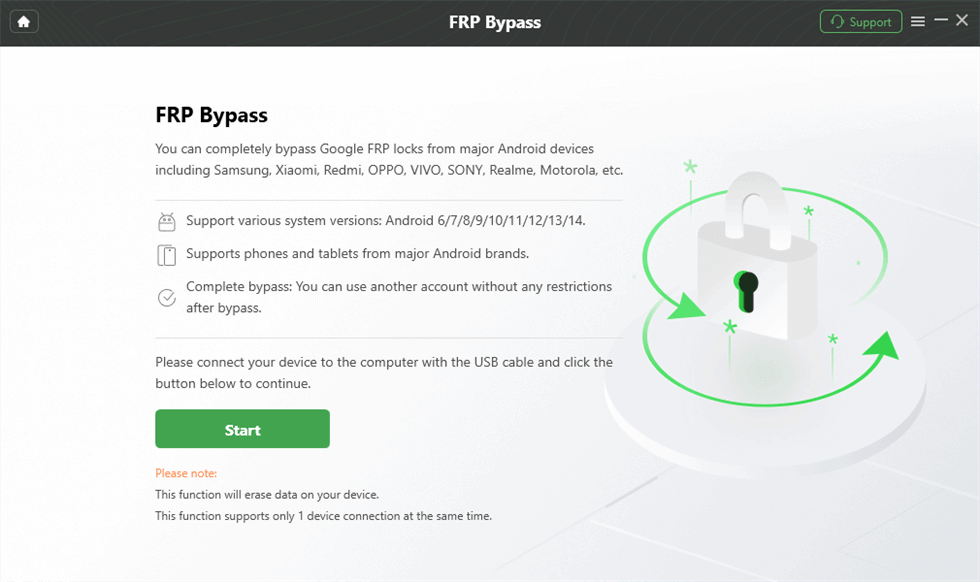
Connect the device and begin the FRP workflow.
Step 3. Wait while the available configuration is prepared. When the applicable workflow is ready, continue with Start to Bypass.
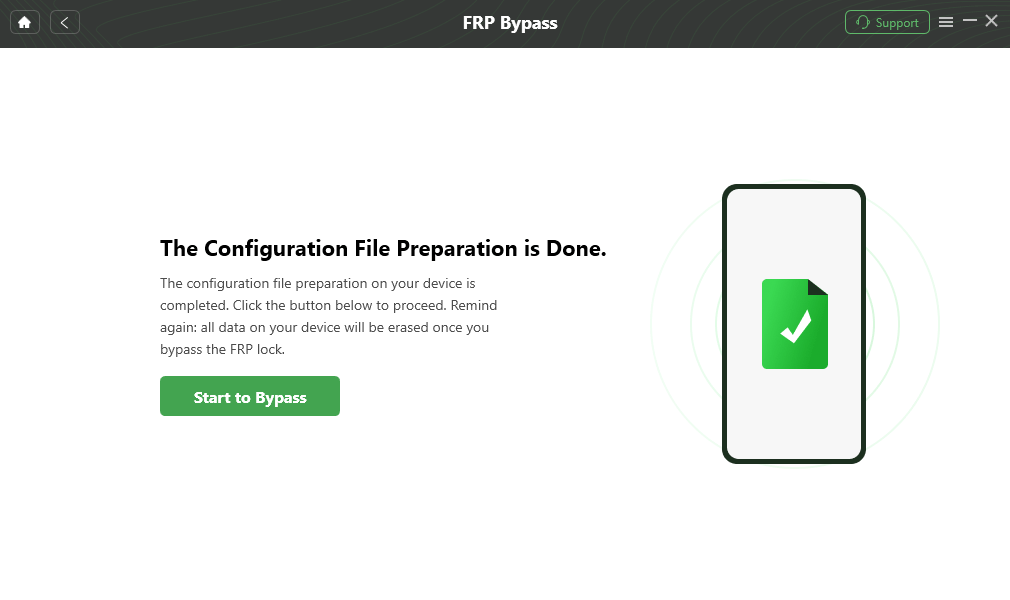
Continue after the applicable FRP configuration is prepared.
Step 4. Select the device or system information requested by the software instead of copying a selection from an unrelated phone tutorial.
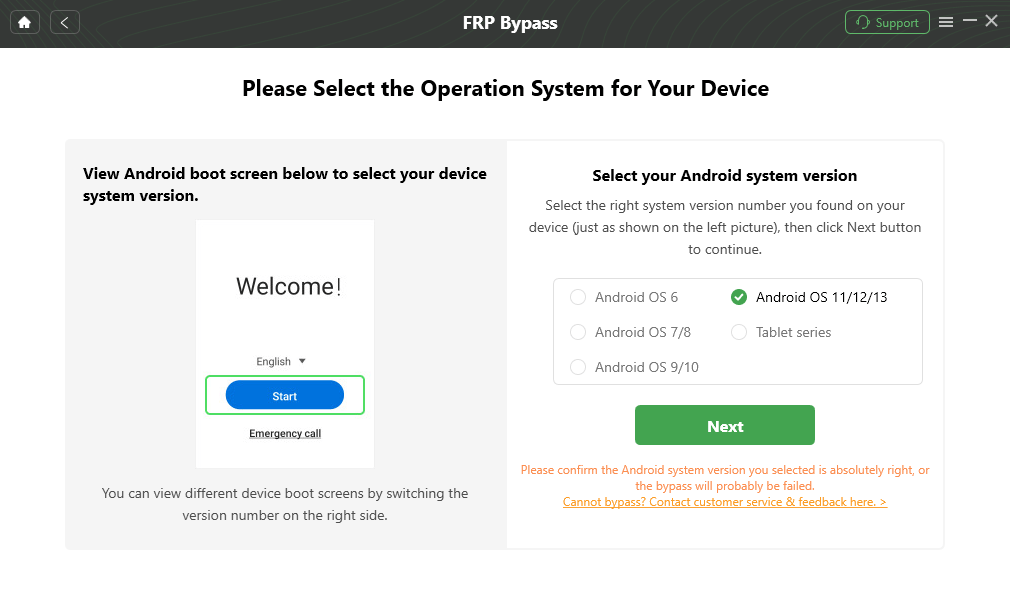
Choose the device information requested by the current workflow.
Step 5. Follow the device-side preparation shown by the software.
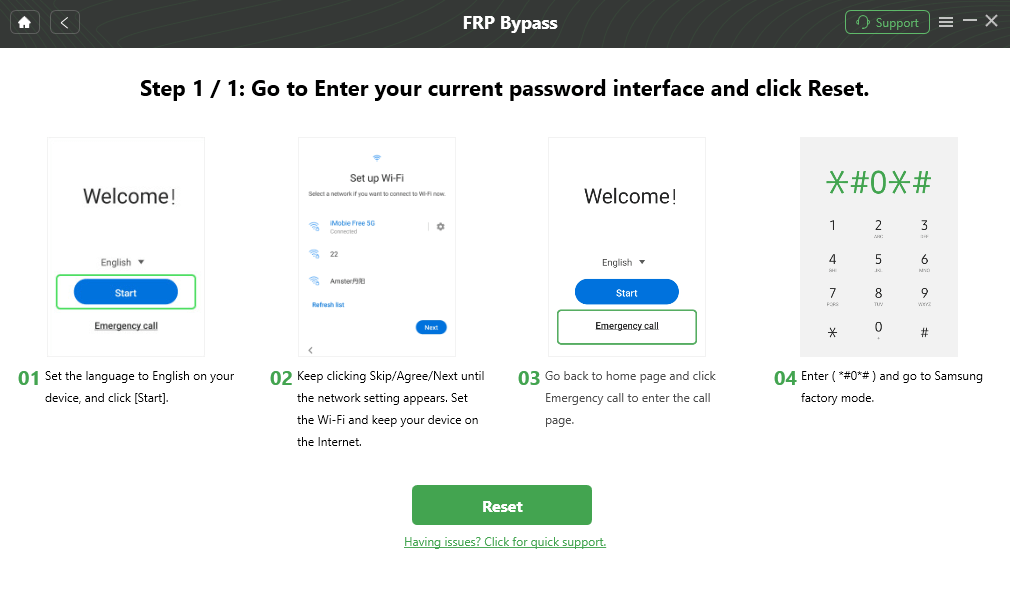
Complete the preparation shown for the selected device route.
Step 6. Keep the phone connected until the software reaches its completion result, then follow the device setup instructions shown for that route.
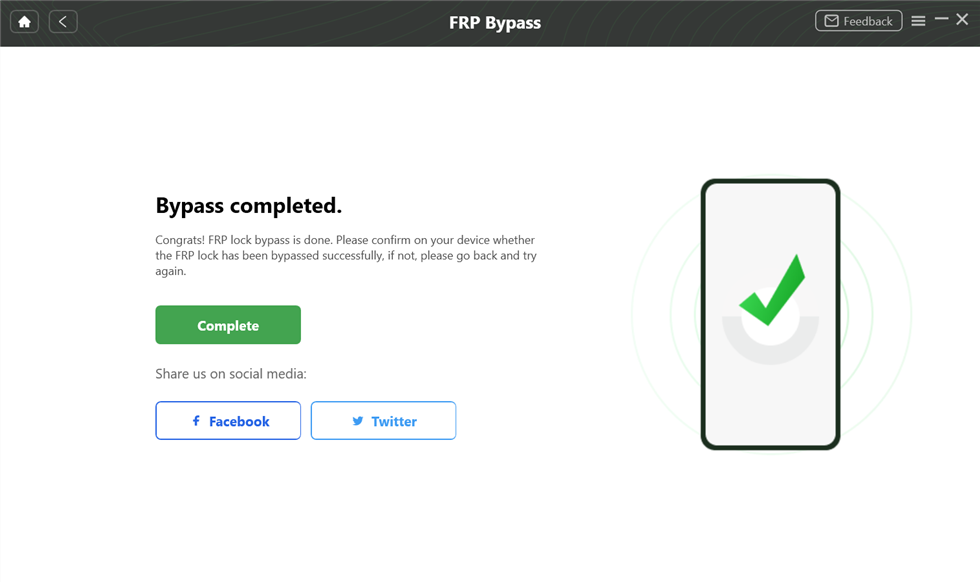
DroidKit FRP workflow completion screen.
DroidKit is commercial software. For someone arriving from D&G, the reason to evaluate it is specific: the old archive or D&G workflow has stopped providing enough information to resolve a Google-verification problem, and you now want to check a current FRP route for the actual connected device.
D&G Password Unlocker FAQ
Is D&G Password Unlocker the same as D&G Unlocker Tool?
These names generally refer to the same search intent. Users also search for DG Password Unlocker and D & G Password Unlocker. The archive and interface matter more than the spelling because two similarly named downloads are not automatically identical.
Is D&G Password Unlocker an APK?
The package referenced by this article is a RAR archive used for a Windows desktop workflow. It is not an Android APK that you install directly on the locked phone.
Where can I download D&G Password Unlocker?
The existing article references a MediaFire RAR mirror that remains available. Treat it as a historical third-party file source rather than a verified publisher-controlled D&G download or compatibility page.
Is D&G Password Unlocker free?
Older public guides commonly describe the circulated D&G package as free to obtain. That says nothing about whether a particular archive is current or whether its workflow fits your phone, so price should not be the compatibility test.
Why does D&G Password Unlocker not detect my phone?
First check whether Windows detects the phone. Then check the data cable, USB port, required driver, and the device state expected by the D&G guide. If Windows sees the phone but D&G does not, the troubleshooting has moved from the physical connection to the tool/workflow layer.
Why does D&G fail even though my phone brand appears in the tool?
A brand tab is not a model compatibility database. The exact model, Android environment, connection state, and selected action can still differ from the older workflow shown in the tutorial.
Can D&G remove both FRP and screen passwords?
Do not treat those as one lock type. Google verification after a factory reset is FRP, while a PIN, pattern, or password shown before normal device access is a screen lock. Diagnose which screen you actually see before selecting a D&G or alternative workflow.
What should I do when D&G reports completion but FRP is still there?
Record the device model, Android version if known, D&G action used, and final tool message. Do not immediately run every reset option visible in the application. The important question is whether the selected workflow actually matched the phone and Google-verification state.
Should I trust a page claiming to have the latest D&G version?
Not from the phrase “latest version” alone. Look for a verifiable publisher, release history, package identity, and current device information. A recent year in a title does not prove that the underlying D&G archive was updated.
The Difficult Part Is Not Finding the Remove FRP Button
D&G Password Unlocker is easy to recognize because the name and old interface still circulate widely. What is harder is proving that one particular RAR, one particular phone, and one particular operation belong together.
The D&G failure point gives you the useful answer. A RAR that will not extract is a package problem. A phone Windows cannot see is a connection problem. A detected phone whose D&G brand workflow does not match is a procedure problem. A tool that says complete while Google verification remains has produced a result mismatch.
Those are four different problems. Downloading another archive with the same D&G name should not be the automatic answer to all four.
More Related Articles



Joy Taylor is a seasoned technical writer with over a decade of experience in mobile technology. At iMobie, she specializes in producing in-depth content on iOS data recovery, iPhone unlocking solutions, and iOS troubleshooting.
Product-related questions? Contact Our Support Team to Get Quick Solution >
