Bypass Google Account Verification After Reset 2026
Google verification after factory reset depends on what your phone is asking for: the previous Google account, a recent password reset wait, a second-hand seller account, or an FRP setup screen that blocks old no-PC tricks. This guide helps you identify the exact case before choosing account recovery, seller removal, APK methods, or a supported FRP tool.
If your Android phone shows “Verify your account” or “This device was reset” after a factory reset, FRP is asking for the Google account that was previously synced on the device. A reset may erase local data, but it does not always remove this Google verification step.
The right fix depends on why you are locked out: you may need to recover your Google account, wait after a recent password change, ask a previous owner to remove the account, or use a supported FRP method when older APK, keyboard, or SIM tricks no longer work.
Important: Use the methods below only on a phone you own or are authorized to repair. For the broader FRP topic, see the Android FRP bypass guide.
Table of ContentsHide
Quick Decision: Why Is Google Verification Showing?
What Is Google FRP Lock After Factory Reset?
Method 1: Recover the Previous Google Account First
Method 2: Ask the Previous Owner to Remove the Account
Method 3: Bypass Google Account Verification with a PC Tool
Method 4: Bypass Google Account Verification Without PC
Method 5: Google Keyboard Method for Older Android
Method 6: SIM Card Trick — Why It Rarely Works Now
Google Account Verification Methods Compared
Reddit-Style Cases: What Users Usually Mean
Google Verification Bypass Not Working: Fix by Failure Point
How to Avoid Google Verification Before Resetting
FAQs About Google Account Verification After Reset
The Bottom Line
Quick Decision: Why Is Google Verification Showing?
Before choosing a method, match the screen message to the real problem. Many users search for “bypass Google account,” but the cause can be different.
| What You See | Likely Meaning | Best First Step |
| “Verify your account” after factory reset | FRP is asking for the previously synced Google account. | Try Google account recovery or a verified previous-owner removal path first. |
| “This device was reset. To continue, sign in…” | The phone still recognizes a previous Google account after reset. | Review the exact error path before trying tools or APKs. |
| You changed the Google password recently | Google may apply a security waiting period before login works again. | Wait and sign in with the recovered account when allowed. |
| You bought a used phone | The seller’s Google account may still be linked. | Ask the seller to remove the phone from their Google account. |
| You want to unlock a Google account without password | This may mean account recovery, not FRP bypass. | Recover the Google account instead of installing random FRP APKs. |
| Old keyboard, SIM, or APK trick fails | The setup path may be blocked by Android version or security patch. | Use failure-specific troubleshooting before repeating the same steps. |
What Is Google FRP Lock After Factory Reset?
FRP, or Factory Reset Protection, is an Android security feature tied to the Google account on the device. If a phone is reset while a Google account is still linked, the setup process may ask for the same account again. This is why a reset can erase local data but still leave the phone on Google verification.
Google verification after reset is different from a normal screen lock. A PIN, pattern, or password protects access before reset. FRP appears after reset and asks for account verification. If you need a basic explanation of the security feature, the FRP lock explanation covers why this lock appears and why another reset usually does not clear it.
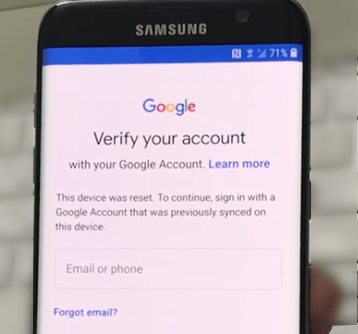
Google Account Verification on Android
Method 1: Recover the Previous Google Account First
If you are the original owner and still control the Google account, account recovery is the lowest-risk route. This is especially important if your query is closer to “unlock Google account without password” or “bypass Gmail,” because the problem may be account access rather than an FRP method.
Step 1. On another phone or computer, go to Google Account Recovery.
Step 2. Use your recovery phone number, backup email, or trusted device to verify ownership.
Step 3. If you recently changed the password, wait if Google requires a security hold before the account can be used on the reset phone.
Step 4. Return to the locked Android phone and sign in with the recovered Google account.
Step 5. After setup, update your recovery phone, backup email, and password manager so the same problem does not happen again.
Account checkpoint: If Google recovery can restore the previous account, do that before APK, SIM, keyboard, or PC-tool methods. It avoids file-source risk and keeps the device tied to the rightful owner.
Method 2: Ask the Previous Owner to Remove the Account
If the device is second-hand, the FRP screen may belong to the previous owner’s Google account. In that case, a normal reset, another SIM card, or a random APK will not prove ownership. The seller should remove the device from their Google account or complete setup with you.
Step 1. Contact the seller or previous owner.
Step 2. Ask them to remove the Google account from the phone or remove the device from their Google account device list.
Step 3. Ask the seller to complete setup in front of you when possible.
Step 4. After the phone is usable, remove old accounts and add your own Google account.
Step 5. Before the next reset, remove your Google account from Settings first.
If the page message specifically says a previously synced account is required, this previously synced Google account guide explains why the previous account remains relevant after reset.
Method 3: Bypass Google Account Verification with a PC Tool
A PC-based FRP tool becomes relevant when the phone is yours, account recovery cannot be completed, and older no-PC paths are blocked. This page should not treat any tool as universal. The important checks are Android version, brand, recovery mode, USB connection, and whether the tool workflow matches your phone screen.
DroidKit FRP Bypass provides guided desktop steps for supported Android FRP scenarios. It is most relevant when the phone still shows Google verification after reset, APK installation is blocked, keyboard routes do not open Settings, or the setup screen no longer exposes old shortcut paths.
Free Download * 100% Clean & Safe
Step 1. Download and install DroidKit on your Windows PC or Mac. Open the software and choose FRP Bypass.
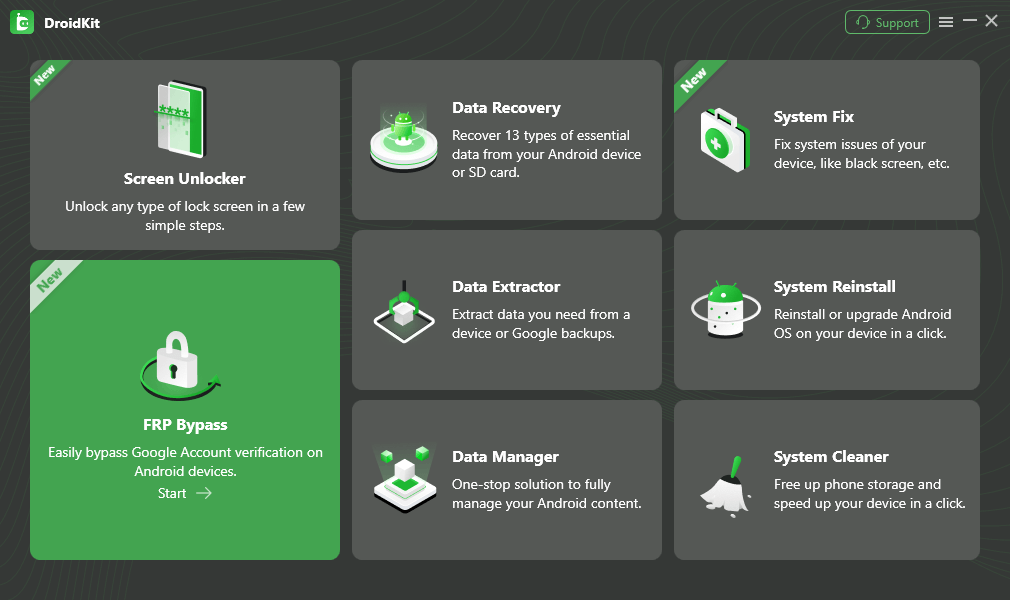
Choose FRP Bypass Mode
Step 2. Connect the locked Android phone with a stable USB data cable and click Start.
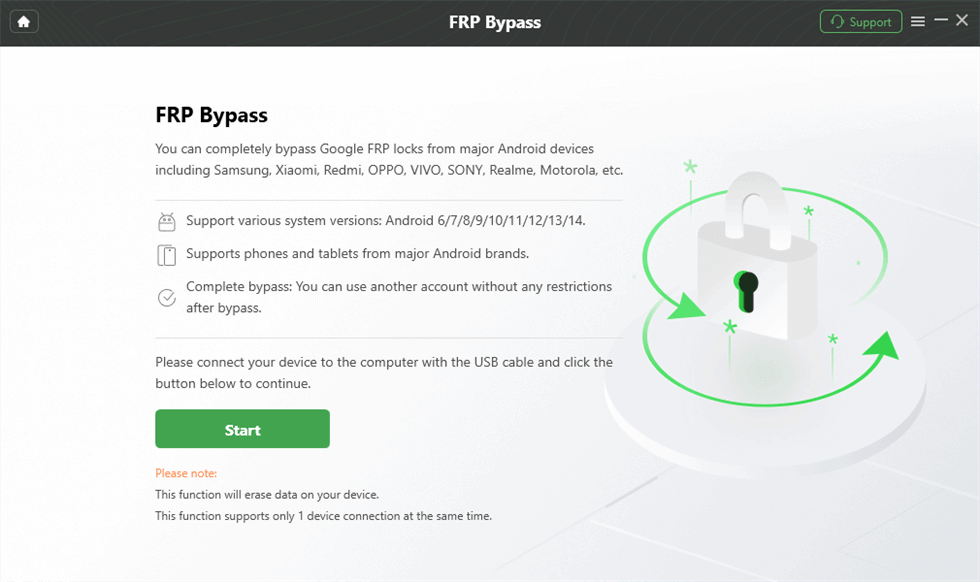
Connect your Phone and Start
Step 3. Wait while DroidKit prepares the configuration file. When the option appears, click Start to Bypass.
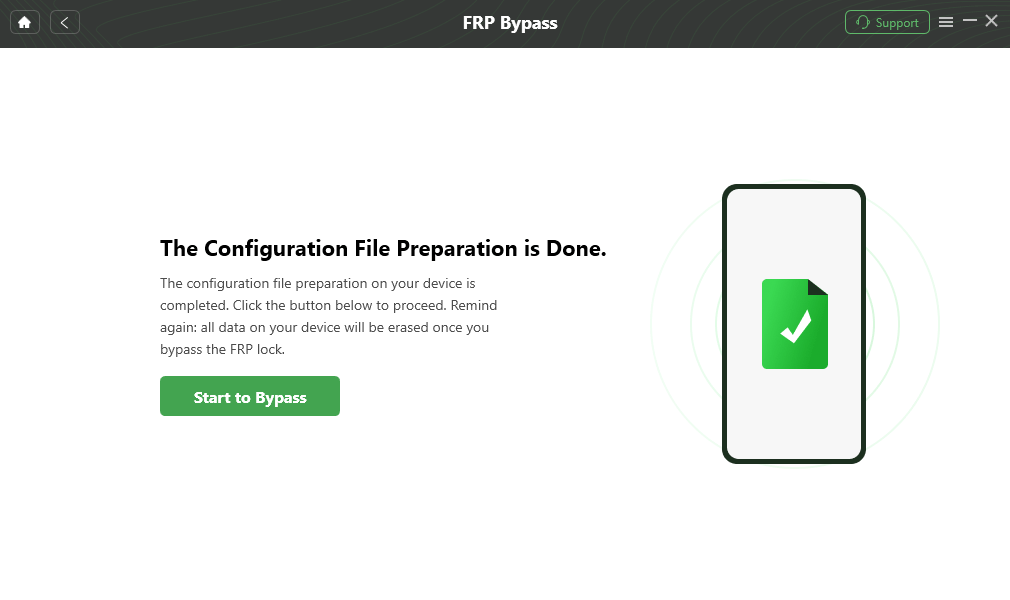
Click Start to Bypass
Step 4. Select the Android system version shown by your device and the software. Do not guess the version if the phone screen does not match the instructions.
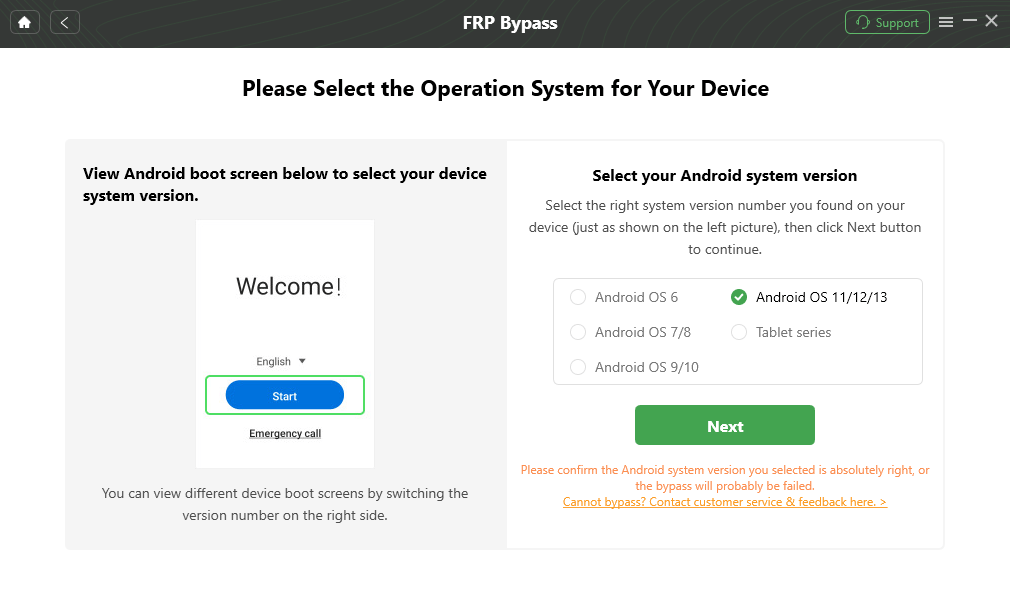
Select the System Version of the Device
Step 5. Follow the on-screen instructions and complete the required reset or recovery-mode steps for your supported device.
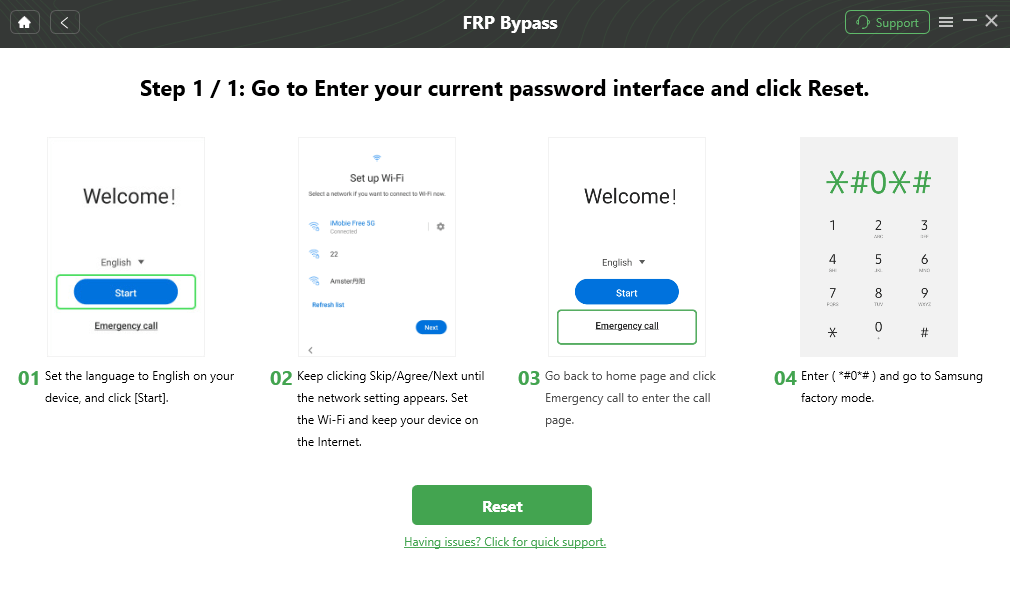
Click Reset Button
Step 6. Keep the phone connected until the process finishes. After the device restarts, set it up with a Google account you control.
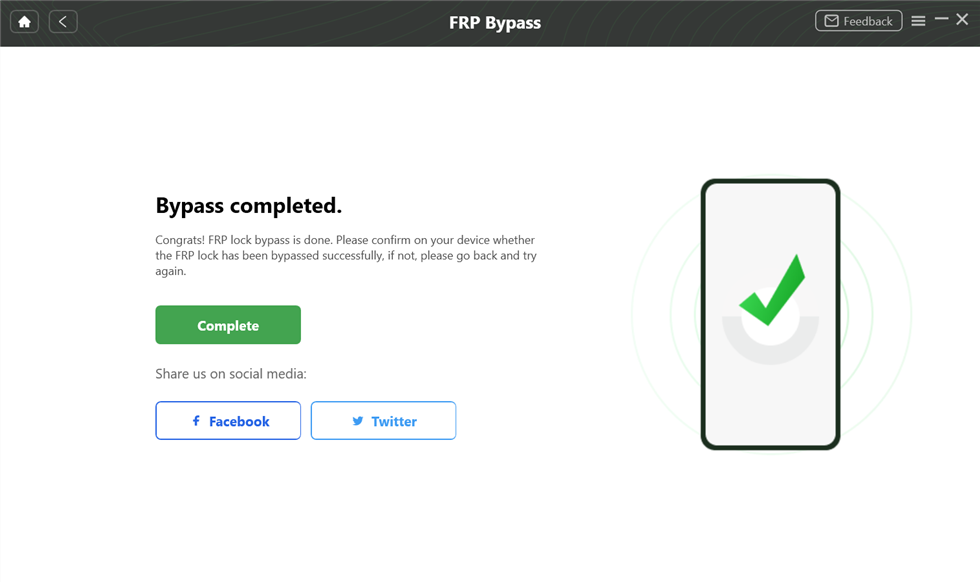
FRP Bypass Complete
Tool checkpoint: Stop if the phone model, Android version, USB state, or recovery screen does not match the tool instructions. A supported workflow is more important than a broad “Android FRP” label.
Method 4: Bypass Google Account Verification Without PC
No-PC searches usually come from users who want APK, OTG, browser, TalkBack, or setup-screen shortcut routes. These methods may work only when the phone still exposes the required entry point. On newer Android versions, the browser, file manager, unknown-source install, accessibility shortcut, or Settings path may be blocked.
| No-PC Route | What Must Still Be Available | Stop If… |
| FRP Bypass APK | Browser, file manager, download, install permission, and Settings access. | The APK says “App not installed” or unknown-source install is blocked. |
| OTG / USB drive route | OTG detection and file manager access during setup. | The phone does not open the USB file path. |
| TalkBack or Accessibility shortcut | Help, browser, YouTube, or Settings path must still open. | The shortcut no longer opens the expected page. |
| Emergency call / SIM route | Old setup behavior must still expose contact or settings access. | The dialer or contact path does not open anything useful. |
APK-based routes have their own file-source and version risks. Before installing any APK, read the FRP Bypass APK guide to check source, Android version, install behavior, and “App not installed” errors.
Method 5: Google Keyboard Method for Older Android
The Google Keyboard method belongs to older Android setup behavior. It may appear in old tutorials for Android 6 or earlier, but it is commonly blocked on modern Android builds. Use it only as a compatibility check, not as a guaranteed method.
Step 1. On the Google verification screen, tap the email or phone field to open the keyboard.
Step 2. Press and hold the @ key if the keyboard route appears.
Step 3. Tap keyboard settings if the option opens.
Step 4. Look for Help & Feedback.
Step 5. Try to open a help article and select text only if the screen allows it.
Step 6. Check whether Web Search or Settings can be opened.
Step 7. Stop if any of these entry points are missing. Newer Android builds often block this route before it reaches Settings.
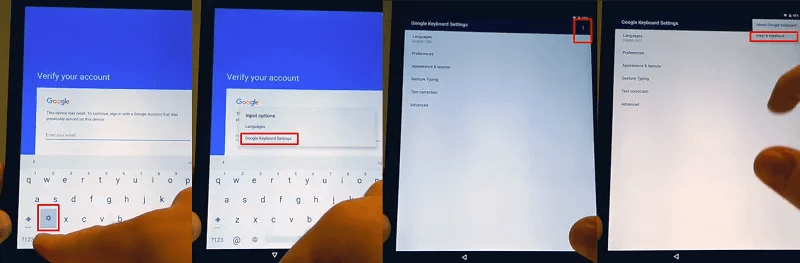
Go to the Help Page from Google Keyboard Settings
Method 6: SIM Card Trick — Why It Rarely Works Now
The SIM card trick is one of the oldest Google account bypass ideas. It relied on setup behavior that sometimes allowed call, contact, or notification actions before setup was complete. On current Android versions, this path is usually blocked or too inconsistent to rely on.
Step 1. Insert a SIM card only if your phone allows calls during setup.
Step 2. Call the locked phone from another phone.
Step 3. Check whether call controls, contact creation, or settings shortcuts appear.
Step 4. Stop if the call screen does not expose the expected options.
This method is included because users still search for old bypass routes. It should not be the main plan for Android 10, 11, 12, 13, 14, 15, or phones with recent security patches.
Google Account Verification Methods Compared
Use this table to avoid choosing a method only because it sounds fast. Match the method to the exact situation on your phone.
| Method | Best For | Main Limit | Risk Level |
| Google Account Recovery | Original owners who can verify the previous Google account. | May require recovery email, phone number, trusted device, or waiting period. | Low |
| Previous-owner removal | Second-hand devices still linked to the seller. | Requires seller cooperation. | Low |
| DroidKit FRP Bypass | Supported devices where account recovery is unavailable and no-PC routes are blocked. | Requires PC/Mac and compatibility checks. | Medium |
| FRP Bypass APK | Older devices where browser, file manager, and install paths still open. | File-source risk and blocked install paths. | Medium to High |
| Google Keyboard method | Older Android 6-era setup screens. | Often patched on newer Android versions. | Medium |
| SIM card trick | Very old setup behavior only. | Rarely exposes useful settings now. | Medium |
| Firmware or flashing routes | Technicians with exact model files and flashing experience. | Wrong firmware can cause boot or data issues. | High |
If you are comparing tool-based routes after a failed manual method, the best FRP bypass tool comparison can help you separate APK, PC, Samsung-focused, and service-style options.
Reddit-Style Cases: What Users Usually Mean
One of the current query patterns is similar to “how to skip Google account after factory reset Reddit.” Those searches often mix three different cases. Use the table below before following a random comment thread.
| Search Wording | What It Usually Means | Better Direction |
| How to skip Google account after factory reset | The user is stuck on FRP after reset. | Check account recovery, previous owner, Android version, and method availability. |
| How to unlock Google account without password | The user may need Google account recovery rather than FRP bypass. | Recover the account first and wait if a security hold applies. |
| Bypass Gmail | The user may be referring to the Google sign-in screen during setup. | Confirm whether it is FRP, Gmail login, or a brand account lock. |
| Bypass Google account 2022 | The user may be following an old method. | Check whether the method still works on the current Android version. |
| Google FRP bypass | Broad FRP intent across brands and Android versions. | Start with the problem type, then choose account recovery, no-PC, PC tool, or brand guide. |
Google Verification Bypass Not Working: Fix by Failure Point
If a bypass method fails, do not keep repeating the same route. The failure point usually tells you what changed.
| Failure Point | Likely Cause | Next Step |
| Google account recovery rejects login | Wrong account, recent password reset, or security verification issue. | Recover the correct account and wait if Google requires a hold. |
| Phone still asks for previous owner | The seller’s Google account is still linked. | Ask the seller to remove the device from their Google account. |
| Keyboard method does not open Help | Android setup path is patched. | Stop using that old method and check another route. |
| APK says App not installed | Wrong APK version, blocked unknown source, damaged file, or Android mismatch. | Check APK source and Android version before trying any file. |
| OTG drive is not detected | File manager or OTG access is blocked during setup. | Use a different route instead of changing APK files repeatedly. |
| PC tool does not detect the phone | USB cable, driver, device mode, or unsupported model issue. | Use a data cable, change USB port, and check compatibility. |
| FRP returns after restart | The method did not clear Google verification. | Use account recovery, seller removal, or a supported workflow. |
For a deeper failure map, use the FRP bypass not working guide before testing more APKs or tools.
How to Avoid Google Verification Before Resetting
The easiest way to avoid Google verification after reset is to remove the Google account before you reset, sell, trade in, or give away the phone.
Step 1. Open Settings on the Android phone before resetting it.
Step 2. Go to Accounts, Passwords & accounts, or Users & accounts.
Step 3. Select the Google account linked to the device.
Step 4. Tap Remove account and confirm with the screen lock if required.
Step 5. After the account is removed, perform the factory reset from Settings.
If you are preparing a device for sale, this guide to disabling Factory Reset Protection explains why account removal before reset matters.
FAQs About Google Account Verification After Reset
Why does my phone ask for Google account after factory reset?
The phone is likely protected by FRP. If a Google account was still linked before the reset, Android may ask for the previously synced account during setup.
Can a factory reset remove Google account verification?
No. A factory reset may trigger Google verification if the Google account was not removed before the reset. That is why the phone can still ask for the previous account after local data is erased.
How do I unlock Google account without password?
If you mean the Google account itself, use Google Account Recovery with your recovery email, phone number, or trusted device. If you mean the phone’s FRP screen, first confirm whether the phone belongs to you and whether the previous account can be recovered or removed.
Can I bypass Google account verification without a PC?
Sometimes, but mostly on older Android devices where browser, file manager, Settings, OTG, or APK install paths still appear during setup. On newer Android versions, no-PC paths are often blocked.
Is FRP bypass legal?
It is legal only when you are working on a phone you own or are authorized to repair. Bypassing Google verification on a stolen, lost, or unauthorized device can be illegal and unethical.
Why do old Google account bypass methods from 2022 stop working?
Many old methods relied on setup-screen shortcuts, keyboard Help pages, SIM tricks, OTG file access, or APK installation paths. Android updates, Google services changes, OEM setup changes, and security patches can block those routes.
What should I do if the phone is second-hand?
Contact the seller and ask them to remove the Google account from the device. Do not rely on random APKs or SIM tricks if the phone is still tied to someone else’s account.
Does bypassing Google verification erase data?
FRP usually appears after a factory reset, so the original local data may already be erased or inaccessible. Some additional reset, recovery, or tool-based methods may also affect device data or settings.
What is the best method for newer Android versions?
For newer Android versions, start by checking account recovery, previous-owner removal, and the exact device brand. If no-PC routes are blocked and the device is supported, a PC-based FRP workflow may be more realistic than keyboard, SIM, or random APK methods.
The Bottom Line
Bypassing Google account verification after reset starts with identifying the account problem, not downloading the first tool or APK you find. If you can recover the previous Google account, use that path. If the phone is second-hand, the seller should remove the linked account. If the screen shows “This device was reset,” treat it as an FRP ownership check rather than a normal password problem.
For older Android builds, keyboard, SIM, OTG, or APK methods may still appear in search results, but they depend on setup paths that are often patched. For supported devices where recovery and previous-owner removal are not available, a PC-based workflow can be considered after checking Android version, USB connection, and device compatibility.
Free Download * 100% Clean & Safe
More Related Articles


Roger Smith is a senior technical writer with years of experience in providing Android solutions. He loves to help users solve various problems such as Android unlock, Android data recovery, and Android system repair.
Product-related questions? Contact Our Support Team to Get Quick Solution >
