ST MTK Tool V3.0: Download, Safety & FRP Bypass Guide
ST MTK Tool V3.0 is mainly searched as a Windows download for MediaTek FRP work, but the key checkpoints are the archive source, MTK USB drivers, BROM or Preloader detection, and whether Erase FRP works on the exact device. This guide covers setup, FRP steps, common detection failures, and an alternative guided workflow.
ST MTK Tool is commonly searched by users who need a Windows utility for FRP work on a MediaTek-powered Android phone. You may also see the same search intent written as ST-MTK Tool, ST MTK Tool V3.0, or ST MTK Universal Tool V3.0.
A V3.0 ZIP or RAR label does not prove that a file is official, current, or compatible with your phone. Before running ST MTK Tool, verify the exact MediaTek chipset, evaluate the archive source, install the required USB driver, and identify whether the phone connects through Preloader or BROM mode.
Quick Answer: ST MTK Tool may be worth considering when you have an MTK-based Android device, a Windows PC, and enough technical experience to handle USB drivers and device-detection modes. It is a weaker fit when the archive source cannot be evaluated, the phone is not detected, or Erase FRP repeatedly fails. In those cases, identify the exact failure point before downloading another copy of the tool or changing FRP methods.
Use FRP servicing tools only on a phone or tablet you own or are explicitly authorized to repair. If the original Google account can still be recovered, completing normal account verification remains the most direct route.
What Is ST MTK Tool V3.0?
ST MTK Tool is a third-party Windows utility associated with servicing selected Android phones that use MediaTek chipsets. Its FRP-related interface includes options such as Erase FRP and a Samsung-specific FRP option in versions circulated online.
The tool is not a universal Android FRP solution. A phone brand alone does not determine compatibility because manufacturers can release regional or carrier variants with different chipsets. A Xiaomi, Redmi, OPPO, Vivo, Realme, Tecno, Infinix, or Samsung phone may use MediaTek in one version and another hardware platform in a different variant.
Before trying ST MTK Tool, verify the exact model number and chipset. If you are comparing utilities for several chipsets or device families, the Android FRP tool guide provides a broader starting point instead of assuming an MTK-specific utility will work on every Android phone.
What Is ST MTK Universal Tool V3.0 Used For?
Search results and download pages use several similar names, including ST MTK Tool V3.0, ST MTK Universal Tool V3.0, and ST MTK Tool 3.0. In the FRP context, users mainly look for the utility to communicate with a MediaTek device over USB and run an available FRP erase operation.
The working path generally depends on four checkpoints:
- The phone actually uses a compatible MediaTek chipset.
- Windows loads the required MTK USB driver correctly.
- The phone enters the connection mode expected by the tool.
- The exact device and security level accept the selected FRP operation.
If the process stops at one of these checkpoints, downloading another archive with a slightly different filename may not solve the underlying problem.
ST MTK Tool Pros and Limitations
| Factor | Potential Advantage | Main Limitation |
| Cost | Commonly circulated as a free utility | No single official distribution channel is identified in the supplied article |
| Chipset focus | Designed around MediaTek device workflows | Not intended as a general solution for Qualcomm, Exynos, Kirin, or Apple hardware |
| FRP operation | Provides direct FRP-related options in the interface | Results depend on the model, chipset, drivers, device mode, and security level |
| Setup | Runs from a Windows PC | Driver and device-detection troubleshooting can be difficult for beginners |
| Download | Third-party mirrors can be found online | Archives may be outdated, modified, or incorrectly labeled |
Is ST MTK Tool V3.0 Safe to Download?
The biggest safety question is not the phrase “V3.0” itself. It is whether you can identify and evaluate the exact archive you are downloading.
The download page referenced by the supplied article is hosted on Android File Host and points to an archive named install ST MTK Tool.zip. The page identifies a third-party uploader, so it should be treated as a mirror rather than proof of an official ST MTK release channel.
Before opening any ST MTK Tool ZIP or RAR archive:
- Check that the download page and archive name match what you expected.
- Scan the compressed archive before extracting it.
- Scan the extracted executable again before opening it.
- Avoid forced installers, browser extensions, unrelated password requests, and unexpected bundled software.
- Do not disable Windows Defender simply to force an unknown executable to run.
- If security software repeatedly flags a file and you cannot explain the detection, stop instead of creating broad security exclusions.
A search such as ST MTK Universal V3.0 RAR describes an archive format and version label; it does not establish authenticity. Two packages with nearly identical filenames can contain different files.
Should You Turn Off Antivirus for ST MTK Tool?
Do not turn off system-wide protection just because an installation tutorial tells you to do so. Scan the archive, inspect the source, check the extracted files, and stop if the package cannot be evaluated with confidence.
If you are deciding between third-party MTK utilities, commercial desktop software, and other FRP routes, the FRP bypass tool comparison helps compare broader tool choices rather than focusing on a single ST MTK archive.
ST MTK Tool V3.0 Download & FRP Bypass Steps
The workflow below preserves the main ST MTK Tool process while making the device-detection checkpoints clearer. Exact connection behavior can differ by phone, chipset, driver package, security level, and tool build.
Before starting, prepare:
- A Windows computer.
- A stable USB data cable.
- The exact Android model number.
- Confirmation that the phone uses a MediaTek chipset.
- The appropriate MTK USB driver for the device workflow.
- Enough battery power to avoid interruption.
Step 1. Obtain the ST MTK Tool archive from a source you have evaluated. The supplied article references an Android File Host mirror for an archive named install ST MTK Tool.zip. Treat it as a third-party mirror rather than an official ST MTK distribution channel.
Step 2. Scan the downloaded ZIP archive before extracting it. Extract the package to a dedicated folder and scan the executable files again.
Step 3. Install the MediaTek USB drivers required by the device workflow. If Windows cannot detect the phone in the required connection mode, ST MTK Tool cannot proceed correctly.
Step 4. Open the extracted ST MTK Tool folder and run the intended executable with administrator permission only after checking the source and files.
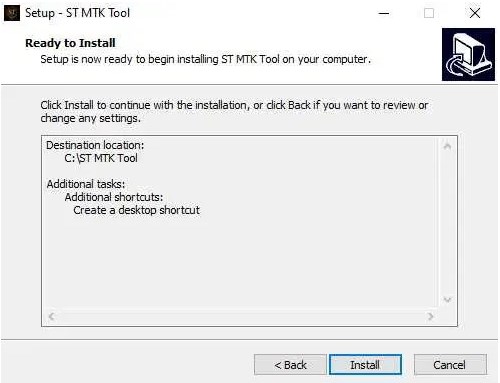
Open ST MTK Tool on the Windows computer.
Step 5. Power off the MediaTek Android device completely.
Step 6. Connect the phone with a reliable USB cable using the connection procedure required by the exact model. Some MTK workflows detect the phone through Preloader mode, while others require a Boot ROM or BROM connection procedure.
Step 7. Wait for the tool to detect the device. Do not choose a different chipset or device route simply because the correct option is missing.
Step 8. In the ST MTK Tool interface, select the FRP operation that matches the device scenario supported by the tool, such as Erase FRP or the Samsung-specific option shown in the interface.
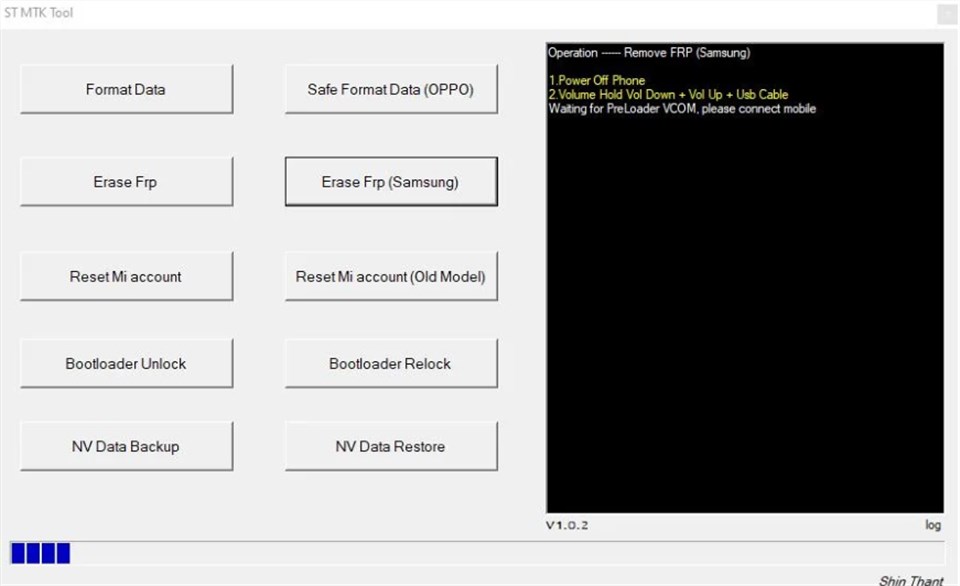
Choose the appropriate FRP operation after the MTK device is detected.
Step 9. Keep the USB connection stable while the operation is running. Do not unplug the device during an active process.
Step 10. After the tool reports completion, restart the phone and check the setup screen. If Google verification remains, do not immediately repeat random erase or format operations. Diagnose the failure point first.
ST MTK Tool Not Working: Common Fixes
Many ST MTK Tool failures occur before the FRP operation actually starts. Instead of repeatedly clicking Erase FRP, identify the stage where communication breaks down.
| Problem | Likely Check | Next Action |
| Tool does not detect the phone | Driver, cable, USB port, device mode, chipset | Confirm the MTK chipset and repair the detection path first |
| Device connects and disconnects repeatedly | USB stability, Preloader/BROM timing, driver conflict | Try another data cable or USB port and check the driver installation |
| Erase FRP fails immediately | Unsupported device, wrong mode, tool-build limitation | Stop repeating the operation and check the exact model and connection state |
| Tool reports success but verification remains | Operation did not match the device scenario or security level | Recheck the exact model and use a device-appropriate route |
| Archive is flagged by security software | Unknown source, modified package, false positive, or unsafe file | Do not disable protection blindly; evaluate the file or use another route |
1. ST MTK Tool Is Not Detecting the Phone
First confirm that the phone actually uses a MediaTek chipset. Then check Windows Device Manager, USB cable quality, USB port stability, and the MTK driver installation. Detection should be fixed before changing FRP settings inside the tool.
2. The Phone Keeps Connecting and Disconnecting
A repeating connection loop can point to USB instability, a driver conflict, or device-mode timing. Try a known-good data cable, a direct USB port on the computer, and the connection sequence required by the exact phone model.
3. BROM or Preloader Mode Does Not Work
Do not assume one button combination works on every MediaTek phone. Connection behavior varies by manufacturer and model. Check the procedure for the exact device instead of copying instructions from another phone that only shares the same chipset family.
4. Erase FRP Fails or Google Verification Remains
If the device is detected but Erase FRP fails, the problem may be device compatibility, security level, connection state, or a limitation of the particular tool build. Repeating unrelated format or erase functions can increase the risk of data loss or startup problems.
5. ST MTK Tool V3.0 Download Is Flagged
Do not solve an unexplained security alert by turning protection off permanently. Recheck the mirror, archive name, extracted files, and whether the package matches the source description. If the origin cannot be evaluated, switching workflows is more sensible than creating security exclusions for an unknown executable.
ST MTK Tool vs. Other FRP Routes
The right next step depends on why you searched for ST MTK Tool. A technician who already understands MTK drivers and BROM communication has different needs from a user whose main goal is to get through Google verification on a supported device.
| Situation | Better Starting Point | Reason |
| You have an MTK phone and understand drivers and device modes | ST MTK Tool or another MTK-specific utility | You can diagnose chipset and connection problems manually |
| You are comparing several FRP utilities | Android FRP tool guide | You need a broader tool-selection view rather than one MediaTek download |
| The archive source looks questionable | Stop and evaluate another route | A V3.0 label alone does not establish authenticity |
| The device is repeatedly not detected | Driver and connection troubleshooting | An FRP operation cannot begin without stable device communication |
| You prefer on-screen instructions for a supported device | Guided FRP software | It reduces the amount of manual MTK driver and BROM troubleshooting |
ST MTK Tool Alternative for FRP Bypass
ST MTK Tool is most relevant when you specifically need a MediaTek-oriented Windows workflow and are comfortable troubleshooting chipset detection, USB drivers, and BROM or Preloader communication. If the archive source cannot be evaluated, the phone never appears in the expected mode, or manual MTK troubleshooting is becoming the main obstacle, downloading more copies of the same utility usually does not fix the underlying issue.
For supported Android device routes, DroidKit FRP Bypass provides a guided desktop workflow. It is accessed through iMobie rather than requiring users to search third-party mirrors for an ST MTK ZIP or RAR archive.
When DroidKit May Be a Better Fit
- You cannot confirm that the ST MTK archive comes from a source you trust.
- Your device is not detected and you do not want to troubleshoot MTK drivers or BROM communication manually.
- You prefer on-screen instructions for an available supported device route.
- You want a structured desktop workflow instead of working from third-party archives.
Step 1. Download and install DroidKit on your computer. Open the program and choose FRP Bypass.
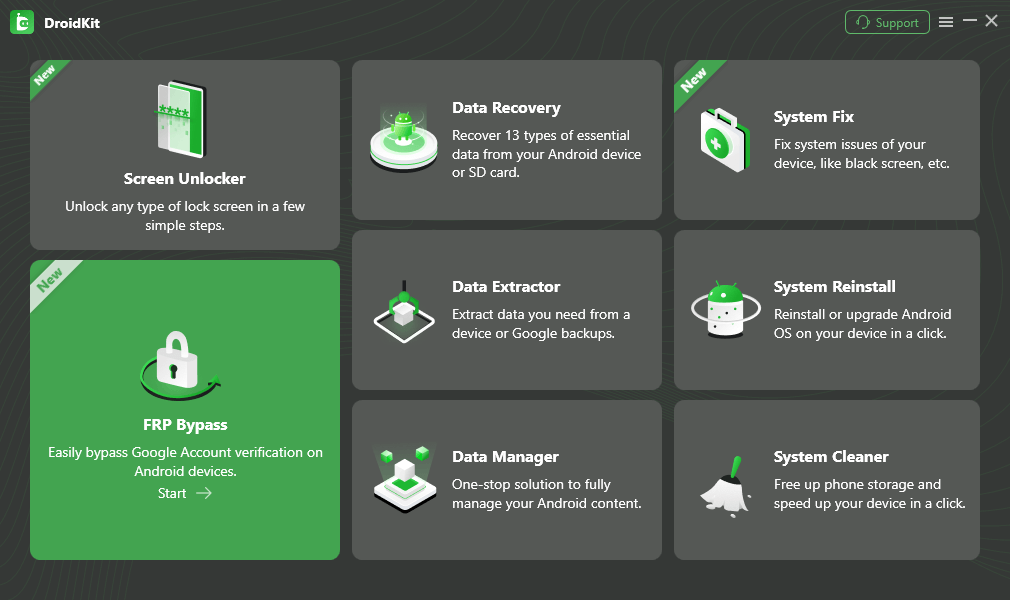
Choose FRP Bypass from the DroidKit main screen.
Step 2. Connect the Android device with a USB data cable. After the device is recognized, click Start to continue.
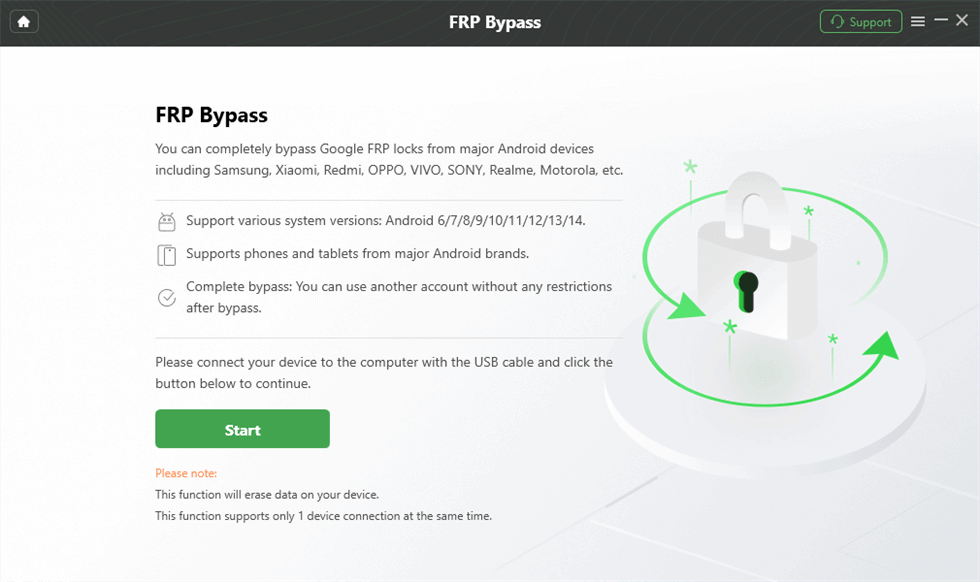
Connect the device and start the FRP workflow.
Step 3. Wait while the required configuration is prepared. When the software prompts you, click Start to Bypass.
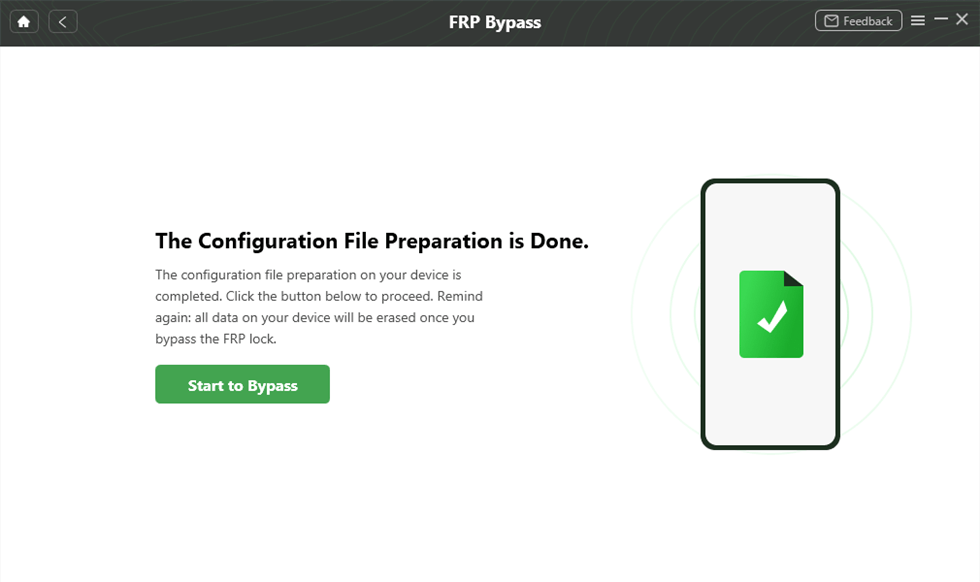
Wait for the FRP configuration process to finish.
Step 4. Follow the instructions shown for the detected device route and complete the requested operations on the phone.
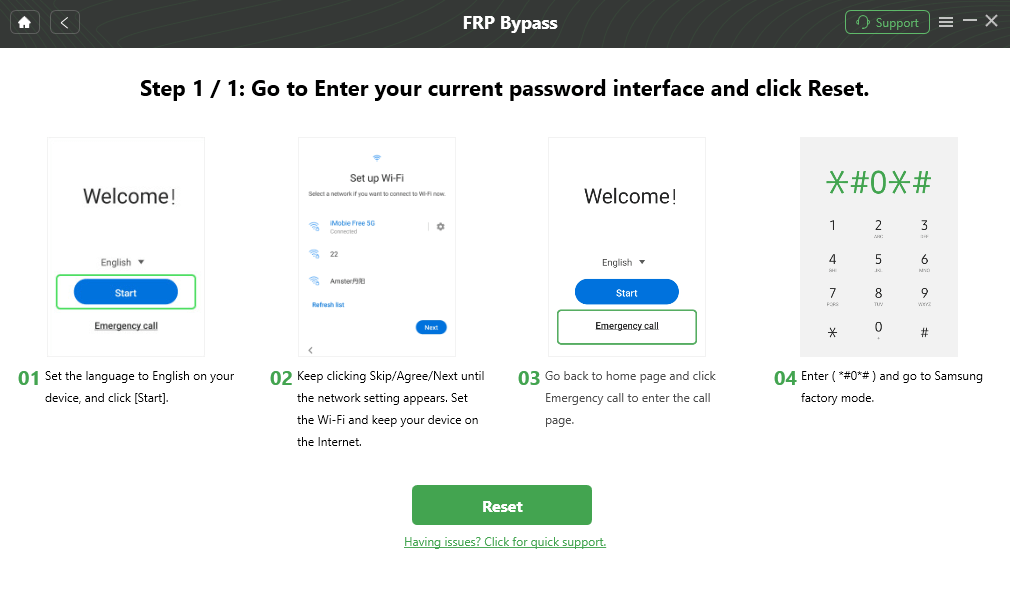
Complete the device-side steps shown by the software.
Step 5. Keep the device connected until the software reports that the process is complete.
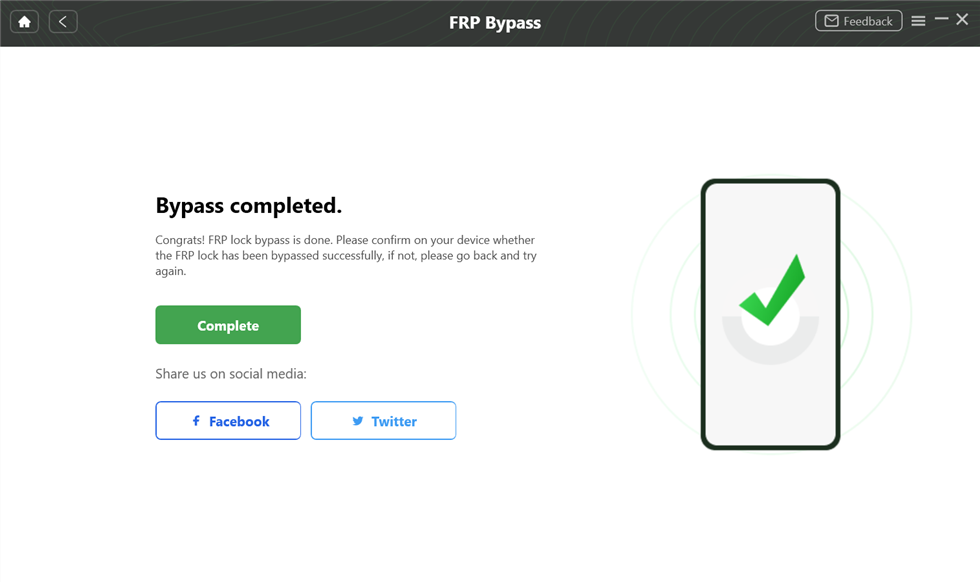
Complete the guided FRP workflow.
DroidKit is commercial software. Check the available supported device route before purchasing. The reason to consider switching from ST MTK Tool is not simply that one utility is commonly circulated for free and the other is commercial; the more useful question is whether your blocker is an untrusted archive, failed MTK detection, BROM setup difficulty, or a preference for guided device-specific instructions.
FAQs About ST MTK Tool
Where can I download ST MTK Tool V3.0?
The supplied article references an Android File Host mirror for an archive named install ST MTK Tool.zip. Because the page identifies a third-party uploader rather than a single official ST MTK release channel, evaluate the source information and scan the archive before opening it.
Is ST MTK Tool V3.0 free?
ST MTK Tool is commonly circulated as a free third-party utility. Be cautious of sites that use the tool name to push unrelated paid installers, forced extensions, or suspicious download buttons.
Is ST MTK Universal Tool V3.0 the same as ST MTK Tool?
The names are often used for closely related search and download intent, but a similar filename does not guarantee identical contents. Check the exact archive source and executable instead of relying only on terms such as V3.0, Universal, ZIP, or RAR.
Does ST MTK Tool work on every Android phone?
No. ST MTK Tool is associated with MediaTek device workflows and should not be treated as a universal tool for other chipset platforms. Even among MediaTek phones, results can depend on the exact model, chipset, security level, drivers, connection mode, and tool build.
Why is ST MTK Tool not detecting my phone?
Common checkpoints include an incorrect chipset assumption, missing or conflicting MTK USB drivers, a poor USB cable, an unstable USB port, or failure to enter the connection state expected by the device workflow. Diagnose detection before repeatedly selecting Erase FRP.
Do I need BROM mode to use ST MTK Tool?
Some MediaTek workflows require Boot ROM or another low-level connection state, while others may use Preloader detection. The exact requirement depends on the phone and tool workflow. Follow information for the exact model instead of copying a connection sequence from another MTK device.
Should I disable Windows Defender to install ST MTK Tool?
Do not disable system-wide protection merely to run an unknown executable. Scan the archive and extracted files, evaluate the source, and stop when you cannot explain a repeated security detection.
What should I do if Erase FRP does not work?
Stop repeating random erase or format operations. Confirm the phone model, chipset, driver state, connection mode, and whether the tool build fits that device scenario. If the download source or technical setup is the main blocker, use another appropriate route rather than trying unrelated low-level functions.
Conclusion: Check the MTK Failure Point Before Switching Tools
With ST MTK Tool V3.0, the main question is not simply where to click Download. First confirm the MediaTek chipset and archive source. Then establish stable driver and BROM or Preloader communication before judging whether Erase FRP is suitable for the exact phone.
If ST MTK Tool detects the device and you understand the MTK workflow, troubleshoot the stage that actually failed rather than collecting differently named copies of the same archive. If the package source cannot be evaluated, the phone never connects correctly, or low-level MTK troubleshooting is outside your experience, a guided workflow for an available supported device route may be a more practical next step.
More Related Articles



Joy Taylor is a seasoned technical writer with over a decade of experience in mobile technology. At iMobie, she specializes in producing in-depth content on iOS data recovery, iPhone unlocking solutions, and iOS troubleshooting.
Product-related questions? Contact Our Support Team to Get Quick Solution >
