AddROM FRP Bypass APK: Download, Settings, and What Still Works in 2026
AddROM FRP Bypass APK is a legacy Android FRP route associated with APK downloads, Settings shortcuts, Google Account Manager packages, and the add.rom/frpbypass search phrase. This guide explains what those terms mean, why AddROM may show “App not installed” or fail to open Settings, how to screen APK risks, and when to stop using the legacy route.
Quick Answer: AddROM FRP Bypass APK belongs to an older group of Android FRP methods that depend on setup-screen shortcuts, browser or Settings access, APK installation, and in some guides a matching Google Account Manager package. Whether the route still applies depends on the exact phone, Android build, security patch, and which setup options remain accessible.
Searches for addrom apk, addrom settings, and add.rom/frpbypass often lead back to legacy FRP instructions rather than one verified universal download. If the APK says “App not installed,” Settings will not open, Google Account Manager fails, or the browser shortcut shown in an old video is missing, treat that as a compatibility signal instead of downloading random replacement files.
FRP protects an Android phone after a factory reset by requesting a Google Account that was previously synced with the device. Use the information below only for a device you own or are authorized to service. If the phone still belongs to another person’s Google account, resolving that account relationship should come before trying third-party APK files.
Table of ContentsHide
Before Using AddROM: Confirm the FRP Problem
What Is AddROM FRP Bypass APK?
AddROM APK, AddROM Settings, and add.rom/frpbypass Explained
Does AddROM FRP Bypass Still Work in 2026?
Is AddROM FRP Bypass APK Safe to Download?
AddROM Not Working: APK, Settings, and GAM Fixes
AddROM vs. Other Legacy FRP APK Routes
Checklist Before Trying AddROM
AddROM vs. DroidKit: Which Route Fits?
What to Do When the AddROM Route Is Blocked
FAQs About AddROM FRP Bypass APK
Before Using AddROM: Confirm the FRP Problem
AddROM is relevant only when the problem is Google verification after a factory reset. A phone that is asking for its normal PIN, pattern, Samsung account, Mi Account, or another manufacturer-specific lock has a different problem.
If Android shows “Verify your account,” “This device was reset,” or asks for a Google Account previously synced with the phone, see the Google verification after factory reset guide to distinguish account recovery, previous-owner issues, password-change delays, and FRP-specific methods before relying on an APK route.
AddROM is only one legacy path within that larger FRP situation. If you still know the Google Account, can recover it, or can contact the previous owner of a used phone, resolve that first rather than treating an APK as the default solution.
What Is AddROM FRP Bypass APK?
AddROM FRP Bypass APK is a name associated with older Android FRP instructions that use APK packages, Android Settings activities, browser shortcuts, Google Account Manager, or similar setup-screen paths. It is not an official Google or Android recovery tool.
The important detail is that “AddROM” does not describe one universally compatible APK. An old walkthrough may rely on a particular Android build, Google Account Manager version, setup wizard, browser path, or Settings activity. A file that appears in one tutorial may fail on another phone even when both devices show the same Google verification screen.
Typical AddROM-related checkpoints include:
- Whether the setup screen can still open a browser or search activity.
- Whether Android Settings can be reached before verification is completed.
- Whether APK installation is allowed from that setup state.
- Whether the Google Account Manager package expected by the guide matches the phone.
- Whether shortcut activities used by the walkthrough still exist.
- Whether the downloaded file comes from a source you can evaluate.
If any of those checkpoints is different, a copied AddROM walkthrough may stop even though the APK filename appears correct.
AddROM APK, AddROM Settings, and add.rom/frpbypass Explained
AddROM search results mix several different ideas. Understanding the search term first is more useful than downloading every file that contains the AddROM name.
| Search Term | What It Usually Refers To | What to Check |
| addrom | General legacy FRP instructions associated with AddROM | Exact phone, Android build, security patch, and guide date |
| addrom apk | An APK used somewhere in an older FRP workflow | Source, filename, permissions, and whether the package matches the walkthrough |
| addrom settings | A shortcut intended to reach Android Settings during setup | Whether that Settings activity is still accessible on the device |
add.rom/frpbypass |
A URL-like phrase copied from older FRP videos or instructions | Do not assume the phrase is a current or official download destination |
| AddROM Google Account Manager | A GAM package used by some legacy instructions | Android-version and package compatibility |
| QuickShortcutMaker with AddROM | A shortcut-activity technique found in older tutorials | Whether the required Android activity can still open during setup |
The existence of an AddROM APK file does not prove that the complete FRP workflow will work. The setup path around the APK is usually just as important as the file itself.
Does AddROM FRP Bypass Still Work in 2026?
AddROM should be treated as a legacy, build-dependent method rather than a universal 2026 FRP solution. The useful question is not simply whether AddROM “works,” but whether your phone still exposes the exact browser, Settings, APK, GAM, and shortcut behavior expected by the guide you are following.
Check the AddROM Failure Points
| What You See | What It Suggests | What to Do Next |
| The required browser or search option opens | One legacy entry point is still available | Continue only if the remaining instructions also match the exact phone |
| AddROM APK says “App not installed” | The package, installation state, or Android build may not match | Do not cycle through random APK versions |
| AddROM Settings will not open | The Settings activity used by the old route may be restricted | Treat the walkthrough as incompatible with the current setup state |
| Google Account Manager will not install or open | The GAM package may not match the Android framework expected by the guide | Do not download multiple unknown GAM files simply to experiment |
| Unknown-source installation is unavailable | The setup wizard does not expose the installation path used by the tutorial | Stop the APK route rather than disabling unrelated security controls |
| A video shows menus your phone does not have | The device, build, region, or patch level differs | Compare the actual model and software rather than the brand name alone |
A missing menu is useful information. It usually means the legacy route does not match the current phone state, not that you need a differently named copy of the same APK.
Why Device and Brand Differences Matter
AddROM instructions are often copied between Samsung, Huawei, Xiaomi, Motorola, Tecno, Infinix, and other Android devices even though their setup wizards and security layers can differ substantially.
| Device Factor | Why It Matters |
| Exact model number | Two phones with similar product names may expose different setup activities. |
| Android build | Browser, Settings, and package-install behavior can change between builds. |
| OEM software | Samsung One UI, Xiaomi software, Huawei software, and other OEM layers use different setup flows. |
| Security patch | A previously accessible shortcut can be closed by a security update. |
| Google Account Manager package | A package used in an older guide may not fit the framework on another device. |
For that reason, avoid compatibility claims based only on a broad Android version. The actual setup behavior on the target device is the stronger checkpoint.
Is AddROM FRP Bypass APK Safe to Download?
AddROM download safety deserves extra attention because many APK files associated with legacy FRP methods are distributed outside official app stores or manufacturer channels. A familiar filename or a “latest” label does not establish file authenticity.
| Risk | What It Can Mean | Recommended Check |
| Renamed or fake APK | The file may use the AddROM name without containing the package expected by the guide | Evaluate the source and file details before installation |
| Modified package | The APK may contain additional code or unwanted components | Scan the file and avoid unexplained permissions |
| Version mismatch | The APK or GAM package may target a different Android environment | Stop rather than testing many unknown versions |
| Credential harvesting | A suspicious app or webpage may request Google credentials | Never enter account credentials into an untrusted app or page |
| Misleading download buttons | Advertising pages can redirect to unrelated installers or files | Do not install software that does not match the package you intended to obtain |
Do not disable security software, accept unrelated permissions, or install several unknown packages simply because an old AddROM tutorial expects a particular APK to launch.
AddROM Not Working: APK Install, Settings, and GAM Fixes
AddROM failures are more useful when diagnosed by the stage where the route stops. An installation error is different from a missing Settings shortcut, and both are different from a Google Account Manager mismatch.
AddROM APK Says “App Not Installed”
An “App not installed” message can indicate that the APK does not fit the device environment, the installation route is restricted, the package conflicts with another component, or the setup wizard no longer allows the legacy workflow.
Do not respond by downloading ten differently named AddROM files. First confirm that the exact guide was written for the target model and software state. If it was not, the installation failure may simply show that the route is no longer applicable.
AddROM Settings Does Not Open
Older AddROM instructions may depend on opening a Settings activity from a browser, shortcut app, or setup-screen link. If tapping the expected option does nothing or returns to setup, that Settings path may be restricted on the current build.
Repeating the same shortcut or searching for another copied page normally does not restore an activity that the system no longer exposes.
Google Account Manager Will Not Install or Open
Google Account Manager packages used in older FRP tutorials are version-sensitive. If the GAM file expected by the guide does not install or crashes when opened, do not assume another random GAM APK is safe or compatible.
Instead, treat the mismatch as evidence that the walkthrough may have been written for a different Android framework.
Browser or File Access Is Blocked
A legacy no-PC method cannot proceed through its normal APK path if the setup wizard no longer exposes browser downloads, file access, or package installation. The absence of those options is a reason to change strategy, not a reason to weaken unrelated security settings.
AddROM Worked in a Video but Not on My Phone
Compare the video’s exact model, Android build, OEM software, security patch, menu layout, and package filenames with your phone. A video that looks visually similar can still demonstrate a different setup environment.
The Downloaded APK Looks Suspicious
If the file source is filled with deceptive buttons, redirects, unrelated installers, or unexplained permission requests, do not continue. AddROM search intent does not make an unknown APK trustworthy.
AddROM vs. Other Legacy FRP APK Routes
AddROM is often researched alongside VNROM, Technocare APK, and QuickShortcutMaker because all of them appear in older Android FRP instructions. They should be compared by workflow and device fit rather than by which APK has the newest-looking filename.
| Option | Common Role in Legacy Guides | Main Limitation |
| AddROM | APK, Settings, GAM, or shortcut-based FRP route | Depends heavily on setup access and package matching |
| VNROM | APK-oriented FRP instructions for various Android devices | Source and compatibility claims vary |
| Technocare APK | Commonly associated with older Samsung FRP walkthroughs | Exact Samsung build and setup behavior matter |
| QuickShortcutMaker | Attempts to open specific Android activities | The required activities may be restricted during setup |
If you have already established that an APK route does not match your phone, compare broader FRP bypass tool options instead of moving from one unknown APK mirror to another.
AddROM Checklist Before You Try Any FRP Method
| Check | Question to Answer |
| Ownership | Do you own the device or have clear authorization to service it? |
| Lock type | Is the phone actually showing Google FRP verification after reset? |
| Exact device | What is the model number, Android build, OEM software, and security patch? |
| Guide match | Does the AddROM walkthrough show the same menus and setup state as your phone? |
| APK source | Can you evaluate where the file came from and what it requests? |
| Settings access | Does the Settings activity used by the guide actually open? |
| GAM dependency | Does the guide require a Google Account Manager package, and is that dependency appropriate for the phone? |
If several of these answers are unknown, do not treat the AddROM APK as the next automatic step. Establish the actual phone state first.
AddROM vs. DroidKit: Which Route Fits Your Situation?
AddROM and DroidKit represent two different FRP approaches. AddROM is associated with legacy mobile APK and Settings routes. DroidKit FRP Bypass is a computer-based workflow that provides on-screen steps for device routes supported by the software.
| Factor | AddROM | DroidKit FRP Bypass |
| Workflow | Legacy APK, browser, Settings, or shortcut route | Desktop software workflow |
| Main checkpoint | Whether the required setup activities and APK path still exist | Whether the connected device route is supported by the software |
| File-source concern | Third-party APK source must be evaluated carefully | Software is obtained through iMobie |
| Computer | Many legacy AddROM routes are mobile-only | Windows or Mac computer required |
| When it becomes relevant | The exact legacy walkthrough matches the phone | AddROM entry points are blocked and a supported desktop route is available |
Changing to a desktop tool is most logical when you have already identified the AddROM blocker—for example, Settings will not open, APK installation is unavailable, or the GAM dependency does not match the phone. The reason to switch is that the workflow no longer fits, not simply that one method is newer than another.
What to Do When the AddROM Route Is Blocked
If AddROM stops at the APK, Settings, browser, shortcut, or Google Account Manager stage, do not keep replacing files until something installs. First decide which of these situations applies:
- You still have access to the Google Account and can recover it.
- The device is second-hand and the previous owner needs to resolve the linked account.
- The AddROM walkthrough clearly targets another phone or Android build.
- The legacy setup-screen shortcut is no longer available.
- You need a different FRP method whose device support can be checked before use.
For a supported device route, DroidKit provides the following general desktop flow:
- Step 1. Open DroidKit on a Windows or Mac computer and select FRP Bypass.
- Step 2. Connect the Android device with a USB data cable.
- Step 3. Select the device information requested by the software.
- Step 4. Follow the instructions presented for the available device route.
- Step 5. Keep the phone connected until the workflow completes or the software provides the next instruction.
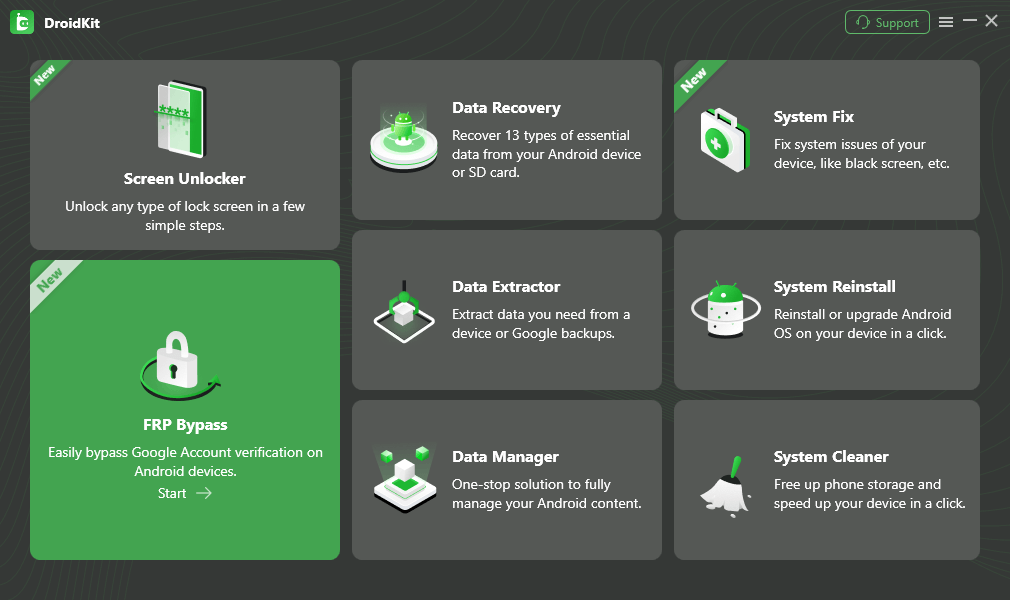
Check the available device route before proceeding. A desktop workflow should not be presented as proof that every model, Android build, or security patch is supported.
FAQs About AddROM FRP Bypass APK
What is AddROM FRP Bypass APK?
AddROM FRP Bypass APK is a name associated with older Android FRP workflows that may use APK files, Settings shortcuts, Google Account Manager, browser access, or other setup-screen activities. It is not an official Google or Android recovery tool.
Does AddROM FRP Bypass still work in 2026?
It can only be evaluated against the exact phone and software state. If the browser path, Settings activity, APK installation route, Google Account Manager dependency, or shortcut expected by the guide is missing, the legacy AddROM workflow does not match that device state.
What does “addrom settings” mean?
“Addrom settings” usually refers to a legacy FRP step that attempts to open Android Settings from the setup process. If the relevant activity is restricted on your phone, the route may stop before an APK can be used.
What is add.rom/frpbypass?
It is a URL-like search phrase that appears in copied FRP instructions and older videos. It should not automatically be treated as an official or current AddROM download destination.
Is AddROM FRP Bypass APK safe to download?
Safety depends on the exact file and source. Third-party APKs can be outdated, modified, renamed, or bundled with unwanted components. Scan files, review permissions, and never enter Google credentials into an app or webpage you do not trust.
Why does AddROM say “App not installed” or stop working?
Common causes include a mismatched APK, restricted package installation, a Google Account Manager mismatch, blocked Settings access, a changed setup flow, or a guide intended for another device build.
Do I need a computer to use AddROM?
Many legacy AddROM instructions are mobile-based and do not use a computer. However, if the phone blocks the required browser, Settings, APK, or shortcut path, being a no-PC method does not make the route usable on that device.
The Bottom Line
AddROM searches can make the problem look like a missing APK download, but the decisive details are usually elsewhere: whether the setup browser opens, whether Settings can be reached, whether the APK installs, whether the Google Account Manager dependency matches, and whether the walkthrough was written for the same device state.
If AddROM shows “App not installed,” Settings refuses to open, or the required shortcut is missing, use that failure to diagnose compatibility. Do not keep replacing APKs until one happens to install. A legacy FRP route that no longer matches the phone should be abandoned rather than forced.


Roger Smith is a senior technical writer with years of experience in providing Android solutions. He loves to help users solve various problems such as Android unlock, Android data recovery, and Android system repair.
Product-related questions? Contact Our Support Team to Get Quick Solution >
