How to Transfer Music from Windows Media Player to iPhone
Want to move Windows Media Player songs to your iPhone? Learn how to find the original music files, sync them with Apple Music and Apple Devices on Windows, or add selected songs with AnyTrans without traditional full-library syncing.
If you have songs in Windows Media Player and want them on your iPhone, you are really transferring the music files stored on your Windows PC. Windows Media Player itself does not sync an iPhone music library directly.
On a current Windows setup, Apple’s official path is to import those local songs into the Apple Music app and then sync them to the iPhone with Apple Devices. If you only want to add selected songs without managing a full Apple Music library, AnyTrans provides a separate computer-to-iPhone music transfer workflow.
Quick answer: Find the actual MP3, AAC, or other compatible song files used by Windows Media Player. For Apple’s official method, import them into Apple Music for Windows, connect the iPhone, and sync Music through Apple Devices. For selective transfer, open AnyTrans > Music > Songs and add only the files you want.
Method 1. Sync Windows Media Player Music with Apple Music and Apple Devices
For a current Windows PC, Apple’s own workflow uses two apps:
- Apple Music to manage the music library on the PC;
- Apple Devices to sync that music to an iPhone, iPad, or iPod.
The songs do not need to remain inside Windows Media Player. As long as you can locate the original compatible music files on your PC, you can import them into Apple Music.
Step 1. Find the Music Files on Your Windows PC
Locate the MP3, AAC, WAV, or other audio files you want to move. If you do not know where Windows Media Player stored them, see the file-location section below.
Step 2. Import the Songs into Apple Music for Windows
Open the Apple Music app on Windows.
Use the sidebar menu and choose Import, then select the song files or folder containing your Windows Media Player music.
You can also drag compatible music files or folders from File Explorer into the Apple Music window.
Apple Music may keep a reference to the original file rather than creating another copy, depending on your library settings. Do not move or delete the original music files afterward unless you know they were copied into the Apple Music media folder.
Step 3. Connect the iPhone
Connect the iPhone to the Windows PC with a USB or USB-C cable.
If this is the first connection, unlock the iPhone and tap Trust when prompted.
Step 4. Open Apple Devices
Launch the Apple Devices app on Windows and select your iPhone in the sidebar.
Step 5. Choose Music
Select Music in the Apple Devices sidebar.
You can choose to sync the entire music library or only selected artists, albums, genres, and playlists, depending on the available sync settings.
Step 6. Apply the Sync
Review your selection and click Apply or start the sync.
Keep the iPhone connected until Apple Devices finishes transferring the music.
Watch for library-replacement warnings. If the iPhone is currently synced with another computer music library, changing its sync relationship can replace previously synced music. Read the Apple Devices warning before confirming the operation.
Can You Still Use iTunes?
Compatible Windows setups can still use iTunes for traditional music syncing. However, it should no longer be presented as the only official Windows method.
For a current Apple Windows setup, Apple Music + Apple Devices is the more relevant workflow.
Method 2. Transfer Windows Media Player Songs with AnyTrans
If you do not want to import your songs into a Windows Apple Music library first, AnyTrans currently lets you select local music files from the computer and add them to an iPhone.
This is useful when Windows Media Player contains a large library but you only want several songs on the iPhone.
AnyTrans – Add Selected Windows Music to iPhone
- Add selected local songs from a Windows PC to iPhone.
- Preview and manage music through the Songs category.
- Avoid creating a full Apple Music library just to transfer several local tracks.
- Manage music already available on the connected iPhone from the same interface.
How to Transfer Windows Media Player Music with AnyTrans
Step 1. Launch AnyTrans on the Windows PC and connect the iPhone with a USB cable.
Step 2. Open Device Manager, then go to Music and Songs.
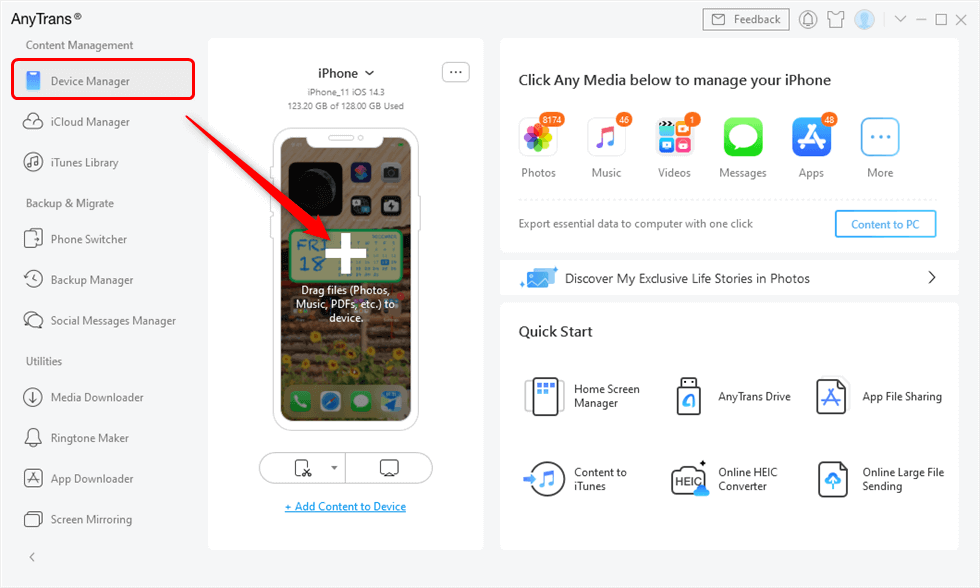
Open the iPhone content-management area in AnyTrans.
Step 3. Click the Add button.
Step 4. Browse to the folder containing your Windows Media Player songs.
Step 5. Select the tracks you want and click Open.
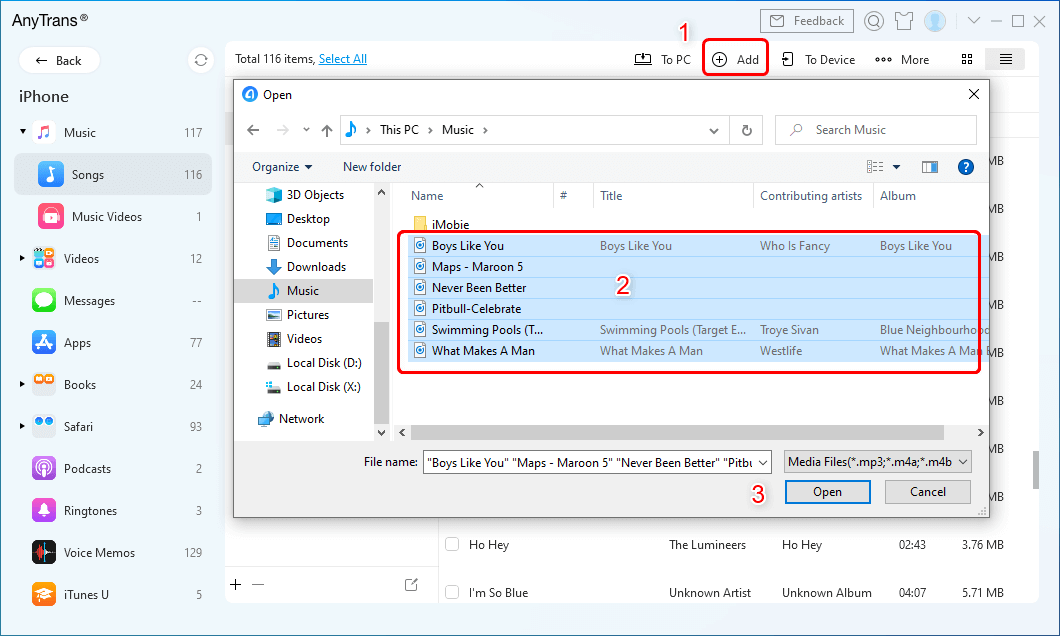
Select the local Windows music files you want to add.
Step 6. Keep the iPhone connected until the transfer completes.
Step 7. Check the transferred songs on the iPhone after the operation finishes.
AnyTrans transfers the underlying music files; it does not directly “sync the Windows Media Player application.” Make sure the songs are stored locally on the PC and are in a compatible audio format.
How to Find Windows Media Player Music Files
If your songs appear in Windows Media Player but you do not know where the original files are stored, locate the actual files before trying to transfer them.
Check the Music Folder
Many locally stored tracks are kept somewhere under the Windows Music folder, but users can choose other locations.
Use File Explorer Search
Search the PC for the song title or common audio extensions such as:
- .mp3
- .m4a
- .aac
- .wav
- .alac
Open the File Location from Your Media Player
If your current Windows Media Player interface provides an Open file location option for a local track, use it to open the folder containing the actual audio file.
Once you find that folder, you can either import it into Apple Music for Windows or select the files directly in AnyTrans.
What If the Song Is Not Actually a Local File?
A song visible in a music app is not necessarily an unrestricted local audio file. Streaming, subscription, DRM-protected, or cloud-only music may not be transferable as an ordinary MP3.
This guide applies primarily to music files that you legitimately have stored on the Windows PC.
Why Won’t Music Transfer to iPhone?
1. Apple Devices Does Not Show Music
Apple currently requires the Apple Music app on the Windows PC for Music syncing through Apple Devices. Make sure both apps are installed and current.
2. The iPhone Does Not Appear in Apple Devices
Unlock the iPhone, reconnect the cable, and tap Trust when prompted. Also try another data-capable USB port or cable.
3. Sync Library Is Enabled
If you subscribe to Apple Music and use Sync Library, some manual music-sync options may behave differently or be unavailable.
Check your Apple Music library configuration before changing the computer sync relationship.
4. Apple Devices Wants to Replace Existing Music
This can happen when the iPhone was previously synced with another computer library. Do not confirm a replacement warning until you understand which existing synced tracks will be removed.
5. The Music File Cannot Be Played on iPhone
The format may be incompatible or the file may contain restrictions. Apple Devices currently provides an option to convert higher-bit-rate songs during synchronization, but it cannot make every unsupported or protected file transferable.
6. Windows Media Player Shows the Song but You Cannot Find It
The entry may point to a moved file, network location, external drive, or another storage source. Locate the actual playable file in File Explorer first.
7. AnyTrans Does Not Detect the iPhone
Unlock the iPhone, use a data-capable cable, approve the computer on the iPhone when prompted, and confirm that the required Apple device components are installed on Windows.
FAQs About Windows Media Player to iPhone
1. Can Windows Media Player sync directly to an iPhone?
Windows Media Player is not Apple’s current iPhone music-sync application. To use the official Windows workflow, import your local songs into Apple Music and sync them through Apple Devices.
2. What replaced iTunes for syncing music from Windows to iPhone?
Apple currently provides the Apple Music app for managing the Windows music library and the Apple Devices app for syncing that music to an iPhone, iPad, or iPod.
3. Can I still use iTunes to transfer music to iPhone?
Yes in compatible Windows environments. However, Apple Music and Apple Devices are the current Apple Windows apps and should be the primary method in an updated guide.
4. How do I get Windows Media Player songs into Apple Music?
Locate the original music files on your PC, open Apple Music for Windows, choose Import, and select the files or folder. You can also drag compatible files from File Explorer into Apple Music.
5. Can I transfer Windows Media Player music without iTunes?
Yes. Apple’s current Windows method uses Apple Music and Apple Devices rather than requiring traditional iTunes. AnyTrans also provides a selective local-music transfer workflow.
6. Can I transfer just a few Windows Media Player songs to iPhone?
Yes. Apple Devices can sync selected music from the Apple Music library. AnyTrans also lets you choose individual local song files from the PC and add them to the iPhone.
7. Will syncing music erase the songs already on my iPhone?
It can replace previously computer-synced music if the iPhone is associated with a different library and you accept a replacement warning. Review the sync relationship before applying changes.
8. Why is a Windows Media Player song missing after I import the folder?
The file may have been moved, may use an unsupported format, or may not actually be stored locally. Check that the original audio file still opens normally from File Explorer.
9. Can AnyTrans add Windows music without syncing the whole library?
Yes. AnyTrans currently supports opening Music > Songs, selecting the Add option, and choosing local files from the Windows PC.
10. Can protected streaming songs be copied from Windows Media Player to iPhone?
Not necessarily. Subscription, DRM-protected, or cloud-only music is subject to the rules of the service that provided it and should not be treated like an ordinary local MP3 file.
The Bottom Line
You do not need Windows Media Player itself to communicate directly with the iPhone. What matters is locating the actual music files stored on the Windows PC.
For Apple’s current official workflow, import those files into Apple Music for Windows and sync them with Apple Devices. If you prefer to choose individual local songs without first building or syncing a full Apple Music library, AnyTrans provides a selective computer-to-iPhone music transfer option.



Joy Taylor is a seasoned technical writer with over a decade of experience in mobile technology. At iMobie, she specializes in producing in-depth content on iOS data recovery, iPhone unlocking solutions, and iOS troubleshooting.
Product-related questions? Contact Our Support Team to Get Quick Solution >

Mentioned in Top Tech Sites:

Highly Rated by Users:
based on Customer Reviews