How to Remove Pattern Lock on Android Without Password
Forgot your Android pattern lock? This guide explains realistic ways to remove an Android pattern lock without the pattern, including DroidKit, Google Find Hub, Recovery Mode, the old Android 4.4 Forgot Pattern option, and Safe Mode for third-party lock apps. It also shows when data may be erased and why Google verification may appear after reset.
Forgot your Android pattern lock and cannot get past the lock screen? Android usually does not let you view or recover the old pattern. On most current Android phones, removing a forgotten built-in pattern means either resetting the phone, erasing it with Google Find Hub, or using a supported screen unlock tool that guides the removal process.
This guide focuses on practical pattern lock removal options, not SIM unlocking, network unlocking, app passwords, or Google FRP bypass. Before you start, check whether you have a recent backup and whether you know the Google account previously synced to the device, because both can matter after the pattern lock is removed.
Quick Answer: You can remove an Android pattern lock without knowing the pattern, but most working methods on modern Android phones erase the device. The old Forgot pattern option applies only to Android 4.4 or lower. For newer Android versions, Google Find Hub, Recovery Mode, or a supported tool such as DroidKit can remove the pattern by resetting or unlocking the device. After the reset, Factory Reset Protection may ask for the Google account previously used on the phone.
Before You Remove an Android Pattern Lock
First, make sure the problem is really a screen pattern lock. A pattern lock protects access to the Android home screen. It is different from a Google account verification screen after reset, a SIM or carrier network lock, a bootloader lock, an app lock, or an MDM restriction.
This guide applies when the phone asks for a pattern before you can access Settings, photos, apps, and the home screen. If the phone has already been reset and now asks for a Google account, you are dealing with Factory Reset Protection instead.
| What You See | What It Means | Where to Start | Data Risk |
| Draw pattern to unlock | Built-in Android screen pattern | Use the methods in this guide | Usually high on modern Android |
| Verify your Google account | Factory Reset Protection after reset | Use the previously synced Google account | Reset already happened |
| SIM network unlock PIN | Carrier or SIM restriction | Contact the carrier | Not a screen lock issue |
| Pattern only appears inside one app | App lock or third-party locker | Try Safe Mode or app recovery | Usually lower |
If you are looking for a broader explanation of forgotten pattern recovery terms, see the guide on how to unlock an Android pattern lock. This page stays focused on removing the pattern lock when you do not know the pattern.
Can You Remove a Pattern Lock Without Losing Data?
This is the most important question to answer before you choose a method. If you can still unlock the phone with another enrolled method, such as fingerprint, face unlock, PIN, or password, you may be able to change the pattern from Settings without losing data. If you cannot access the phone at all, data-preserving options are very limited on Android 5 and later.
| Situation | Best Next Step | Will It Erase Data? | Important Note |
| You know another unlock method | Unlock the phone and change the screen lock in Settings | No | This works only if Android accepts the other enrolled method. |
| You forgot the pattern on a current Android phone | Use Google Find Hub, Recovery Mode, or a supported screen unlock tool | Usually yes | You may need the previous Google account after reset. |
| The phone runs Android 4.4 or lower | Try the old Forgot pattern option | Usually no | This option is not available on modern Android versions. |
| A third-party lock app created the pattern | Boot into Safe Mode and uninstall the app | No, if it works | Safe Mode does not remove Android’s built-in pattern lock. |
Note: Be careful with any method that promises to remove a modern Android screen pattern with no data loss on all models. Android screen locks are designed to protect local data. If there is no backup and no accepted unlock method, data stored only on the locked phone may not be recoverable.
Which Pattern Lock Removal Method Should You Choose?
The right method depends on what you still have: a working Google account, internet access on the locked phone, the correct button combination, an old Android version, or only physical access to the device. Use this table before jumping into the steps.
| Method | Best For | Requirements | Main Limitation |
| DroidKit Screen Unlocker | Users who want guided Android pattern lock removal for supported devices | Computer, USB cable, supported Android model | Most Android devices are unlocked with data removal. |
| Google Find Hub / Find My Device | Phones linked to your Google account and connected to the internet | Google account, Find Hub enabled, phone visible online | It erases the device instead of showing the old pattern. |
| Recovery Mode factory reset | Offline phones or phones not reachable from Find Hub | Physical access and correct key combination | Erases the phone and may trigger Google verification. |
| Forgot pattern | Very old Android phones | Android 4.4 or lower and Google login | Not available on current Android phones. |
| Safe Mode | Pattern locks created by third-party lock screen apps | Ability to boot into Safe Mode | Does not bypass the built-in Android screen pattern. |
If you prefer to compare tool-based options before using one, this Android phone unlocking software guide can help you understand common lock removal tool types and limitations.
Method 1. Remove Android Pattern Lock with DroidKit
If you cannot remember the pattern and manual reset paths are not convenient for your model, DroidKit Screen Unlocker can be used as a tool-assisted option for supported Android devices. It is designed to remove common screen locks such as pattern, PIN, password, fingerprint, and face lock.
This method is most relevant when you own the phone, can connect it to a Windows or Mac computer, and accept the data-loss risk shown during the process. It should not be treated as a guaranteed no-data-loss pattern remover for every Android phone.
* Check compatibility and data-loss notes before removing the pattern lock.
Free Download
* Check compatibility first
Step 1. Download and install DroidKit on your computer. Open the program and choose Screen Unlocker.
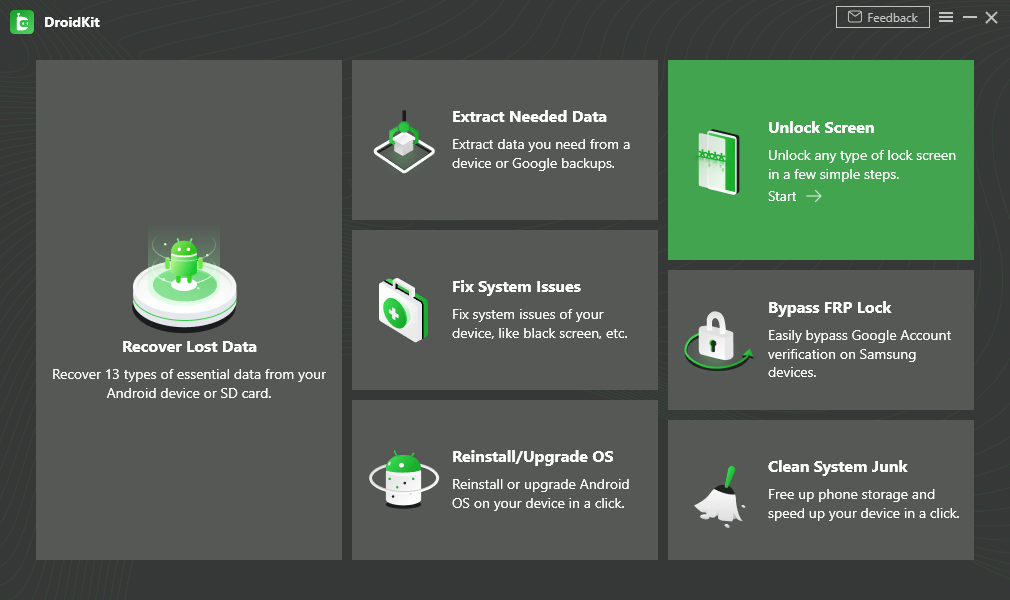
Choose DroidKit Screen Unlocker
Step 2. Connect the locked Android phone to the computer with a USB cable. When DroidKit detects the device, click Start to continue.

Connect the Locked Android Phone
Step 3. Wait while DroidKit prepares the configuration file for your device. Then click Remove Now. Read the on-screen notice carefully because the process may erase the phone.
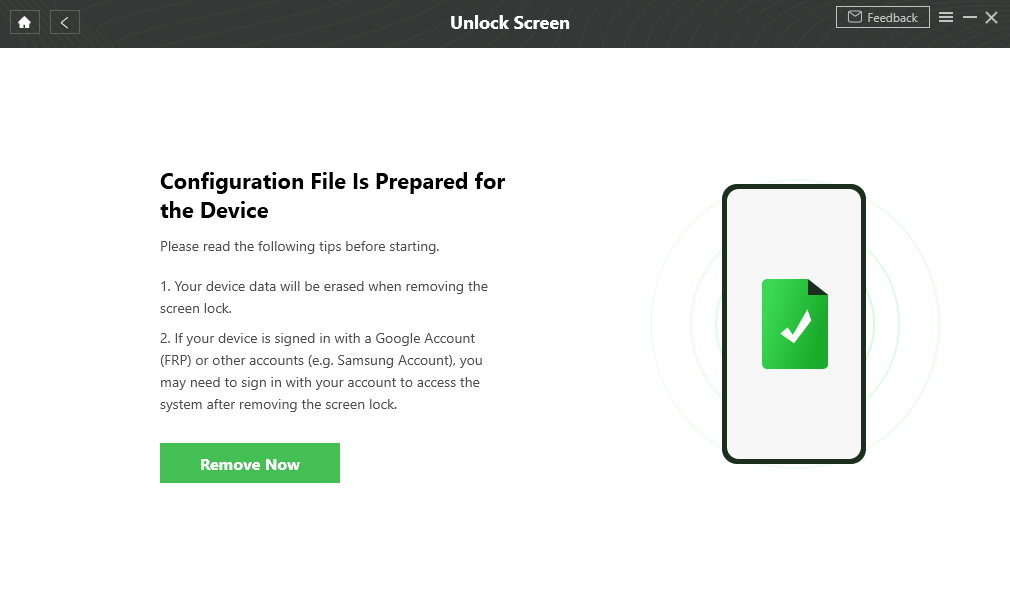
Click Remove Now
Step 4. Follow the instructions shown in DroidKit to put your Android phone into recovery mode. The exact buttons vary by brand, so follow the device-specific guide shown on the screen.
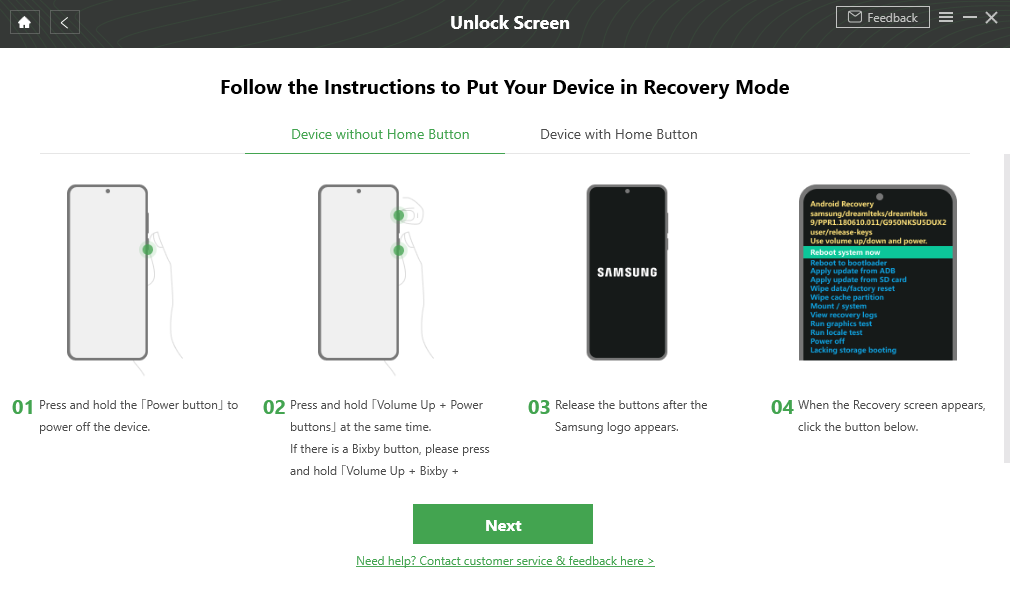
Enter Recovery Mode
Step 5. When the process finishes, the Android pattern lock will be removed and the phone can be set up again. Sign in with the Google account previously synced to the phone if Android asks for verification during setup.
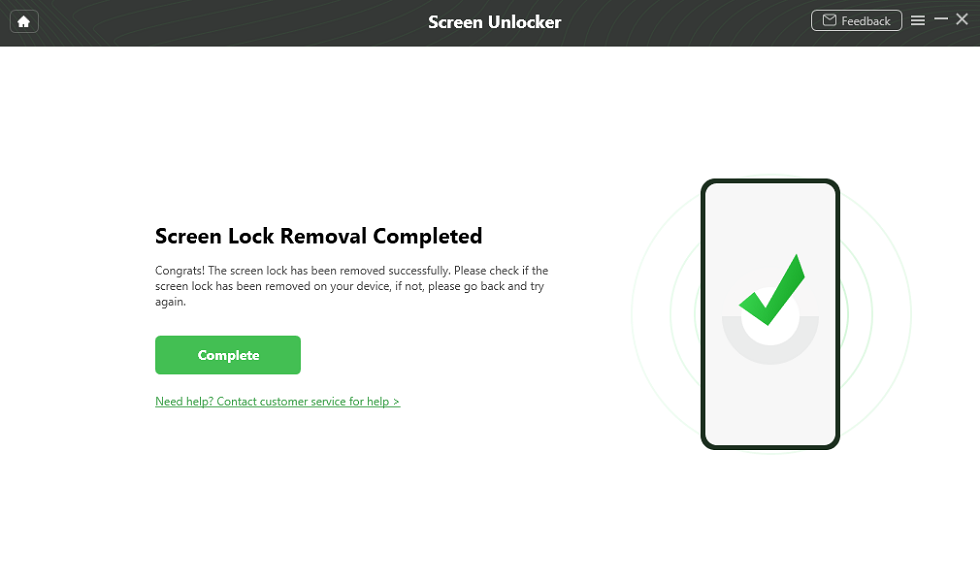
Pattern Lock Removal Completed
Tip: If the device was bought second-hand, ask the previous owner to remove their Google account before reset or setup. Pattern lock removal does not automatically remove Factory Reset Protection.
Method 2. Remove Pattern Lock with Google Find Hub
Google Find Hub, still known by many users as Find My Device, can find, secure, or erase an Android device connected to your Google account. If your locked phone is online and appears in Find Hub, you can erase it remotely. This removes the pattern lock because the phone is reset, but it also deletes the data stored on the device.
Step 1. Open Google Find Hub / Find My Device on another phone or computer.
Step 2. Sign in with the same Google account that is linked to the locked Android phone.
Step 3. Choose the locked phone from the device list.
Step 4. Select Erase device and confirm. The phone will be reset when it is online.
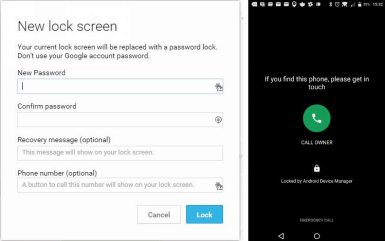
Remove Pattern Lock with Find Hub
After the erase is complete, set up the phone again. If Google verification appears, use the Google account previously synced on that phone. This verification step is separate from the screen pattern itself.
Method 3. Remove Pattern Lock by Recovery Mode Factory Reset
If the locked phone is offline, not visible in Find Hub, or cannot be erased remotely, Recovery Mode is usually the manual fallback. The exact key combination varies by brand and model, but the result is similar: the phone is reset and the pattern lock is removed with the data on the device.
Step 1. Turn off the Android phone completely.
Step 2. Press and hold the recovery key combination for your device. Common combinations include Power + Volume Up or Power + Volume Down, but some brands use different buttons.
Step 3. When the recovery menu appears, use the volume keys to highlight Wipe data/factory reset.
Step 4. Press the Power button to select it.
Step 5. Confirm the reset and wait for the process to finish.
Step 6. Select Reboot system now to restart the phone.
Recovery Mode is useful when you cannot access Settings, but it does not remove Google FRP. If you need a broader reset guide, check this tutorial on factory resetting Android without a password.
Important: If the phone asks for the previously synced Google account after Recovery Mode reset, enter the correct account credentials. If it is a used phone, contact the previous owner.
Method 4. Use Forgot Pattern on Android 4.4 or Lower
The old Android Forgot pattern method appears in many pattern lock guides, but its version limit is strict. It works only on Android 4.4 or lower. If your device runs a current Android version, you will not see this option after failed pattern attempts.
If you are using an old Android 4.4 or lower device, try these steps:
Step 1. Enter the wrong pattern several times until the Forgot pattern option appears.
Step 2. Tap Forgot pattern.
Step 3. Sign in with the Google account that was previously added to the device.
Step 4. Set a new pattern, PIN, or password when prompted.
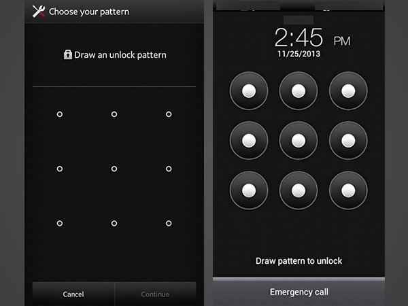
Forgot Pattern on Android 4.4 or Lower
For newer Android phones, skip this method and use Find Hub, Recovery Mode, or another supported removal option instead.
Method 5. Remove a Third-Party Pattern Lock App in Safe Mode
Safe Mode helps only when the pattern lock comes from a third-party lock screen app, not Android’s built-in screen lock. When Android boots into Safe Mode, third-party apps are temporarily disabled. If the pattern disappears in Safe Mode, uninstall the lock screen app and restart the phone normally.
Step 1. Press and hold the Power button until the power menu appears.
Step 2. Press and hold Power off until the Safe Mode prompt appears.
Step 3. Tap OK to restart into Safe Mode.
Step 4. If you can access the home screen, uninstall the third-party lock screen app.
Step 5. Restart the phone normally.
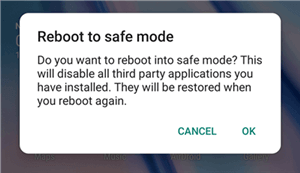
Use Android Safe Mode
If the original Android pattern remains even in Safe Mode, this method will not help. Move to Google Find Hub, Recovery Mode, or a supported screen unlock tool.
What If Google Verification Appears After Removing the Pattern?
After erasing or factory resetting an Android phone, you may see a screen asking you to verify the Google account previously synced on the device. This is Factory Reset Protection, often called FRP. It is designed to reduce unauthorized use after a device has been reset without unlocking it first.
If this is your own phone, sign in with the Google account that was previously used on the device. If you recently changed the Google password, you may need to wait before the account can be used for setup again. If it is a second-hand phone, ask the previous owner to remove the device from their Google account or help complete setup.
If you need a dedicated explanation of the reset verification screen, see this guide on Google account verification after reset. Keep the two problems separate: a screen unlock method removes the pattern lock, while FRP verifies the Google account tied to the device.
What to Do After the Pattern Lock Is Removed
Once you regain access or finish device setup, take a few minutes to prevent the same lockout from happening again.
- Set a new pattern, PIN, or password that you can remember.
- Add at least one backup unlock method if your phone supports it.
- Turn on cloud backup for photos, contacts, and important files.
- Write down the Google account used on the phone and keep recovery options updated.
- Remove accounts from a phone before selling, trading, or giving it away.
FAQs About Android Pattern Lock Removal
Can I remove an Android pattern lock without losing data?
On most modern Android phones, usually no. If you forgot the built-in Android pattern and cannot unlock the phone with another enrolled method, practical removal methods usually erase the device. The old Forgot pattern option may avoid data loss, but it only applies to Android 4.4 or lower.
Does the Forgot pattern option still work on Android?
It works only on Android 4.4 or lower. Modern Android versions do not show the old Forgot pattern option after failed attempts. For current phones, use Google Find Hub, Recovery Mode, a brand recovery option, or a supported tool-assisted removal path.
Can Google Find Hub remove my pattern lock without erasing the phone?
No. Google Find Hub can help you locate, secure, or erase an Android device, but it does not show your old pattern or create a new screen lock password. To remove the forgotten pattern through Find Hub, you need to erase the device.
Can Recovery Mode remove the pattern lock?
Yes, Recovery Mode can remove a built-in Android pattern lock by factory resetting the phone. The trade-off is that the reset erases local data and may trigger Google verification during setup.
Can Safe Mode remove the Android pattern lock?
Safe Mode can remove access barriers caused by third-party lock screen apps only. It cannot bypass Android’s built-in screen pattern. If the pattern was set in Android Settings, Safe Mode will not remove it.
Will DroidKit remove my Android pattern lock?
DroidKit Screen Unlocker is designed to remove common Android screen locks on supported devices, including pattern, PIN, password, fingerprint, and face lock. For most Android 5 and later devices, the process removes device data, so check compatibility and backup status before using it.
What is FRP after removing an Android pattern lock?
FRP stands for Factory Reset Protection. It may appear after you erase or reset a locked Android phone. If FRP is triggered, Android asks for a Google account previously synced on the device. This is separate from the screen pattern itself.
Can I remove a pattern lock from a second-hand Android phone?
You can reset the device, but you may not be able to complete setup without the previous owner’s Google account if FRP is active. Before buying or resetting a used phone, ask the seller to remove their accounts and disable the screen lock from the device.
Is a pattern lock the same as a SIM or network lock?
No. A pattern lock protects access to the phone screen. A SIM or network lock controls which carrier SIM cards can be used. Removing a screen pattern does not carrier-unlock the phone, and a carrier unlock code will not remove the screen pattern.
The Bottom Line
If you forgot your Android pattern lock, first identify the device situation. For Android 4.4 or lower, the old Forgot pattern option may still work. For most modern Android phones, the realistic pattern removal paths are Google Find Hub, Recovery Mode factory reset, or a supported screen unlock tool such as DroidKit. The key limitation is data loss: removing a forgotten built-in pattern usually means erasing the phone.
Before you reset, check your backup and make sure you know the Google account previously synced to the device. If Google verification appears after reset, use the original account or ask the previous owner for help. That protects both your data and legitimate device ownership.
* Check compatibility and data-loss notes before removing the pattern lock.
Free Download
* Check compatibility first



Jeremy Feron is a writer for iMobie with a deep passion for Android. He specializes in creating clear guides on Android tips and the latest updates, helping users navigate their devices and get the most out of new features.
Product-related questions? Contact Our Support Team to Get Quick Solution >
