How to Recover Photos After Factory Reset on Android
Can you recover photos after a factory reset? Check Google Photos, cloud and computer backups, SD cards, and Android recovery options first. Learn what is realistically recoverable with or without backup on modern Android phones.
A factory reset erases the user data stored on an Android phone, including photos that existed only in the phone’s internal storage. But that does not necessarily mean every photo is gone. Photos may still exist in Google Photos, an OEM cloud service, a computer backup, or a removable SD card.
The most important question is where the photos were stored before the reset. If they had already been backed up, recovery is usually straightforward. If they existed only inside the encrypted internal storage of a modern Android phone and the device has already been factory reset, recovery becomes much less likely and should not be guaranteed.
Quick answer: Check Google Photos first, then any Samsung, Xiaomi, Huawei or other cloud service you used, followed by computer backups and removable SD storage. If there is no backup at all, direct internal-storage recovery after a factory reset may be limited or impossible on modern encrypted Android devices.
Can Photos Be Recovered After a Factory Reset?
Yes in some situations, but not in every situation.
| Where the Photos Were Before Reset | Recovery Outlook | What to Check First |
| Google Photos backup | Good | Sign in to the same Google Account and check Google Photos |
| Samsung, Xiaomi, Huawei or another cloud service | Good if synchronization was enabled | Sign in to the same manufacturer account |
| Computer backup | Good if the photos were copied before reset | Check the PC/Mac backup folder or OEM backup software |
| Removable microSD card not erased during reset | Often good | Remove the card and inspect it separately |
| Internal storage only, modern encrypted Android, no backup | Low and device-dependent | Avoid adding new data and evaluate whether any recovery path remains |
| Photos permanently deleted from cloud before reset | Depends on cloud Trash/retention status | Check the service’s Trash or Recently Deleted area |
Why Factory Reset Makes Internal-Storage Recovery Difficult
A factory reset wipes Android’s user-data area. Modern Android devices also protect internal storage with encryption. On devices using file-based encryption, access to user files depends on cryptographic keys tied to the device and user credentials.
This is why an old data-recovery rule such as “deleted files remain on storage until they are overwritten” cannot safely be applied to every current Android phone after a factory reset.
If the photos are important, avoid repeatedly installing apps, recording videos, downloading files, or performing additional resets while you investigate the available backups and recovery options.
Factory Reset Is Different from Deleting Photos
If you simply deleted photos from Google Photos, the cloud service may still hold them temporarily in Trash. A factory reset is different: it erases local Android user data but does not automatically delete photos that were already backed up to your Google Photos account.
Recover Photos After Factory Reset with Google Photos
If Google Photos Backup was enabled before the factory reset, this should be the first place you check.
Step 1. Check the Main Google Photos Library
Sign in to Google Photos with the same Google Account used before the reset.
On the restored Android phone, open the Google Photos app. You can also check Google Photos from a browser on another device.
Look through the main Photos timeline first. If the pictures were backed up before the reset and were never deleted from Google Photos, they should normally still appear there.
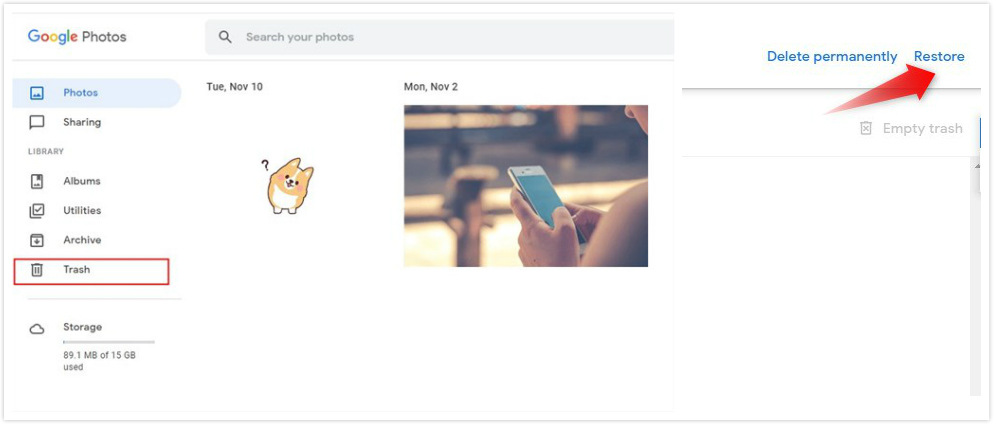
Check the Google Photos library before looking in Trash.
Step 2. Check Google Photos Trash Only If the Photos Were Deleted
If you know the photos were deleted from Google Photos itself, open Collections > Trash.
Google currently says:
- backed-up photos and videos stay in Trash for 60 days after deletion;
- photos and videos that were not backed up stay in Trash for 30 days;
- items permanently deleted from Trash cannot be restored through Google Photos.
If the photo is still there:
Step 1. Select the photo or video.
Step 2. Tap or click Restore.
Step 3. The item will return to the Google Photos library and relevant albums where applicable.
A factory reset does not itself put your cloud-backed photos into Google Photos Trash. Use Trash only when those photos were separately deleted from Google Photos.
What If Google Photos Is Empty?
Check that you signed in to the correct Google Account. Many users have more than one Gmail account, and the old Android phone may have backed up photos under a different account.
Also check:
- the account profile shown in Google Photos;
- Archive;
- Locked Folder if you used it and it was backed up under the applicable configuration;
- shared albums;
- other Google Accounts previously used on the phone.
Recover Photos from Cloud, Computer or Local Backups
If the photos are not in Google Photos, look for another copy that existed before the reset.
Check the Phone Manufacturer’s Cloud Service
Depending on the phone and the services you enabled, photos may have been synchronized or backed up through the manufacturer’s ecosystem.
Examples can include Samsung, Xiaomi, Huawei or other vendor accounts. The exact backup features vary by brand, region and software version, so sign in to the account you actually used rather than assuming every Android phone has the same Backup and Restore menu.
Check a Previous Computer Backup
If you previously copied photos to a PC or Mac, search for common folders such as:
- DCIM;
- Camera;
- Pictures;
- Downloads;
- screenshots;
- folders created by the manufacturer’s backup software.
A computer copy is independent of the factory reset and can simply be copied back to the phone if needed.
Do Android Google Backups Automatically Include All Photos?
No. Android’s general Google backup and Google Photos are related services but they are not the same backup source.
Google’s current Android backup documentation lists device data such as apps and app data, call history, contacts, device settings, and SMS/MMS. Photos and videos are backed up through Google Photos.
Therefore, seeing an Android device backup under your Google Account does not automatically mean every photo from the phone was backed up.
Do not tell users that “Backup by Google One was enabled, therefore all photos can be restored.” Verify the Google Photos library separately.
What About a Local Backup Stored on the Phone?
A local backup stored only in the phone’s internal user-data area may also be erased by a factory reset. It is useful only if the backup survived somewhere outside the wiped internal storage, such as:
- a removable SD card;
- a PC or Mac;
- an external drive;
- a manufacturer’s cloud service.
This is why the generic instruction Settings > Backup and Restore > Restore should not be presented as a universal post-reset solution for every Android brand.
Recover Photos from an SD Card
If the Android phone used a removable microSD card, inspect it separately. A normal factory reset may leave a removable card untouched unless you specifically chose an option to erase external storage as well.
Step 1. Power off the Android phone if possible.
Step 2. Remove the microSD card.
Step 3. Insert it into a computer with a compatible card reader.
Step 4. Check folders such as DCIM, Camera, Pictures and app-specific media folders.
Step 5. Copy any surviving photos to another storage location immediately.
If Android formatted the SD card as adopted/encrypted internal storage, another computer may not be able to read it normally. Do not format the card when prompted if you still need the files.
Recover Photos After Factory Reset Without Backup
This is the part where the recovery limits matter most.
If there is truly no Google Photos copy, no manufacturer cloud backup, no computer backup and no readable SD card, the remaining photos would have to come from the phone’s internal storage.
On modern encrypted Android devices, a factory reset can make those old internal files inaccessible because the user-data area and encryption state have been reset. Therefore, no recovery program should be described as guaranteeing that every photo can be recovered after a factory reset.
Can DroidKit Recover Photos After Factory Reset?
DroidKit Android Data Recovery currently supports photo recovery from Android internal memory, SD cards and Google Account data sources. It provides Quick Recovery and Deep Recovery modes.
However, a factory-reset case is more difficult than ordinary accidental deletion. Whether any photos remain recoverable depends on the exact device, Android version, encryption, reset process and where the photos had actually been stored.
DroidKit – Check Recoverable Android Photos
- Supports photo scanning from compatible Android data sources.
- Quick Recovery does not root the Android device.
- Deep Recovery performs a deeper scan but requires rooting.
- Lets you preview available recovery results before choosing what to save.
- Recovery after an actual factory reset is device-dependent and should not be treated as guaranteed.
Try Quick Recovery Before Deep Recovery
For ordinary recoverable data scenarios, DroidKit currently describes Quick Recovery as its first-choice, no-root scan.
If the software can detect useful photo data without deeper access, there is no reason to root the device first.
What About Deep Recovery?
DroidKit’s current documentation says that Deep Recovery roots the Android device in order to perform a deeper internal-storage scan.
This is an important correction to the old version of this article, whose top module promises recovery “without root” and later instructs the user to choose Deep Recovery and click Root Now. :contentReference[oaicite:8]{index=8}
How to Check for Recoverable Photos with DroidKit
Step 1. Launch DroidKit and connect the Android phone to the computer.
Step 2. Open the Android data-recovery area and begin with the recovery mode appropriate for your situation.
Step 3. Select Photos as the data category.
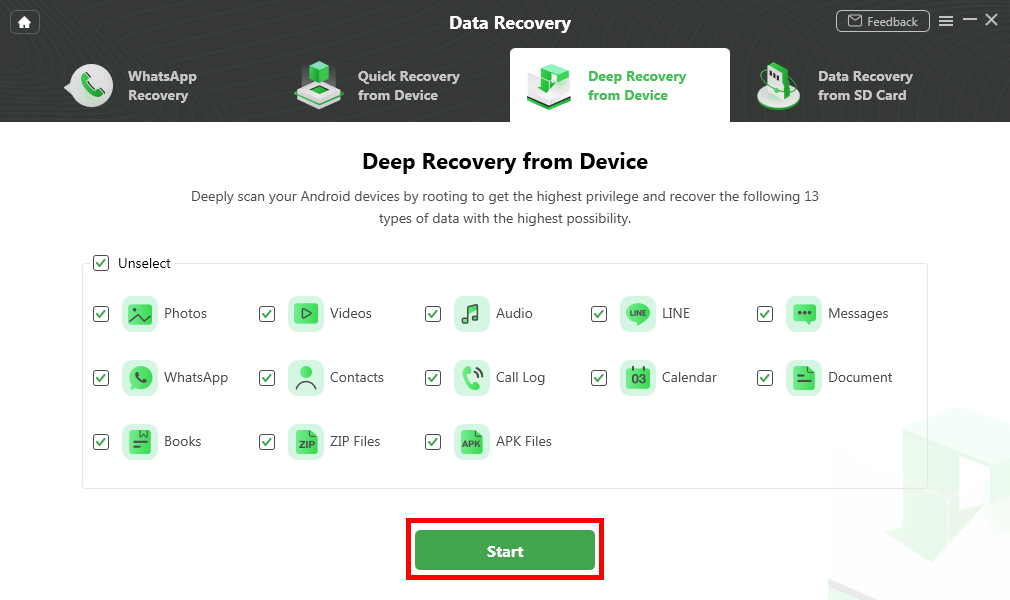
Select Photos as the recovery category.
Step 4. Let DroidKit scan the data source available from the connected device.
Step 5. Preview any photos that the scan can actually detect.
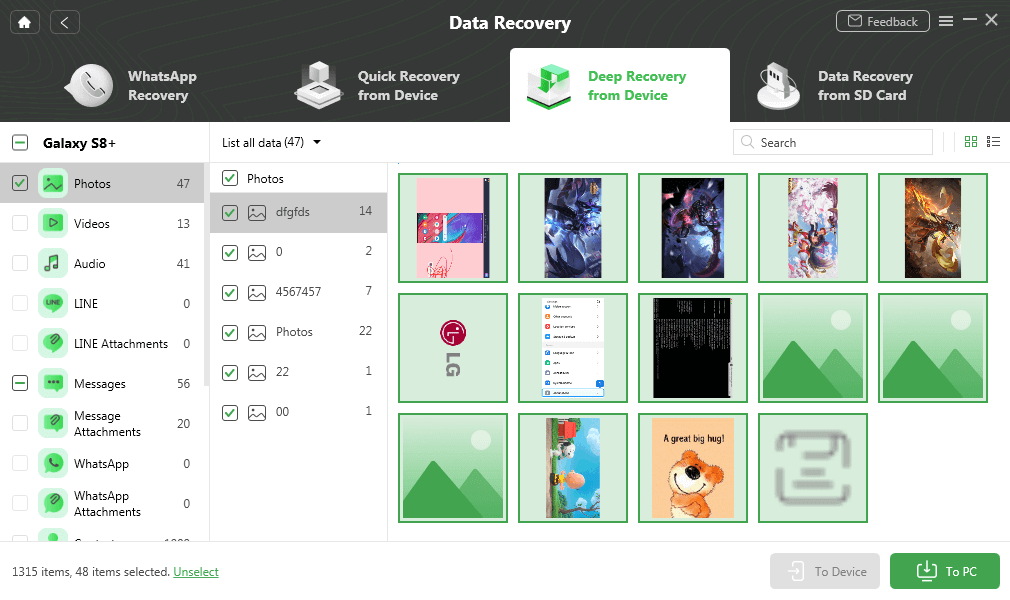
Preview the items detected before selecting photos to recover.
Step 6. Save the recoverable photos to the computer or another supported destination.
If Quick Recovery does not find the photos, do not assume Deep Recovery will automatically restore them. Deep Recovery requires root, and a factory reset on an encrypted modern Android phone may have already made the previous internal data inaccessible.
Should You Root the Phone Just to Recover Factory-Reset Photos?
Consider the risk before doing so. Rooting changes the device software state and may involve additional writes or device-specific procedures. If the photos are highly valuable, first exhaust Google Photos, cloud backups, external storage and computer copies before modifying the phone further.
What About PhoneRescue for Android?
The older version of this article also includes a second full commercial method using PhoneRescue for Android. :contentReference[oaicite:9]{index=9} Its product page is still available, but keeping two almost identical Android photo-recovery tools in the same guide adds little decision value.
This updated version uses one primary recovery workflow instead: check official backup sources first, then evaluate DroidKit only when the backup routes do not contain the photos.
FAQs About Photo Recovery After Factory Reset
1. Does factory reset delete photos on Android?
A factory reset erases photos and other user data stored locally in the Android phone’s user-data area. It does not automatically delete copies that were already backed up to Google Photos, another cloud service, a computer or an unaffected removable SD card.
2. Can I recover photos after factory reset without backup?
Sometimes a recovery tool may still find data in certain device-specific scenarios, but recovery should not be guaranteed. On modern encrypted Android devices, a factory reset can make old internal-storage data inaccessible because user data and encryption information are reset.
3. Does factory reset delete Google Photos?
No. Photos that were successfully backed up to your Google Photos account remain in the cloud after the phone is factory reset. Sign in to the same Google Account and check the main Google Photos library.
4. Why are my photos not in Google Photos after the reset?
Possible reasons include using the wrong Google Account, Backup not being enabled before the reset, the photos never finishing upload, or the photos having been deleted from Google Photos itself.
5. How long does Google Photos keep deleted photos?
Google currently keeps deleted backed-up photos and videos in Trash for 60 days. Photos and videos that were not backed up remain in Trash for 30 days. Permanently deleted items cannot be restored through Google Photos.
6. Does Google Android Backup include my photos?
Not in the same way as Google Photos. Google’s Android device backup covers data such as apps, call history, contacts, settings and messages, while pictures and videos are backed up through Google Photos.
7. Can a local backup survive a factory reset?
Only if the backup was stored somewhere that the reset did not erase, such as a removable SD card, computer, external drive or cloud account. A backup kept solely in the internal user-data partition may be erased with the rest of the phone.
8. Can DroidKit recover all photos after a factory reset?
No recovery result should be guaranteed. DroidKit can scan supported Android data sources and preview what it finds, but the result after a factory reset depends on the device, Android version, encryption and whether usable photo data still exists.
9. Does DroidKit Deep Recovery require root?
Yes. DroidKit’s current product documentation says Quick Recovery does not root the device, while Deep Recovery requires rooting for its deeper scan.
10. Can I recover photos from an SD card after resetting Android?
Possibly. If the removable SD card was not erased or encrypted as adopted internal storage, remove it and inspect it with a computer. Do not format the card if the system says it cannot be read and you still need the files.
The Bottom Line
After an Android factory reset, start with copies that exist outside the erased internal storage. Check Google Photos, manufacturer cloud services, computer backups and removable SD cards before trying deeper recovery.
If no backup exists, expectations should be realistic. Modern Android devices use encrypted user storage, and a factory reset can make old internal photos permanently inaccessible. DroidKit can be used to check compatible recovery sources and preview what remains detectable, but it should not be presented as a guaranteed way to recover every factory-reset photo.



Joy Taylor is a seasoned technical writer with over a decade of experience in mobile technology. At iMobie, she specializes in producing in-depth content on iOS data recovery, iPhone unlocking solutions, and iOS troubleshooting.
Product-related questions? Contact Our Support Team to Get Quick Solution >

Mentioned in Top Tech Sites:

Highly Rated by Users:
based on Customer Reviews